


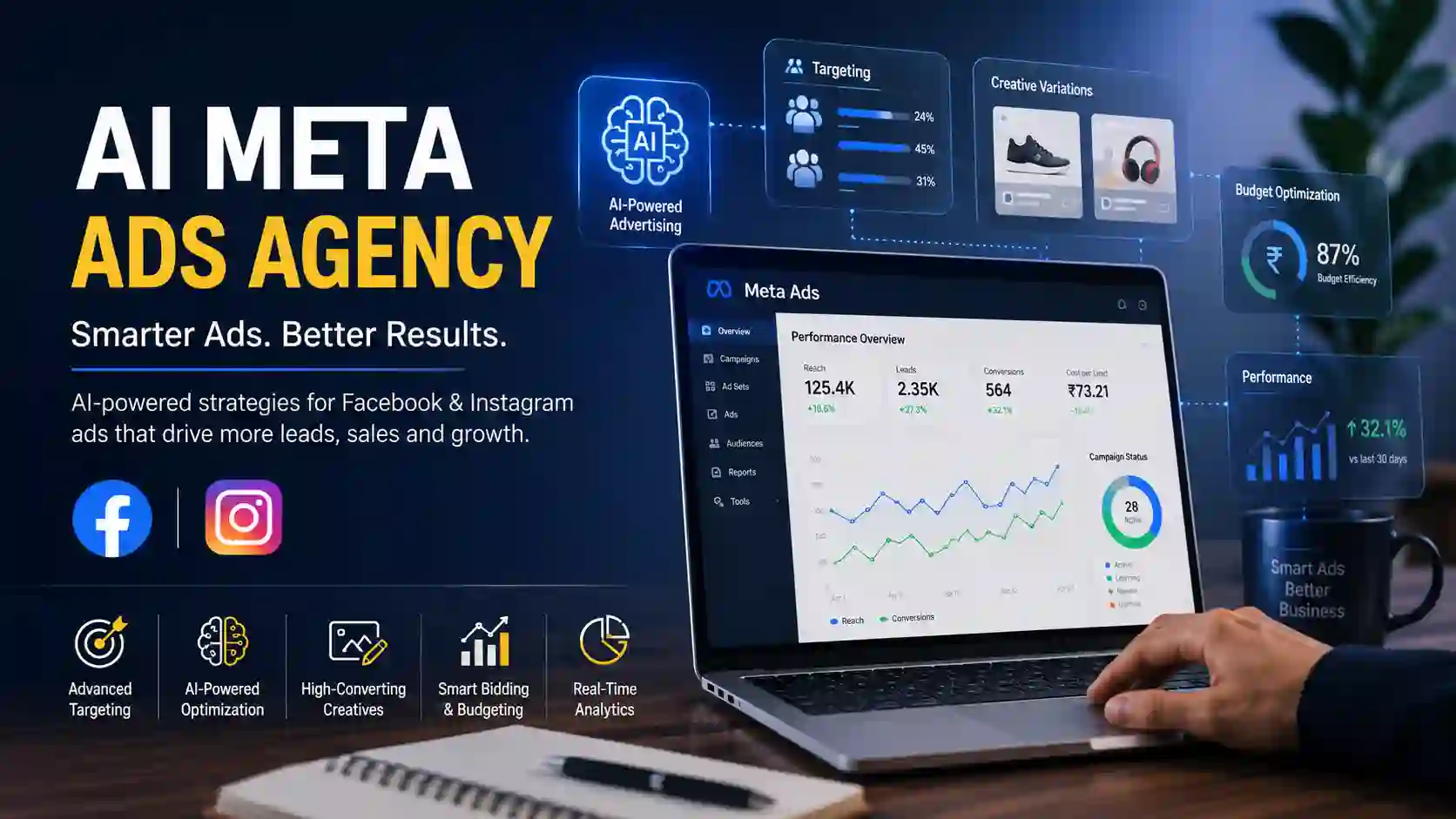
AI Meta Ads Agency: How AI Is Changing Meta Advertising for Businesses
Meta advertising has become much harder to manage casually. A business can put money into Facebook and Instagram ads, get plenty of clicks, and still wonder where the actual enquiries went.
That problem is one reason businesses are now looking for an AI Meta ads agency instead of relying only on traditional campaign management.
The idea is not simply to put AI into Ads Manager and expect better results. Meta already uses machine learning heavily in delivery, audience matching, bidding and campaign optimisation. The real work is understanding what information should be given to the system, what should be tested, what should be stopped and what the numbers are actually saying.
An AI Meta ads agency works around that process. It can use AI for audience research, creative testing, copy development, campaign analysis and faster decision making, while human judgement remains important for the business side.
For an Indian business, this distinction matters. A local jewellery store, a D2C skincare brand and a B2B software company cannot be advertised in the same way just because all three use Meta.
Understanding What an AI Meta Ads Agency Actually Does
An AI Meta ads agency manages advertising on platforms such as Facebook and Instagram while using artificial intelligence and automation to support research, creative work, campaign decisions and analysis.
That sounds technical, but the basic job is still familiar.
The agency needs to understand what the business sells, who is likely to buy it, how much a customer is worth, what kind of enquiry matters and what happens after someone clicks the advertisement.
AI can help process large amounts of campaign information quickly. It can identify patterns in ad performance, compare creative variations, group audience behaviours and assist with writing or testing different messages.
But there is a common misunderstanding here.
AI does not know that a lead is useless just because the lead converted.
Suppose a real estate company in Pune receives 200 enquiries from a Meta campaign. The dashboard may show a healthy number of leads. But if 150 people were simply looking for a rental property while the company sells premium apartments, the campaign has a business problem, not necessarily a lead volume problem.
This is where an AI Meta ads agency needs human judgement.
I personally prefer agencies that treat AI as an assistant rather than pretending it can run the whole marketing operation. I have seen campaigns where automated recommendations looked perfectly reasonable inside the advertising dashboard but made little sense once actual sales conversations were checked.
The agency may work on campaign setup, audience research, creative testing, copywriting, budget allocation, conversion tracking and reporting. AI can support several of these areas, but the final decisions still need context.
That context is often missing from a purely automated approach.
Why Businesses Are Turning to AI for Meta Advertising
Meta advertising produces a lot of information.
There are impressions, clicks, click through rates, landing page views, leads, purchases, cost per result, frequency, engagement and several other signals. Looking at all of this manually every day can become tiring, particularly when a business has multiple campaigns running.
An AI Meta ads agency can use automation and AI assisted analysis to process this information more quickly.
For example, if three creatives are being tested, AI tools can help identify differences in performance and suggest patterns worth examining. One advertisement might attract cheap clicks but very few enquiries. Another may have a higher cost per click but generate people who are much more likely to purchase.
That difference matters.
Indian businesses also operate across very different customer groups. A campaign for a coaching institute in Delhi may need a different message from one selling industrial equipment to manufacturers in Gujarat. Even within the same industry, buying behaviour can vary by city, price range and customer intent.
AI can help analyse these variations, but someone still needs to understand the market.
There is another reason businesses are interested in an AI Meta ads agency. Creative production has become faster.
Earlier, creating several ad variations could take considerable time. Today, AI assisted tools can help generate different copy ideas, hooks, visual concepts and variations much faster. The agency can then test these rather than relying on one advertisement for weeks.
I would still be careful about producing dozens of meaningless variations. More ads do not automatically mean better advertising. Sometimes five well thought out creatives teach you more than fifty versions that are barely different.
That part often gets overlooked.
How AI Helps Create Better Meta Ad Campaigns
The useful part of an AI Meta ads agency is not the word AI itself. It is the ability to use data and automation during several parts of campaign management without losing sight of the actual business objective.
Campaign creation usually begins with understanding the offer.
Is the company trying to generate leads, sell products, get app installations or bring people into a physical location?
The answer changes the campaign structure.
AI can help analyse previous campaign data and identify which messages, formats and audience groups have historically performed better. It can also help compare performance across different periods.
Suppose an online furniture company notices that its ads featuring compact study tables receive stronger engagement than ads showing complete bedroom sets. That does not prove the study table is a better product. It may simply mean the creative is more relevant to the audience at that stage.
An AI Meta ads agency can flag this pattern for further testing.
The same applies to campaign budgets. If one campaign is producing expensive leads while another is consistently generating qualified enquiries, the data may support moving more budget towards the second campaign. But this should not happen blindly.
A sudden increase in budget can sometimes change delivery behaviour.
This is one reason I do not like the idea that AI automatically knows the best decision. It can make very good recommendations, but advertising accounts contain business context that a model may not see.
Tracking is another important area.
If Meta is receiving poor conversion signals, even a technically well managed campaign can struggle. An AI Meta ads agency should therefore pay attention to what happens between the advertisement and the actual business outcome.
A lead form submission is not always the final conversion.
For a B2B company, the real journey could be advertisement, enquiry, sales call, technical discussion, quotation and finally order. If the agency optimises only for the first event, the campaign may find people who are good at filling forms rather than people who are good customers.
That distinction can save a lot of wasted advertising money.
Audience Research and Targeting with AI
Audience targeting on Meta has changed considerably over the years.
Businesses once relied heavily on manually selecting interests, behaviours, demographics and other audience characteristics. Today, Meta’s systems can use its own machine learning to find people who are more likely to take the desired action.
An AI Meta ads agency can support this process by studying customer information, previous campaign data and broader market behaviour.
For example, imagine a premium ethnic wear brand selling mainly to women aged 25 to 45 in Mumbai, Bengaluru and Delhi. The agency may analyse which products receive the strongest response, which cities generate better purchase rates and which customer groups repeatedly engage with specific creative themes.
AI can help identify patterns across that information.
But audience research is not only about demographics.
A customer who purchases a ₹5,000 saree and someone who purchases a ₹50,000 designer lehenga may both technically belong to the same age group. Their intent and purchasing behaviour are completely different.
This is why customer data from the business itself is valuable.
Past buyers, website visitors, high quality leads and repeat customers can provide stronger signals than assumptions about who “should” buy something.
An AI Meta ads agency may use these signals to develop different audience hypotheses and test them.
I might be wrong here, but I think businesses sometimes overestimate how much control they have over Meta’s audience targeting now. The platform’s automated systems have become increasingly important, so obsessing over tiny interest combinations may not always produce meaningful gains.
The better question is often whether Meta is receiving a useful conversion signal and whether the advertisement itself is attracting the right person.
There is also a practical Indian issue.
Language matters.
An advertisement for a local coaching centre may work better with a mixture of English and Hindi. A regional business may need Marathi, Tamil, Bengali or another local language depending on its customers. AI can help generate and adapt language variations quickly, but someone should still check the wording.
A machine can produce grammatically correct copy that sounds completely unnatural to a person from the market.
That has happened enough times that I would never publish AI generated local language advertising without human review.
Creating Ad Copy, Visuals and Creative Variations
Creative work is probably where an AI Meta ads agency can save the most practical time.
Meta users scroll quickly. An advertisement has very little time to communicate why someone should stop.
That does not mean every ad needs a dramatic hook.
Sometimes a straightforward message works better.
For example, a dental clinic might test an advertisement focused on appointment availability, another around specific treatments and another around a common concern such as delayed dental care. AI can help generate multiple copy directions, headlines and short descriptions.
The agency can then test them against real audience behaviour.
For ecommerce brands, the process can involve product images, short videos, reels, testimonials, comparison messages and promotional creatives. AI assisted tools can help create different concepts without requiring a designer to start every version from zero.
But there is a limit.
A beautifully generated advertisement can still be a bad advertisement.
I have more confidence in simple creative testing than in making every ad look sophisticated. A real product photograph, a clear offer and believable customer language can sometimes outperform an advertisement that took hours to make.
This is particularly relevant for Indian small businesses.
A local furniture seller may get better response from a genuine workshop video showing how a product is made than from a polished stock style visual. Customers want to know what they are actually getting.
An AI Meta ads agency can help identify these creative patterns by comparing results across campaigns.
The important thing is not just asking which ad got the highest click through rate. The agency should ask what happened after the click.
One creative may produce curiosity.
Another may produce actual buyers.
Those are not the same thing.
AI can also help with creative fatigue. When the same advertisement is repeatedly shown to the same audience, performance may decline. Changes in frequency, engagement and conversion behaviour can indicate that a creative needs to be refreshed.
The agency can then develop new versions while retaining what worked in the original message.
There is a slightly uncomfortable part here too. AI makes it very easy to create more content than a business actually needs. Suddenly there are twelve headlines, eight images and six video concepts sitting in a folder, and nobody knows what should be tested first.
More options can create more confusion.
A sensible AI Meta ads agency should narrow the choices, not bury the client under them.
And sometimes the best creative idea is sitting in the sales team’s WhatsApp messages, where customers have been repeatedly asking the same question. That kind of language is often more useful than a polished brainstorming session.
This is where advertising starts feeling less like software and more like listening to people.
A business should also be careful about judging creative performance too early. Meta campaigns need enough meaningful data before strong conclusions are made, and results can fluctuate because of audience size, competition, seasonality and the offer itself.
An AI Meta ads agency can speed up analysis, but it cannot remove uncertainty from advertising.
That uncertainty is still there.
For example, a campaign may perform well during a festive shopping period and then weaken afterwards. That does not necessarily mean the campaign setup suddenly became poor. Customer demand changed.
Similarly, a lead generation campaign can look expensive in one week and reasonable in the next.
The job is to understand why before making another change.
This is also where StratMarketer can take a more practical approach. Instead of treating AI as a replacement for campaign management, the focus can remain on using AI where it genuinely saves time or reveals useful patterns, while keeping the advertising decisions connected to the company’s sales process and actual customer behaviour.
I have always been a little uncomfortable with the promise that an AI Meta ads agency can simply “automate growth”. Advertising is not that predictable. A weak offer cannot be rescued indefinitely by better targeting, and an unclear landing page can waste a very good campaign.
Sometimes the problem is much simpler.
The advertisement is promising one thing and the website is saying another.
No algorithm fixes that neatly.
And that is probably the part businesses should keep in mind when comparing agencies. Ask what they actually examine after a lead comes in, how they judge lead quality, what happens when an ad stops working, and how much of their decision making comes from the real business rather than just the Meta dashboard.
The technology is useful.
The judgement around it is where the difference usually appears.
Using AI to Manage Meta Ads Budgets and Bidding
Budget decisions are one of the areas where an AI Meta ads agency can be genuinely useful, especially when several campaigns are running at the same time. A business may have separate campaigns for lead generation, remarketing, product sales and different cities. Watching every campaign manually can become messy very quickly.
AI assisted analysis can help identify where money is being spent and where results are coming from. It can compare cost per lead, conversion rates, audience response and creative performance and highlight campaigns that deserve closer attention.
But budget management is not simply about putting more money behind the campaign with the cheapest result.
That can go wrong.
Imagine a coaching institute spending ₹1,000 per day on two campaigns. Campaign A generates leads at ₹80 each, while Campaign B generates leads at ₹180 each. At first glance, Campaign A looks like the obvious winner. But if most Campaign A leads never answer the phone while Campaign B produces students who actually visit the centre, the cheaper campaign is not necessarily better.
An AI Meta ads agency should look beyond the surface number.
AI can support budget allocation by identifying performance patterns, detecting sudden increases in costs and helping compare campaigns over time. Meta’s own automated bidding and delivery systems also use machine learning to decide how ads are delivered within the selected objective and budget.
The agency still needs to decide what the campaign is trying to achieve.
For an ecommerce business, purchase value may matter more than the number of transactions. For a B2B company, qualified opportunities may matter more than raw lead volume. For a local service provider, completed appointments could be more useful than form submissions.
This is why I would not hand over budget decisions completely to automation.
A campaign can suddenly perform well because of a temporary offer, a festive period or a competitor becoming less active. Increasing the budget aggressively at that moment can produce disappointing results later.
AI can identify the movement.
Someone still needs to ask why it happened.
There is also a difference between daily budget management and overall advertising strategy. An AI Meta ads agency may use automated tools to monitor campaign performance, but the larger decisions should consider margins, customer value, sales capacity and the amount the business can realistically spend to acquire a customer.
A business selling a ₹2,000 product cannot look at its advertising budget in the same way as a company selling a ₹2 lakh service.
The numbers need context.
Tracking Leads, Conversions and Campaign Performance
An advertisement does not end when somebody clicks it.
That is where many businesses get confused.
A Meta dashboard can show clicks, impressions, leads and conversions, but the business needs to know whether those actions mean anything commercially. An AI Meta ads agency can help connect campaign data with the wider customer journey, provided the tracking setup is reliable.
Consider a company selling commercial solar equipment. Someone sees a Meta advertisement, fills out a form and receives a call from the sales team. The enquiry might then go through technical discussion, site evaluation, quotation and negotiation before becoming a customer.
If the campaign is judged only on form submissions, the business could end up rewarding advertisements that attract people who are not serious buyers.
This is why conversion tracking deserves attention before campaign optimisation begins.
The agency may need to review events, landing pages, forms, website actions and CRM information. Depending on the business, useful events can include purchases, qualified leads, booked appointments, calls or other meaningful actions.
AI can then help identify patterns within the available information.
For example, if one creative consistently generates leads that progress further through the sales pipeline, that is a useful signal. If another creative generates a large number of cheap leads but almost none become opportunities, something needs to be questioned.
This is also where businesses should be honest about their own data.
I have seen companies blame Meta when the actual problem was poor follow-up. A lead arrives at 11 am and nobody calls until the next evening. Then the sales team says the leads were bad.
That irritates me because the advertising platform cannot fix a slow sales response.
An AI Meta ads agency can point out campaign patterns, but it cannot replace a functioning sales process.
Performance reporting should therefore explain what is happening rather than simply list numbers. A useful report might show how much was spent, how many qualified leads came in, which campaigns produced them and where costs changed.
For ecommerce businesses, return on ad spend can be useful, but even that needs careful interpretation. A high return on one product may hide poor margins, discounts or repeat customer differences.
The same applies to cost per lead.
Cheap is not automatically good.
Sometimes a ₹300 lead is more valuable than a ₹70 lead.
That sounds obvious when written down, but advertising dashboards make it very easy to forget.
An AI Meta ads agency can help businesses examine large amounts of performance data faster. It can identify unusual changes, compare creative groups and surface trends that might take longer to notice manually.
Still, I would question any report that claims every campaign movement has one clear explanation. Marketing data is noisy. Some patterns are real and some disappear when you look at another week.
That does not make the data useless.
It means you need some patience before reacting.
Common Meta Ads Mistakes Businesses Still Make
One of the most common mistakes is changing campaigns too frequently.
A business sees the cost per lead increase for two days and immediately changes the audience, creative, budget and campaign objective. After that, nobody knows which change caused the next result.
This becomes especially problematic when automation is involved.
AI tools can make recommendations quickly, but quick recommendations do not always require immediate action.
Another mistake is focusing too heavily on clicks.
A high click through rate can look impressive, but if the landing page is confusing or the offer is weak, those clicks may not turn into customers.
I have seen this with local service businesses where the advertisement was actually fine. The problem was that the website took too long to load on mobile and the enquiry form asked for too much information.
The campaign was blamed.
The website was the problem.
A third mistake is using the same creative for too long. Meta audiences can become tired of seeing the same advertisement repeatedly, particularly in smaller geographic markets. When performance starts declining, businesses sometimes increase the budget instead of testing fresh creative.
That rarely solves the underlying issue.
Another common problem is poor offer positioning.
An AI Meta ads agency can generate dozens of versions of ad copy, but if the offer itself is unclear, the variations will not magically make it attractive.
For example, “Get the best digital marketing services” is vague. A more specific message explaining the service, target customer and commercial outcome gives the audience something concrete to understand.
Businesses also sometimes target too narrowly because they assume more targeting means more precision.
That does not always hold anymore.
Meta’s delivery systems have become increasingly automated, and restricting the audience too much can reduce the system’s ability to find suitable users. The right approach depends on the campaign, conversion volume and business category.
There is no universal audience setting that works for everyone.
Another issue is ignoring mobile behaviour.
Most Meta advertising happens in environments where people are scrolling on mobile devices. If the landing page looks acceptable on a desktop but feels awkward on a phone, advertising money can disappear quickly.
Then there is the classic mistake of stopping a campaign simply because one day looked bad.
One bad day is not a diagnosis.
I might be wrong here in some accounts because unusual events can absolutely matter, but generally I would rather investigate a pattern than react to one disappointing day.
Businesses should also avoid assuming that AI generated content is automatically better. It can be repetitive, overly polished or disconnected from the way real customers speak.
An AI Meta ads agency should use AI to produce and test ideas, not publish everything a tool generates.
There is a human layer that still matters.
How StratMarketer Supports Businesses with AI Meta Ads
StratMarketer approaches AI assisted Meta advertising around the actual campaign and business requirements rather than treating AI as a magic button.
The process can begin with understanding the product or service, customer profile, sales cycle and conversion goal. From there, campaign planning can include audience research, creative development, copy variations, budget planning and tracking requirements.
AI can be used where it makes the process faster.
For instance, several versions of an advertisement can be developed around different customer concerns. Creative concepts can be compared, copy can be refined and campaign performance can be reviewed across multiple data points.
The useful part is what happens after that.
If a campaign is generating leads but the sales team says the quality is poor, the campaign should not simply be labelled successful because the cost per lead looks attractive. The lead quality needs to feed back into the advertising decisions.
StratMarketer can use this kind of feedback to help businesses look at Meta advertising as part of a larger acquisition process.
That includes the advertisement, landing page, enquiry process, conversion tracking and sales outcome.
For ecommerce businesses, the focus may be different. Product margins, purchase value, repeat customers, creative performance and campaign efficiency become more important.
For a local service business, calls, enquiries and booked appointments may matter more than website traffic.
For B2B companies, lead quality and sales progression can take priority over raw lead volume.
This flexibility matters because an AI Meta ads agency should not force every business into the same campaign model.
I also prefer a testing mindset over making dramatic changes every few days. Test the creative. Check the audience. Review the landing page. Look at the conversion signal. Then make the next decision based on what actually changed.
It sounds slower than pressing buttons all day.
Usually it is more sensible.
AI can help StratMarketer review campaign information and generate creative variations more efficiently, while human analysis remains necessary for deciding what the numbers mean in the context of the business.
That distinction is important.
A company should know why its budget is being moved, why an advertisement is being replaced and why a campaign is being scaled. If the only explanation is “the AI suggested it”, there is not much of a strategy behind the account.
There will also be campaigns where the expected result simply does not happen. That is normal. Advertising involves testing assumptions, and some assumptions turn out to be wrong.
The uncomfortable part is accepting that before spending another month trying to rescue the same idea.
Frequently Asked Questions About Hiring an AI Meta Ads Agency
What is an AI Meta ads agency?
An AI Meta ads agency manages Facebook and Instagram advertising while using AI and automation for tasks such as audience research, creative development, campaign analysis and performance monitoring. Human judgement remains important for strategy and business decisions.
Is AI enough to run Meta advertising without an expert?
Not reliably.
AI can process information quickly and automate several tasks, but it does not automatically understand your margins, sales process, customer objections or operational limitations. Someone needs to interpret the data.
Can an AI Meta ads agency reduce advertising costs?
It can help identify inefficient campaigns, weak creatives and poor performing audience segments, but lower costs are not guaranteed. Sometimes spending more is sensible if the additional advertising generates profitable customers.
How long does it take to know if a Meta campaign is working?
There is no fixed number that applies to every business. The required time depends on budget, audience size, conversion volume, sales cycle and campaign objective. Making major decisions after a very small amount of data can be misleading.
Should businesses use AI generated ad creatives?
They can, but the output should be reviewed and tested. AI is useful for producing variations quickly. It should not replace knowledge of the product, customer or market.
Can StratMarketer manage both lead generation and ecommerce Meta campaigns?
The campaign approach can differ depending on the business model. Lead generation needs attention to lead quality and sales progression, while ecommerce campaigns usually need stronger focus on purchases, revenue, product economics and customer behaviour.
What should I ask an AI Meta ads agency before hiring it?
Ask how they measure success, how they handle poor quality leads, what tracking they set up, how they test creatives and how often they make campaign changes. I would also ask what happens when performance falls. The answer tells you quite a lot.
Is an AI Meta ads agency suitable for a small Indian business?
It can be, provided the advertising budget and customer value justify the service. A small business does not necessarily need a complicated account with dozens of campaigns. Sometimes a simpler setup with better tracking and stronger creative is enough.
And this is where the whole AI discussion becomes a little less glamorous.
The technology can help. It can make research faster, analysis easier and creative testing less tedious. But if the offer is weak, the sales team does not follow up, or the website makes customers work too hard, AI will not quietly solve those problems in the background.
The businesses that usually get the most from an AI Meta ads agency are the ones willing to look at the entire customer journey, not just the number sitting beside “cost per lead” in Ads Manager.
Sometimes that means changing the advertisement.
Sometimes it means admitting the advertisement was never the real problem.