


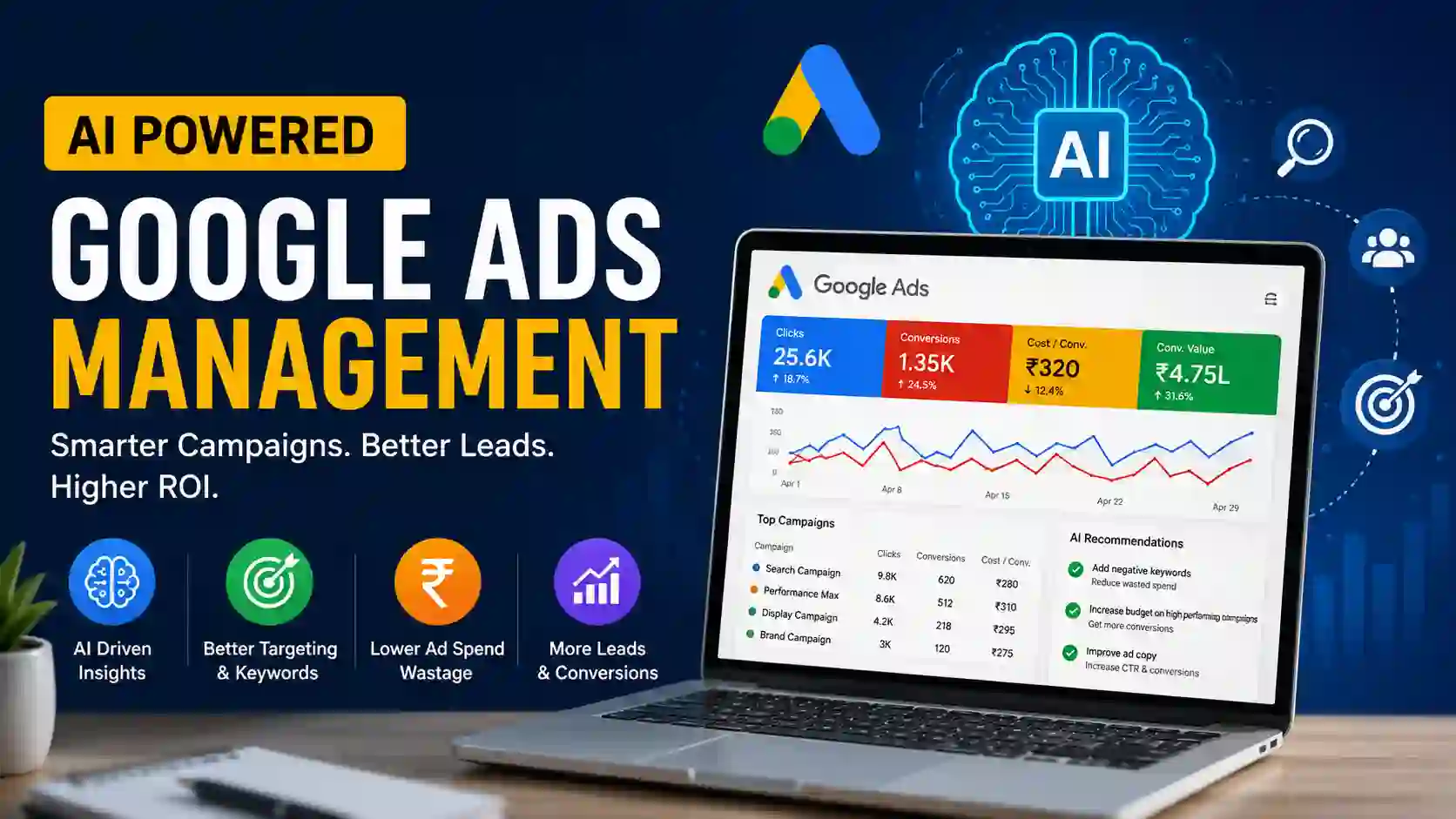
What an AI Google Ads Agency Actually Does for Modern Businesses
For many businesses, Google Ads looks simple from the outside. Pick a few keywords, write an advertisement, set a budget and wait for enquiries. In actual campaigns, things become messy quite quickly.
A business can spend ₹2,000 in a day and receive clicks without a single serious enquiry. Another campaign may generate leads, but half of them are looking for jobs, free information or something completely different from what the company sells. This is where an AI Google Ads agency has a practical role.
An AI Google Ads agency uses artificial intelligence along with normal paid search expertise to analyse campaign data, search behaviour, keywords, audiences and conversion patterns. AI does not replace the person managing the account. It gives the person more information to work with and helps identify patterns that are difficult to spot manually.
For example, suppose a Pune based engineering consultancy is advertising project finance consulting. A campaign may receive searches containing terms such as “project finance consultant”, “project finance loan” and “project report for bank loan”. All three may look relevant initially. But once conversion data starts coming in, one group might produce serious business enquiries while another produces mostly low intent traffic.
That difference matters more than the number of clicks.
An AI Google Ads agency can analyse such patterns across search terms, devices, locations, timings, audience signals and previous conversion behaviour. The objective is not simply to get advertisements shown more often. It is to spend money where there is a reasonable commercial possibility.
This distinction is often missed.
Google Ads is an auction. Businesses compete for visibility based on factors such as bid, ad relevance and expected user experience. A higher budget alone does not guarantee good leads. If the campaign is poorly structured, even a generous budget can disappear surprisingly fast.
AI can help with the repetitive part of this work. Search term analysis, performance comparisons, keyword clustering, bid signals and anomaly detection can involve a large amount of information. A human specialist still needs to decide what the numbers actually mean.
I would be cautious about any agency claiming that AI can run the entire account without human judgement. That sounds impressive until the campaign starts attracting the wrong customers.
A good AI Google Ads agency usually combines three things: advertising knowledge, conversion tracking and AI assisted analysis. The combination is more useful than any one of them alone.
There is also a practical difference between an AI tool and an AI Google Ads agency. A business owner can access several AI based advertising features directly through Google’s advertising ecosystem. But tools do not automatically understand the commercial reality of a company.
A local healthcare business, a B2B manufacturer and an online education company can all use Google Ads, but their conversion journeys are completely different.
That is where human judgement becomes important.
Why Businesses Are Moving Towards AI Powered Google Ads Management
The biggest reason is not that businesses suddenly became fascinated with AI.
It is cost.
Google Ads can become expensive when campaigns are not watched closely. Even a small amount of wasted traffic becomes meaningful when it repeats every day. A company spending ₹50,000 per month can tolerate some inefficiency, but it cannot afford to keep paying for irrelevant searches for months.
Earlier, campaign managers often relied heavily on spreadsheets and manual analysis. That still has value. But advertising platforms now generate huge amounts of information, especially for accounts with several campaigns, locations and conversion actions.
An AI Google Ads agency can process this information much faster.
Suppose an account has 15 campaigns and several thousand search terms. A human can review them, but the process takes time. AI assisted systems can identify unusual changes, recurring patterns and groups of similar searches much quicker.
This becomes particularly useful when performance changes suddenly.
A campaign that normally generates leads at ₹700 each may suddenly move to ₹1,200. The reason could be a change in search behaviour, competition, landing page performance, conversion tracking, seasonality or simply a poor traffic mix.
AI can help flag the change. Someone still has to investigate why it happened.
This is one area where I strongly prefer practical use over exaggerated claims. AI should help a campaign manager ask better questions. It should not be treated as a magic button that makes every campaign profitable.
Indian businesses also have another problem. Search behaviour can vary considerably by city and by language.
A customer in Bengaluru may search differently from someone in Jaipur. A person looking for a CA in Delhi might search for a service using professional terminology, while another customer may simply type a problem into Google. Some users also mix Hindi and English in their searches.
These details can influence keyword choices, ad copy and landing page messaging.
AI tools can identify patterns in search queries at a scale that would be tedious to review manually. That gives an AI Google Ads agency a better starting point for campaign decisions.
There is also the issue of speed.
A traditional campaign review might happen once a week or once every few days. AI assisted monitoring can highlight changes much sooner. If one keyword suddenly consumes a large portion of the daily budget without producing conversions, the account manager can investigate before too much money is spent.
But speed is not always a virtue.
Sometimes a campaign looks weak for two days and then produces several high value leads. Turning everything off too quickly can damage an account. This is why I do not agree with the idea that AI should automatically make every advertising decision.
Advertising needs context.
A ₹3,000 lead may be expensive for one business and extremely cheap for another. If that lead turns into a ₹5 lakh contract, the economics are completely different.
So the real shift towards AI powered Google Ads management is less about replacing campaign managers and more about giving them better analysis, faster feedback and more ways to test decisions.
How AI Helps an AI Google Ads Agency Find Better Search Opportunities
Keyword research is one of those tasks that looks easy until you manage a real account.
You start with the obvious keywords. Then you find variations, related searches, questions, location based terms and commercial phrases. After the campaign runs, actual users start searching for things you never predicted.
Those real searches are valuable.
An AI Google Ads agency can analyse search term data and group related queries according to intent. This can reveal opportunities that traditional keyword research may overlook.
Take a simple example.
A company selling commercial solar installation services might initially target:
“commercial solar installer”
“industrial solar company”
“solar EPC company”
After running the campaign, the search term report may reveal searches such as “solar plant for factory”, “solar subsidy for industrial unit” or “rooftop solar for manufacturing unit”.
Not every one of these searches should become a keyword. That is an important point.
AI can help classify the terms, but the business context decides whether they are commercially useful. A company that only handles large ground mounted projects may not want traffic for residential rooftop installation.
This is where search intent becomes more important than keyword volume.
High search volume can be tempting. But a keyword searched 20,000 times per month is not automatically better than a keyword searched 300 times if the smaller keyword comes from people ready to contact the business.
An AI Google Ads agency can look for these relationships by comparing keyword groups with actual conversion data.
It can also help identify negative keyword opportunities.
Negative keywords are often ignored by inexperienced advertisers. That can be costly.
Suppose a company sells premium accounting software. The campaign targets “accounting software”, but searches may include “free accounting software”, “accounting software jobs”, “accounting software course” and “accounting software tutorial”.
Those searches may generate clicks.
They may even look relevant in a basic report.
But they are not necessarily potential customers.
Adding suitable negative keywords can reduce this type of waste. AI assisted analysis can make the process quicker by identifying recurring irrelevant patterns.
Location data is another useful area.
A business serving only Mumbai and Navi Mumbai does not necessarily want enquiries from every part of India. AI can help analyse performance by location and identify where clicks and conversions are actually coming from.
Still, I would not blindly exclude locations based on a short period of data. Small datasets can be misleading.
I might be wrong here in some cases, but I have found that businesses sometimes make decisions too early because one city looks expensive for a week. A longer view can tell a different story.
Search opportunities also change with customer behaviour. New products, regulations, seasonal demand and competitor activity can alter what people type into Google.
For an AI Google Ads agency, this means keyword research cannot really be treated as a one time task.
The campaign itself becomes a source of research.
That is probably one of the more useful ways to think about paid search.
Google Ads Campaign Structure, Keywords and Audience Targeting
Campaign structure sounds boring until a poorly organised account starts causing problems.
A good structure makes it easier to understand which products, services, locations and customer groups are actually producing business.
For example, an Indian construction company offering industrial construction, warehouse development and commercial interiors may not benefit from putting everything into one campaign. Each service has different search intent, pricing, competition and customer behaviour.
Separating them can make analysis easier.
Keywords also need careful handling. Broad match, phrase match and exact match behave differently, and Google’s automation has become increasingly sophisticated. That does not mean advertisers should throw every keyword into broad match and forget about it.
I strongly disagree with that approach.
Broad match can work well when the account has reliable conversion data and proper controls. But for a new account with limited tracking, it can bring a mixture of searches that are difficult to judge.
An AI Google Ads agency may use AI assisted keyword clustering to organise search terms and identify themes. But the campaign manager should still understand why each theme exists.
Audience targeting works differently depending on the campaign type.
Search campaigns often begin with people actively looking for a service. Other Google Ads campaign formats can use audience signals, remarketing data, customer lists and behavioural indicators.
This is where first party data becomes increasingly important.
If a business knows which customers eventually become valuable clients, that information can be more useful than generic audience assumptions. For example, a B2B consultancy may discover that leads from senior decision makers convert better than general website enquiries. That insight can influence bidding and audience analysis.
Conversion tracking is critical here.
If the account counts every contact form submission as a conversion without checking lead quality, the AI system receives bad information. It may then optimise towards actions that look successful but do not generate revenue.
This is one of the most common problems I see conceptually with automated advertising.
Bad input produces bad optimisation.
Consider a real looking situation. A real estate company receives 100 leads through Google Ads in a month. The dashboard shows a healthy conversion rate. But after the sales team checks them, only 12 are serious buyers and several enquiries are people looking for rental properties, jobs or completely different locations.
The campaign is not necessarily successful just because it produced 100 leads.
An AI Google Ads agency should ideally connect advertising metrics with business outcomes. Cost per lead is useful. Cost per qualified lead is often more useful. Revenue generated from those leads can tell an even clearer story.
This is also why landing pages cannot be separated completely from campaign management.
If the advertisement promises “industrial project finance consultation in Delhi” but the landing page talks about general financial services across India, users may hesitate. The traffic can be relevant and the campaign can still perform poorly.
AI can help analyse landing page content, search intent and ad messaging. But someone needs to understand what the customer is actually expecting after clicking.
That human check is not optional in my view.
How AI Google Ads Agency Services Can Control Wasted Ad Spend
Wasted spend rarely comes from one huge mistake.
It usually comes from small leaks.
An irrelevant search here. A poorly performing location there. A keyword that keeps spending without generating useful conversions. An ad that attracts clicks because the wording is interesting but brings the wrong audience.
After a month, the total can be surprisingly high.
AI Google Ads agency services can help identify these leaks by continuously analysing campaign signals.
One useful area is search term analysis. The system can look for irrelevant queries and recurring themes. If a business selling professional legal services keeps receiving searches from students looking for law notes, the account needs tighter controls.
Another area is budget allocation.
Suppose Campaign A generates qualified leads at ₹600 while Campaign B generates them at ₹1,400. It may make sense to shift some budget towards Campaign A.
But not automatically.
Campaign B might be targeting a service with much higher customer value. A ₹1,400 lead could be more valuable than a ₹600 lead if the eventual revenue is substantially higher.
This is where simple cost comparisons can become dangerous.
AI can spot the numbers. The business has to provide the meaning.
Bid management is another area where automation can help. Google Ads offers automated bidding strategies designed around goals such as conversions, conversion value or return on ad spend. AI assisted campaign management can work alongside these systems by monitoring whether the chosen approach is actually producing useful results.
There are also times when automation behaves in ways that make a business owner uncomfortable.
A campaign suddenly spends more than expected. Search volume changes. One audience segment starts receiving a larger share of traffic. A manager may look at the dashboard and wonder what happened.
That irritation is understandable. I have seen business owners become suspicious of Google Ads simply because they cannot explain where the money went.
The answer is usually not to abandon automation completely. It is to make sure budgets, conversion actions, search terms, locations and account rules are being checked regularly.
AI can also help detect unusual performance changes.
For instance, if click through rate falls sharply or cost per conversion rises, an automated monitoring system can flag the change. The account manager can then investigate whether there was a competitor change, tracking issue, landing page problem or shift in search demand.
This can prevent small problems from becoming expensive ones.
Still, not every drop is a problem.
A campaign for an education company may behave differently during admission season. A tax consultancy may see demand rise around filing deadlines. A travel company can experience strong seasonal changes.
So automated alerts need interpretation.
There is a slightly uncomfortable point here. Sometimes businesses want AI because they believe it will remove the need to make difficult decisions. It will not.
AI can tell you that one campaign is spending more.
It cannot always tell you whether that spending is strategically sensible.
That distinction matters.
A good AI Google Ads agency should therefore focus not just on reducing spend, but on reducing unproductive spend while protecting opportunities that have genuine commercial value.
And sometimes the right decision is to spend more.
That sounds contradictory after talking about wasted spend, but it happens. If a campaign is consistently producing high quality customers and there is room to scale without destroying efficiency, holding the budget too tightly can become its own problem.
Maybe the better question is not, “How do we spend less on Google Ads?”
It is, “Which part of our Google Ads spend is actually earning its place?”
That question tends to lead to better decisions, especially when the account has enough conversion data to support them.
There will still be days when the numbers look strange. Google Ads is not perfectly predictable, and anyone promising otherwise is making the conversation too easy.
Creating Better Ad Copy and Landing Page Experiences with AI
Getting someone to click an advertisement is not the difficult part. Getting the right person to click, understand the offer and take the next step is where most campaigns become difficult.
An AI Google Ads agency can use AI tools to analyse search queries, existing advertisements, competitor messaging and customer language to identify patterns in how people describe their problems. This can help when creating headlines and descriptions that sound closer to what the customer is actually searching for.
For an Indian business, small wording differences can matter.
A company offering business loans may advertise “Fast Business Loan Assistance”. That sounds acceptable, but it is quite broad. If the actual customer is searching for “business loan consultant for manufacturing company”, a more specific message may communicate relevance much better.
AI can help generate variations around these themes, but I would not publish every AI generated line directly.
Some AI written advertisements sound polished but strangely empty. They use words that nobody in the target market actually says. A local manufacturer looking for project finance does not necessarily care about impressive sounding advertising language. They want to know if the consultant understands their project, funding requirement and documentation.
That human check matters.
Ad copy should also match the landing page. If the advertisement promises “Project Finance Consultation for Manufacturing Units”, the landing page should immediately explain that service. Sending the user to a generic homepage creates unnecessary friction.
This is where AI can help analyse the relationship between search terms, advertisements and landing page content. It can identify missing topics, repeated messaging and possible gaps between what users search for and what they see after clicking.
Landing pages also need to load properly on mobile devices. A large portion of Indian internet traffic comes through smartphones, and a page that takes too long to open can waste paid traffic before the visitor even reads the offer.
I have a simple preference here. I would rather have a plain landing page with a clear service explanation, trust signals and a visible enquiry option than a beautifully designed page that makes the visitor search for the contact button.
That may sound obvious, but it gets missed surprisingly often.
AI can support headline testing, content variations, page analysis and user behaviour interpretation. It can also help identify which messages appear to attract higher quality enquiries.
But there is a limit.
The strongest advertisement is still useless if the business cannot fulfil the promise behind it.
Tracking Leads, Conversions and Google Ads Performance
Google Ads reporting can make a campaign look successful while the sales team tells a completely different story.
This usually happens when conversion tracking is too basic.
A form submission is counted as a conversion. A phone button click is counted as another conversion. Perhaps a WhatsApp click is counted too. The dashboard then reports 80 conversions.
Sounds good.
But what if only eight of those people were genuinely interested?
An AI Google Ads agency needs reliable conversion data before using automation or AI based analysis. Otherwise, the system is learning from misleading information.
For a service business, tracking should ideally go beyond the first enquiry. Businesses should try to understand which leads became qualified opportunities and which eventually became customers.
That can be difficult when leads are handled manually. A sales executive may receive an enquiry through a form, call the prospect and update the status in a CRM. If none of this information reaches the advertising system, Google only sees the initial enquiry.
It does not know what happened afterwards.
This is particularly important for B2B companies.
Imagine a Pune based engineering consultancy generating 40 leads through Google Ads. Ten are qualified. Three request detailed proposals. One signs a contract worth several lakh rupees.
Judging the campaign only by the 40 lead figure misses the important part.
An AI Google Ads agency can help businesses examine metrics such as cost per lead, conversion rate, cost per qualified lead, search term performance, location performance and campaign level conversion value. Where reliable data exists, revenue and customer value provide an even stronger basis for decisions.
Still, numbers need context.
A campaign with a ₹500 cost per lead is not automatically better than one with a ₹1,000 cost per lead. If the first produces poor quality enquiries and the second produces serious buyers, the cheaper campaign may actually be wasting more money.
This is why I get uncomfortable when agencies talk only about click through rates.
CTR has its place. So do impressions, clicks and average cost per click. But a business ultimately cares about enquiries, customers and revenue.
At the same time, not every business has enough data for sophisticated revenue based optimisation. A new business might only have a handful of conversions each month. In such cases, pretending there is enough data for a highly precise model can be misleading.
I might be wrong here in some account types, but generally I prefer building reliable tracking first and adding complexity gradually.
Performance also needs to be viewed over a sensible period.
One bad day does not necessarily mean the campaign is broken. One excellent day does not mean the campaign has been perfected.
Google Ads moves with search demand, competition, seasonality and customer behaviour.
That is why regular analysis matters more than constant panic.
Common Google Ads Mistakes Businesses Still Make
The most expensive Google Ads mistakes are often quite ordinary.
One of the first is sending all traffic to the homepage.
A company may have separate services for tax consulting, project finance, business valuation and financial advisory, but every advertisement sends visitors to one generic homepage. The user then has to figure out where to go.
Some will.
Most will not spend much time doing it.
Another common mistake is using keywords without understanding search intent. A keyword can look relevant but still attract people who are not buyers.
For example, a company selling paid professional training may target “digital marketing course” without considering searches such as “free digital marketing course”, “digital marketing course syllabus” or “digital marketing course PDF”. Depending on the business model, some of this traffic may have very low commercial value.
Negative keyword management is therefore important.
Then there is poor geographic targeting.
An Indian company serving only Maharashtra may accidentally advertise across the entire country. A local service provider may receive clicks from cities where it has no presence. The problem is not necessarily Google Ads itself. Often, campaign settings were simply never reviewed properly.
Another mistake is changing campaigns too frequently.
A business owner sees poor results after three days and changes the keywords. Two days later, they change the budget. Then the landing page changes. Then the campaign is paused.
At that point, it becomes difficult to understand what actually caused the result.
There is also an overdependence on automated recommendations.
Google provides recommendations inside advertising accounts, and some can be useful. But accepting every recommendation without considering the business objective is not something I would recommend.
An account manager should ask why a recommendation is being made and what could happen after accepting it.
AI creates another possible mistake.
Some businesses assume that because AI can generate ad copy, keyword ideas and campaign suggestions, they no longer need someone who understands paid advertising.
That is risky.
AI does not know that the business stopped offering a service last month unless someone tells it. It may not know that a particular type of lead is terrible for the sales team. It cannot always understand why a seemingly expensive campaign is actually responsible for the company’s largest customers.
Automation needs supervision.
Finally, there is the mistake of measuring everything through immediate sales.
Not every Google Ads campaign has the same buying cycle. A person looking for an emergency repair may convert within minutes. Someone researching a large industrial project may take weeks before making contact.
The tracking model has to reflect that reality.
How StratMarketer Supports Businesses with AI Google Ads Management
StratMarketer approaches AI Google Ads management by combining advertising strategy with AI assisted analysis rather than treating AI as a replacement for campaign management.
The starting point should be the business itself.
What is being sold? Who actually buys it? Which locations can be served? What does a valuable enquiry look like? How long does the sales process normally take?
These questions influence the advertising setup.
For a B2B company, the campaign may need to focus heavily on commercial intent and lead quality. For an ecommerce business, product demand, conversion value and purchase behaviour become more important. A local service business may need tighter location controls and call tracking.
The campaign structure should reflect those differences.
StratMarketer can use AI assisted research to examine keyword opportunities, search intent, advertising themes and performance patterns. Search terms can be reviewed for irrelevant traffic and potential negative keywords. Campaign data can also be studied to identify areas where budget is being spent without enough commercial return.
Ad copy is another area where AI can support the process.
Instead of relying on one advertisement, multiple variations can be created and evaluated against actual campaign behaviour. The useful part is not simply generating more headlines. It is learning which messages attract the right audience.
Landing page relevance also needs attention.
If an advertisement targets a specific service, the landing page should make that service clear. Trust information, service details, enquiry options and useful supporting content should be easy to find.
Tracking is equally important.
StratMarketer can structure campaign reporting around meaningful advertising metrics while keeping an eye on lead quality and business outcomes. This helps prevent the common situation where a campaign appears successful only because it generated a high number of low quality leads.
There is no single Google Ads setup that works for every business.
That is worth saying plainly.
A campaign for a Delhi based legal consultancy will behave differently from one for a Bengaluru software company or an Indian manufacturer selling equipment to other businesses.
AI can help analyse these differences faster, but the campaign still needs business context.
And sometimes the correct decision is not to increase the budget. It may be to fix the tracking, narrow the audience, change the landing page or remove irrelevant searches first.
That is where careful management tends to matter more than fancy terminology.
Frequently Asked Questions About Hiring an AI Google Ads Agency
What is an AI Google Ads agency?
An AI Google Ads agency manages Google advertising campaigns using AI assisted tools along with human campaign expertise. AI may be used for keyword analysis, search term classification, performance monitoring, audience analysis, ad variations and other repetitive tasks.
The person managing the campaign still makes important decisions.
Is an AI Google Ads agency better than a normal Google Ads agency?
Not automatically.
The quality of the campaign depends on strategy, tracking, account management, business understanding and how the available tools are used. AI can make certain processes faster, but it does not guarantee better advertising.
I would look at the agency’s approach rather than choosing one simply because the word AI appears in its service description.
Can AI reduce wasted Google Ads spending?
It can help identify potential waste faster.
Search term analysis, budget monitoring, performance comparisons and anomaly detection can reveal areas that need attention. But reducing spend should not be the only goal. Some expensive keywords may produce high value customers.
The real question is whether the spend is commercially justified.
How long does it take to see results from Google Ads?
There is no universal timeline.
Some campaigns can generate enquiries quickly, especially when people have strong purchase intent. Others need more time because the service has a longer buying cycle or limited search demand.
New campaigns also need enough data before meaningful decisions can be made.
Does AI write all the Google Ads copy?
It can generate copy variations, but it should not necessarily be responsible for the final wording.
Human review is important because advertisements need to match the actual offer, industry, customer expectations and brand voice. An AI generated line can sound perfectly fine and still be completely unsuitable for the business.
Can an AI Google Ads agency guarantee leads or sales?
A serious agency should be careful with guarantees.
Google Ads performance depends on competition, demand, pricing, landing pages, sales follow up, market conditions and many other factors. An agency can control campaign management, but it cannot control how every person who clicks behaves.
How much should a business spend on Google Ads?
There is no fixed amount that suits everyone.
A sensible starting budget depends on keyword costs, market size, conversion rates, customer value and how many enquiries the business can actually handle.
Starting with a realistic test budget is usually more sensible than choosing a random large figure.
Should a small Indian business use AI Google Ads management?
It can make sense, particularly when the owner does not have time to review search terms, conversion data and campaign performance regularly.
But the business should first have a clear service, a workable sales process and proper conversion tracking. AI cannot compensate for an unclear offer or poor follow up.
Is AI Google Ads management fully automated?
No, and it should not be treated that way.
Google already uses substantial automation within its advertising platform. An AI Google Ads agency adds another layer of analysis and management around that technology.
Someone still needs to understand the business and question what the numbers are saying.
Sometimes that means accepting an automated recommendation. Sometimes it means ignoring it.
That second part gets less attention than it deserves.