


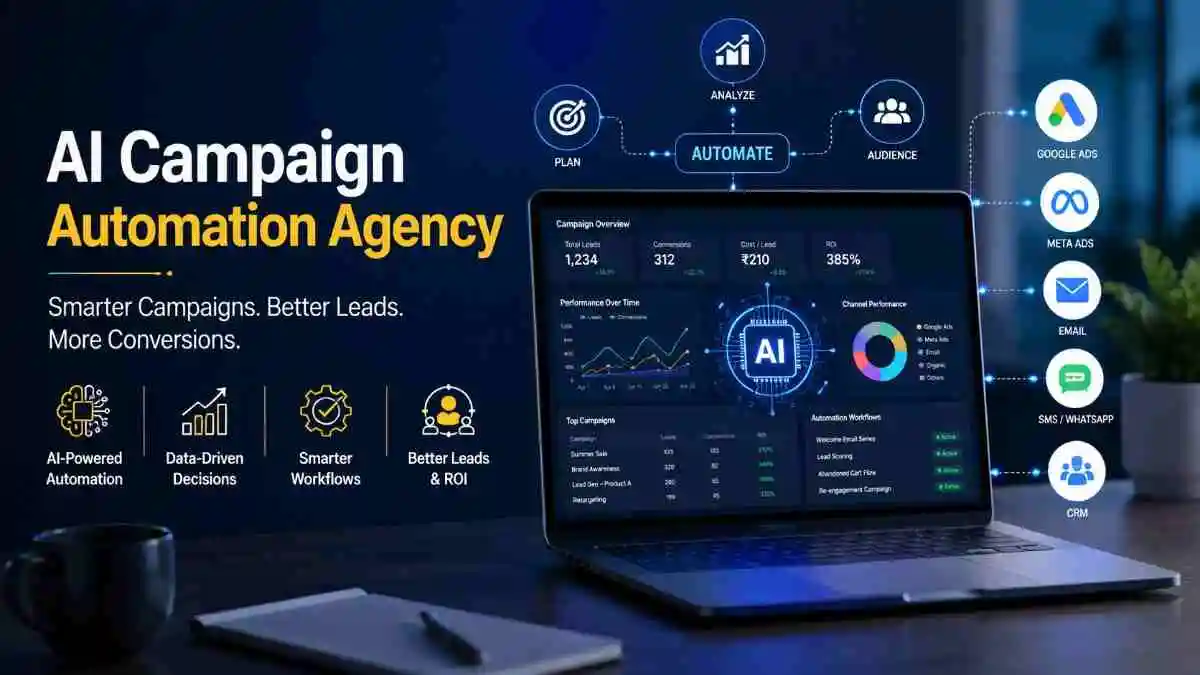
What Is an AI Campaign Automation Agency and Why Businesses Need One
Marketing campaigns have become difficult to manage in the old way. A business may have Google Ads running, Meta campaigns bringing enquiries, email campaigns following up with leads, social media posts going out regularly, and a CRM holding customer information. Then there is the website, landing pages, analytics, remarketing and content. Someone has to keep an eye on all of it.
This is where an AI campaign automation agency can make a practical difference.
An AI campaign automation agency uses artificial intelligence, automation platforms, customer data and marketing systems to reduce repetitive campaign work while helping teams make better decisions. It does not simply mean putting an AI tool into a marketing department and expecting leads to appear. That approach usually creates more problems than it solves.
The real value comes from connecting different parts of marketing so that campaigns can respond to what people are actually doing.
For example, consider an Indian education company running lead generation campaigns for professional courses. A student visits the website, checks the course fee, downloads a brochure and leaves without submitting a form. Traditionally, the marketing team might never know what happened after that visit. With connected tracking and automation, that behaviour can become a signal. The person may enter a remarketing audience, receive a relevant follow-up message or see another advertisement based on the course they viewed.
That is a much more useful role for AI.
An AI campaign automation agency is essentially helping a business build a marketing system where data, decisions and repetitive actions are connected. Human marketers still decide what the business wants to achieve, who it wants to reach and what kind of communication makes sense. AI and automation take care of parts of the ongoing work.
What Does an AI Campaign Automation Agency Actually Do?
The phrase sounds more complicated than it is.
An AI campaign automation agency generally works across campaign planning, audience analysis, content workflows, advertising optimisation, lead management, reporting and customer follow-up. The exact mix depends on the business.
A B2B company may need automated lead scoring and CRM workflows. An ecommerce brand may need product-based audience segmentation and automated remarketing. A local service business may care more about lead capture, WhatsApp follow-up, Google Ads and conversion tracking.
The common thread is that the agency looks for repetitive marketing decisions that can be supported by technology.
Suppose a company receives 500 leads every month. The sales team cannot manually inspect every interaction in detail. Some leads are serious buyers. Some are only looking for prices. Some never respond. Some return to the website three weeks later.
An AI campaign automation agency can help classify those signals and build different workflows around them.
This does not mean AI understands every customer perfectly. It does not. Anyone claiming otherwise has probably spent more time selling automation than actually managing campaigns.
Good automation is selective.
A campaign might automatically change audience targeting based on performance signals, send a follow-up after a particular customer action, move a qualified lead into a CRM stage or generate a report highlighting unusual changes in campaign performance.
The marketing team still needs to decide whether those actions make business sense.
Why Businesses Are Moving Towards Campaign Automation
The biggest reason is not fashion. It is workload.
Marketing teams spend a surprising amount of time doing small operational jobs. Checking campaign dashboards. Downloading reports. Moving leads between systems. Preparing audience lists. Sending follow-up reminders. Creating variations of ad copy. Updating spreadsheets. Looking for campaigns with declining performance.
None of these tasks are necessarily difficult.
They simply consume time.
For a growing Indian business, this can become frustrating very quickly. A company might have only two or three people managing digital marketing across several channels. They are expected to handle SEO, paid advertising, social media, content, leads and reporting at the same time.
Something eventually gets missed.
An AI campaign automation agency can take some of this operational pressure away by connecting tools and creating workflows that operate without someone manually triggering every step.
There is another reason too. Customers do not behave according to the company’s internal marketing schedule.
A customer may interact with a brand at 11 pm. Another may return to the website six days after the first advertisement. Someone may open three emails but ignore every sales message. Someone else may click an advertisement five times before finally enquiring.
Automation allows the marketing system to respond to those behaviours instead of treating every person the same.
That distinction matters.
How AI Campaign Automation Changes the Way Marketing Campaigns Are Managed
Traditional campaign management often follows a fixed routine.
The team decides on an audience, creates advertisements, launches the campaign, checks results after a few days and makes changes. That process still works. It is not obsolete.
But it has limitations when campaigns become large or run across several platforms.
An AI campaign automation agency can introduce more frequent analysis and automated responses. Instead of waiting for a marketer to manually identify every change, systems can monitor selected signals and trigger predefined actions.
Imagine a SaaS company running campaigns for three customer segments. The campaign for small businesses is performing well, the mid-market campaign is slowing down and the enterprise campaign has a high cost per lead.
A manual process may involve checking several dashboards, comparing figures and deciding what to change.
An automated system can bring those signals together.
The marketer can then focus on the important question: why is the enterprise campaign behaving differently?
That is a better use of human attention.
AI can also help with campaign variations. Advertising platforms already use machine learning extensively for bidding, delivery and audience selection. Businesses can also use AI tools to produce variations of headlines, descriptions, email subject lines, landing page copy and creative concepts.
But there is a catch.
More variations do not automatically mean better marketing.
I have seen campaigns where a team produced dozens of ad variations simply because the tools made it easy. The result was not necessarily better. The messaging became repetitive and the team lost track of which ideas were actually worth testing.
Automation should reduce unnecessary work, not create more of it.
Automating PPC, Social Media, Email and Content Campaigns
Most businesses do not have a problem with having too many marketing channels. The problem starts when those channels operate separately.
Google Ads is handled by one person. Meta campaigns are checked by another. Social media posts are planned in a spreadsheet. Email campaigns sit inside another platform. The CRM has customer information, but the advertising team rarely looks at it.
This is where an AI campaign automation agency can bring some order to the mess without forcing every marketing activity into one rigid system.
PPC is usually the easiest place to see the benefit. Advertising platforms already use machine learning for bidding, audience selection, budget allocation and campaign delivery. An AI campaign automation agency can build processes around these capabilities and connect them with business data, conversion tracking and reporting.
For instance, if a B2B company is spending money on Google Ads for industrial equipment, clicks alone are not enough. The business needs to know which campaigns are generating genuine enquiries, which leads are becoming sales opportunities and which keywords are attracting people who are only looking for information.
That means the automation should not stop at the advertising platform.
The data needs to travel further.
A lead can enter the CRM, receive a source tag, move through different sales stages and eventually be connected back to the original campaign. Once that loop is working, the marketing team has a much clearer picture of what the advertising budget is actually producing.
Meta campaigns can work in a similar way.
An ecommerce business may have different creative concepts for different products. AI can help generate variations of copy, analyse engagement patterns and identify combinations worth testing. Automation can also support audience management and reporting.
But I would not allow a system to automatically make every decision just because it can.
There is a tendency to think automation means removing people from the process. I disagree. The better model is to remove repetitive checking and leave the important judgement with people.
Social media is another area where automation is useful but easy to misuse.
A business can automate scheduling, content distribution, basic reporting and parts of the content creation process. AI can help turn one long article into several social posts, suggest different hooks or create content variations for different platforms.
That saves time.
But a local Indian business still needs a human understanding of how its customers actually speak. A restaurant in Jaipur, a manufacturer in Pune and a coaching company in Lucknow cannot communicate in the same generic language simply because an AI tool produced technically correct captions.
The same applies to email.
Email automation becomes much more useful when it reacts to behaviour. Someone who downloads a product catalogue can receive a different sequence from someone who has already requested a quotation. A customer who purchased recently should not keep receiving introductory sales emails.
Content campaigns can also be connected to this system.
Suppose an accounting software company publishes an article about GST compliance. Visitors reading that article can be grouped based on their interaction. Someone who spends a few seconds on the page is different from someone who reads several related articles and then visits the pricing page.
The second person may be closer to making an enquiry.
That does not mean the person should immediately receive five promotional emails. It simply means the marketing system now has more context.
This is what a good AI campaign automation agency should be trying to achieve. Not automation for the sake of automation, but better coordination between channels.
How AI Campaign Automation Helps Businesses Reduce Manual Marketing Work
Marketing teams often underestimate how much time disappears into small tasks.
Someone checks yesterday’s campaign numbers. Someone exports leads. Someone cleans a spreadsheet. Someone prepares an audience list. Someone copies campaign data into a report. Someone sends follow-up reminders. Someone checks whether a lead came from Google or Meta.
None of these tasks look serious individually.
Together, they consume hours every week.
An AI campaign automation agency can identify these repetitive activities and decide which ones can safely be automated.
A simple example is reporting.
Instead of a marketing manager opening several dashboards every morning, campaign data can be brought into a central reporting system. AI can then flag unusual changes such as a sudden rise in cost per lead, a fall in conversion rate or an unexpected increase in traffic from one campaign.
The manager does not need to search for the problem first.
The problem comes to their attention.
That is a small change, but when it happens across dozens of campaigns, the time saving becomes meaningful.
Lead management is another obvious area.
Imagine a company receiving 200 enquiries each month. Some leads are complete. Some have missing information. Some are duplicates. Some come from high-intent campaigns. Others come from broad awareness advertisements.
A properly designed workflow can classify, tag and distribute these leads automatically.
The sales team can then spend more time talking to potential customers instead of sorting spreadsheets.
I remember seeing this kind of issue with service businesses where leads were simply dumped into a common WhatsApp group. It looked convenient initially. After a few weeks, people were asking who had called which customer, which enquiry was still pending and whether somebody had followed up.
The problem was not lead volume.
The process was weak.
Automation would not have solved everything, but a basic CRM workflow with ownership, status and follow-up reminders would have removed much of that confusion.
AI Campaign Automation for Lead Generation and Conversion Tracking
Generating leads is only one part of the marketing job.
The more important question is what happens after the lead arrives.
An AI campaign automation agency can help connect the entire path from advertisement or search result to enquiry, qualification and eventual conversion.
Consider a company offering solar installation services.
A visitor searches for solar panel installation, clicks an advertisement and fills out an enquiry form. The lead enters the CRM. The system records the campaign source and the service requested. The sales team receives the enquiry. If the customer does not respond, a follow-up process can be triggered.
Now imagine the customer later books a site survey.
That action should be recorded.
If the customer eventually purchases, the original marketing source should ideally receive credit for contributing to the sale.
This is where conversion tracking becomes much more meaningful than simply counting form submissions.
A campaign producing 100 leads may look better than one producing 40 leads. But if the first campaign generates only two customers and the second generates ten, the numbers tell a different story.
Marketing teams need to look beyond surface metrics.
Cost per lead is useful.
Cost per qualified lead is better.
Cost per customer can be even more useful when the sales cycle and tracking setup allow it.
For ecommerce businesses, purchase data can be fed back into advertising platforms so that campaign optimisation is based on actual purchases rather than clicks or shallow engagement.
For lead generation businesses, offline conversion tracking can help connect advertising activity with actions that happen later in the sales process.
This is particularly important for high-value services where the customer does not buy immediately.
A ₹2,00,000 industrial service cannot be evaluated properly using the same measurement approach as a ₹1,000 online purchase.
How StratMarketer Approaches AI Campaign Automation for Indian Businesses
AI campaign automation sounds very different when you look at it from the side of an actual Indian business.
A local service company may have only a handful of employees handling marketing and sales. An ecommerce brand may be spending heavily on Meta and Google Ads but struggling to understand which campaigns are actually bringing profitable customers. A B2B manufacturer may receive enquiries through its website, WhatsApp, phone calls and trade portals, with customer information scattered across different places.
The problem is rarely a complete lack of marketing tools.
Usually, there are too many of them.
At StratMarketer, the practical approach to working as an AI campaign automation agency starts with understanding how the business currently acquires, qualifies and converts customers. Only after that does automation become useful.
This matters because every business has a different customer journey.
A real estate company does not sell in the same way as a D2C skincare brand. A coaching institute does not have the same sales cycle as an industrial equipment manufacturer. Even two companies in the same industry can require completely different campaign workflows because their pricing, sales teams, customer locations and buying behaviour differ.
So the first question should not be, “Which AI tool should we use?”
It should be, “Where is marketing work getting stuck?”
That question often reveals more.
Suppose an Indian education business is generating hundreds of enquiries every month. The advertising campaigns may be performing reasonably well, but the sales team is receiving leads without enough context. They do not know which course the person viewed, which advertisement generated the enquiry or how many times the prospect visited the website.
In that situation, creating more advertisements may not solve the real problem.
Connecting campaign tracking, website behaviour, lead forms and CRM information might.
That is the kind of situation where an AI campaign automation agency can be useful.
How to Choose the Right AI Campaign Automation Agency for Your Business
Choosing an AI campaign automation agency is not simply a matter of comparing the number of AI tools an agency uses.
That can be misleading.
One agency may mention twenty platforms during a sales presentation. Another may talk about only five. The second agency could still have a much better understanding of campaign measurement, CRM integration and customer journeys.
The real question is whether the agency understands your business problem.
Before signing anything, ask them to explain how they would approach your current marketing system.
If you are a lead generation business, ask how they would connect advertising leads with actual sales outcomes.
If you run ecommerce, ask how they would measure purchases, repeat orders and customer value.
If you operate a B2B business, ask how they would handle long sales cycles.
A good AI campaign automation agency should be able to discuss these situations without immediately turning the conversation into a list of software names.
Look at the Agency’s Understanding of Your Customer Journey
Campaign automation is only as useful as the customer journey underneath it.
Suppose your customer normally takes three weeks to make a purchase.
An agency that proposes a five-message sales sequence over two days may not understand your business.
Likewise, if customers usually need to speak with a salesperson before purchasing, an automation strategy built entirely around self-service emails may not make much sense.
Ask the agency what happens from the first interaction to the final sale.
They should be interested in your sales process.
Not just your advertising account.
Ask How They Handle Data and CRM Integration
This is one question I would definitely ask.
“Where will the campaign data go?”
The answer should be specific.
If the agency cannot explain how leads move from advertising platforms into the CRM, how campaign sources are recorded or how sales outcomes can be connected back to marketing, there is a problem.
You should also ask what happens when a customer becomes an existing customer.
Does the system know?
Does the acquisition campaign stop when appropriate?
Does the customer move into a different communication journey?
These details often separate useful automation from decorative automation.
Do Not Judge an Agency by the Amount of AI Content It Produces
This deserves to be said clearly.
More AI content does not mean better campaign automation.
A company may generate thousands of ad copy variations, social media posts and email drafts. If the targeting, measurement and customer journey are weak, all that content simply creates more things to manage.
I would personally prefer an agency that can explain why one campaign should be changed than one that promises to create fifty new campaigns overnight.
Speed has value.
But direction matters more.
Ask About Human Oversight
This is another important area.
You should know which campaign decisions are automated and which ones require human approval.
For example, automated alerts for cost increases are sensible.
Automatically changing every campaign budget without defined limits is a different matter.
Similarly, AI generated email drafts can be reviewed before being sent. Customer communication should not always be allowed to operate without supervision, particularly where pricing, financial matters, healthcare, legal services or sensitive personal information are involved.
The agency should have clear controls.
There should also be a way to stop a workflow if something goes wrong.
It sounds obvious.
Until a broken automation sends the wrong message to thousands of customers.
Understand What They Will Actually Measure
A strong AI campaign automation agency should not stop at vanity metrics.
Ask which numbers will determine whether the campaign is working.
For some businesses, that could be qualified leads.
For others, booked appointments, completed purchases, sales value or customer acquisition cost may matter more.
A service company should not judge marketing only by traffic.
An ecommerce company should not judge success only by impressions.
A B2B manufacturer should not celebrate 1,000 enquiries if the sales team can qualify only ten of them.
The measurement system needs to reflect the commercial reality of the business.
Be Careful With Agencies Promising Complete Automation
This is where I would be cautious.
Marketing is not a machine where every input produces a predictable output.
Customer behaviour changes. Offers change. Competitors change. Websites break. Tracking fails. Sales teams change their processes. Sometimes an advertisement suddenly stops working for no obvious reason.
An agency that promises that AI will run everything automatically is making a claim I would question.
AI can handle a lot.
It cannot remove uncertainty from marketing.
The better question is how the agency handles uncertainty when it appears.
Do they monitor campaigns?
Do they review unusual results?
Can they explain why a workflow behaved differently?
Can a person intervene?
Those answers matter more than the number of AI platforms listed in a proposal.
Consider the Quality of Communication
This sounds unrelated to campaign automation, but it is not.
Automation projects involve several moving parts. Advertising platforms, CRM systems, website tracking, forms, email tools and sales processes all have to work together.
If communication between the agency and the business is poor, small problems can remain unresolved for weeks.
You should know who will manage the account, how often performance will be reviewed and who will handle technical issues.
You should also be able to understand the reporting.
A report filled with complicated AI terminology is not necessarily a good report.
If you cannot tell what happened, why it happened and what needs attention, the report has failed.
Start With One Business Problem
A sensible way to test an AI campaign automation agency is to start with a clearly defined problem.
Maybe lead follow-up is slow.
Maybe marketing and CRM data are disconnected.
Maybe campaign reporting takes too much manual effort.
Maybe the sales team cannot identify high-intent leads quickly.
Solve that problem first.
Then expand.
This gives the business a chance to see how the agency works before putting every marketing channel into an automated system.
It also makes the results easier to understand.
And if the first workflow does not work, you have learned something without rebuilding your entire marketing operation.
That matters because automation can become surprisingly complicated once multiple platforms start talking to each other.
There is no prize for having the most complicated setup.
For an Indian business, the right AI campaign automation agency is the one that understands the customer, the sales process, the available data and the commercial objective before deciding what should be automated.
StratMarketer can approach this by treating AI as part of the wider marketing system rather than a separate technology project. PPC, SEO, social media, content, lead generation, CRM workflows and conversion tracking need to support the same business objective.
Sometimes the answer will involve sophisticated automation.
Sometimes it may involve fixing a tracking problem or cleaning a CRM.
And occasionally, the best decision may be to leave a particular process manual because the human judgement involved is simply too valuable to automate.
That is something worth asking before choosing any AI campaign automation agency. Not “How much AI can you add?”
Ask instead, “What should actually be automated in my business, and what should remain human?”
The answer to that question usually tells you far more about an agency than its technology stack ever will.