


What Is an AI Email Marketing Automation Agency and Why Does It Matter?
Email marketing has never really disappeared. Even when social media, paid advertising, WhatsApp and newer AI based channels get more attention, email remains one of the few marketing channels where a business can build a direct relationship with people who have already shown some level of interest.
The problem is that managing email properly becomes difficult as the customer base grows.
A business may have thousands of contacts, different customer groups, abandoned enquiries, inactive subscribers, repeat buyers and leads sitting at different stages of the buying journey. Sending one generic email to everyone usually does very little. Sending everything manually is also not practical.
This is where an AI email marketing automation agency becomes useful.
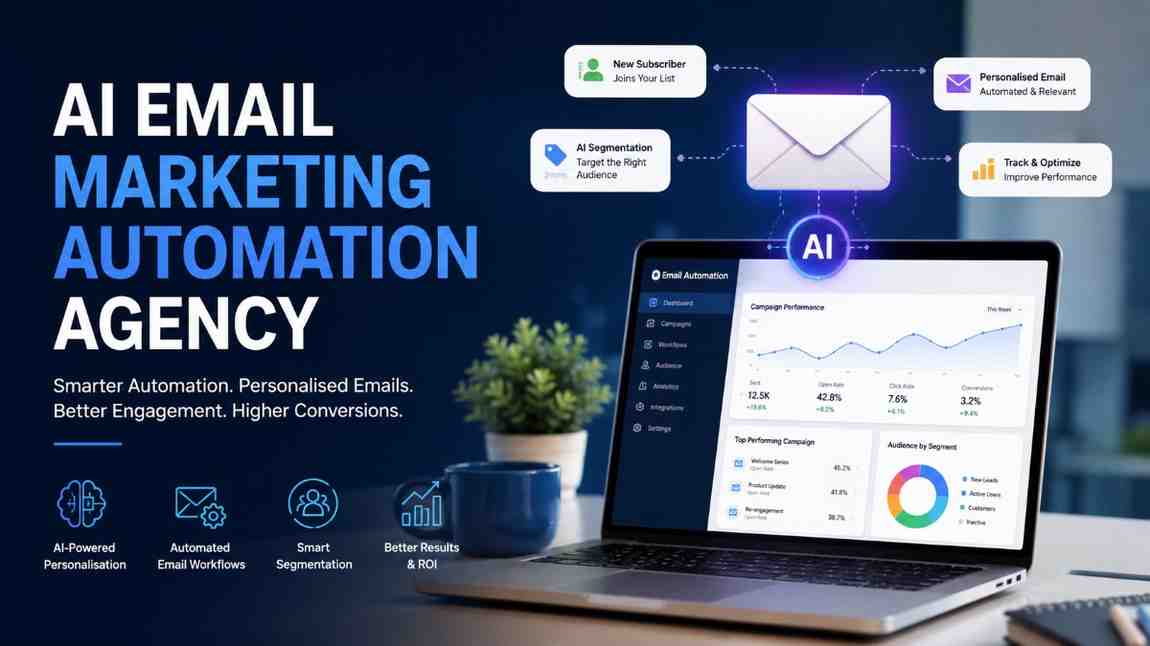
An AI email marketing automation agency combines email strategy, customer data, automation platforms and artificial intelligence to create email journeys that respond to what people actually do. Someone downloads a guide, visits a product page, fills out an enquiry form, abandons a purchase or stops opening emails. These actions can influence what happens next.
That sounds technical, but the basic idea is quite simple.
The right email should reach the right person at a sensible point in their journey.
For an Indian business, this can matter even more because customer journeys are rarely neat. A person might enquire through a website, speak to a sales executive on WhatsApp, check the company on Google, return through an email and then take weeks before making a decision. Treating that person like a completely new lead every time creates unnecessary confusion.
An AI email marketing automation agency can connect these signals and build a more sensible communication process.
There is another important point here. AI does not automatically make email marketing better. I have seen campaigns where AI generated hundreds of emails, but the underlying customer segmentation was poor. The result was simply more irrelevant emails going out faster.
That is not automation. That is automated noise.
Good email automation still starts with understanding the customer, the business model and the reason someone should receive an email in the first place.
For example, consider an Indian education company receiving enquiries for professional courses. A student who downloaded a course brochure is not necessarily ready to enrol. Sending them a discount message immediately may be premature. A better journey could first answer common course questions, explain eligibility, share relevant outcomes and then introduce a consultation or enrolment opportunity.
AI can help identify patterns in engagement and adjust the journey based on those signals.
The agency’s role is not simply to connect a business to an email platform. It involves deciding what should happen, when it should happen and what information should influence the next communication.
That distinction matters.
Why Businesses Are Moving Beyond Basic Email Campaigns
Traditional email marketing often works around campaigns.
A team writes an email, selects a list, schedules it and checks the results afterwards. This can still work for newsletters, announcements and certain promotional campaigns.
But customers do not behave according to a campaign calendar.
One person may open an email immediately. Another may ignore it for three weeks. Someone else may click five times without submitting an enquiry. A previous customer may suddenly return to a product page after six months.
An AI email marketing automation agency looks at these differences rather than treating the entire database as one audience.
This is where automation becomes genuinely useful.
Instead of sending the same five emails to every new subscriber, the system can react to behaviour. If a person engages heavily with a particular topic, subsequent messages can become more relevant to that interest. If engagement drops, the communication pattern can change. If a purchase happens, promotional emails can stop and post purchase communication can begin.
The customer does not need to understand any of this.
They simply receive a more relevant message.
For a company with a large sales team, this can also reduce the number of leads that are forgotten after the first interaction. A lead that has not responded to a salesperson might enter a carefully designed nurturing sequence rather than disappearing into a spreadsheet.
I prefer this approach over building dozens of complicated automations just because the software allows them. More automation is not necessarily better. In some businesses, three well planned customer journeys will outperform twenty poorly designed ones.
That is one area where AI can be useful, but human judgement still matters.
How AI Email Marketing Automation Agencies Change the Way Businesses Manage Email Campaigns
The biggest change is that email stops being treated as a series of isolated messages.
It becomes part of the customer’s broader journey.
An AI email marketing automation agency can help connect customer data, website activity, CRM information, previous interactions and email engagement so that communication is based on context rather than just a mailing list.
Suppose a B2B company receives a website enquiry from a manufacturing business.
The first email could confirm the enquiry. A later email could provide relevant information about the service. If the prospect repeatedly reads technical content but does not contact sales, the next communication can address a common technical concern. If the prospect requests pricing, the journey can change again.
This is very different from sending a weekly newsletter and hoping someone converts.
AI can assist with identifying patterns across large datasets that would be difficult for a marketing team to examine manually.
It can help analyse which subject lines attract attention, which customer segments respond to certain topics, which users are becoming inactive and which behaviours often appear before conversion.
But there is a catch.
AI recommendations are only as useful as the information available to the system. If customer data is incomplete, duplicated or badly organised, the output can be misleading.
This is why an AI email marketing automation agency should first understand the data structure and marketing process instead of immediately switching on AI features.
Automation Can Make Lead Nurturing Less Dependent on Manual Follow Ups
This is particularly relevant for businesses where sales cycles are long.
Real estate, education, financial services, SaaS, B2B manufacturing and professional consulting businesses often have leads that take time to convert. A person may enquire today and purchase several weeks or months later.
Sales teams cannot personally follow up with every lead every few days without creating another problem. People get irritated.
Email automation can handle some of the routine communication while sales teams focus on conversations that actually need human involvement.
An AI email marketing automation agency may build separate journeys for new leads, engaged leads, inactive leads, existing customers and high intent prospects.
For example, a lead who opens several emails and repeatedly visits a service page could receive content that addresses purchase related concerns. A lead who has not opened anything for months may be moved into a re engagement sequence.
This does not mean every behaviour deserves an automated response.
Sometimes doing nothing is the better choice.
That is an uncomfortable point because marketing platforms encourage businesses to create more journeys, more triggers and more messages. In actual campaigns, excessive automation can make a brand feel desperate.
AI Can Help Marketing Teams Work With Large Email Databases
Managing 500 subscribers manually is one thing.
Managing 50,000 or 500,000 contacts is completely different.
An AI email marketing automation agency can help businesses analyse larger audiences and identify meaningful groups based on behaviour, engagement and customer characteristics.
Traditional segmentation might divide contacts into broad categories such as age, location or customer type.
AI can look beyond these basic fields.
For instance, two customers might both be 35 years old and live in Mumbai, but their behaviour can be completely different. One reads educational content and compares products carefully. Another responds mostly to offers and makes quick purchases.
Sending them the same communication simply because their demographic profile matches does not make much sense.
Behaviour can often tell a more useful story.
That does not mean demographic data becomes irrelevant. It means it should not be the only basis for segmentation.
AI Powered Email Personalisation Based on Customer Behaviour and Intent
Personalisation used to mean adding someone’s first name to an email.
That still has its place, but it is a very small part of personalisation.
Real personalisation is about relevance.
An AI email marketing automation agency can use customer behaviour and intent signals to determine which message, offer, topic or timing may be more appropriate for an individual or segment.
Consider an ecommerce customer who has viewed the same product three times but has not purchased it.
A generic promotional email may not address the reason for hesitation.
Perhaps the customer is unsure about delivery. Perhaps they want more information. Perhaps the price is too high. Perhaps they simply forgot.
A smarter email journey could test different messages rather than assuming every visitor needs a discount.
The same principle applies to B2B marketing.
Someone downloading a technical specification sheet is showing a different level of interest from someone who only reads a general blog post. Treating both contacts identically wastes an opportunity.
AI can help classify these behavioural signals and support more relevant communication.
Behavioural Data Can Reveal Intent Earlier Than a Form Submission
Businesses often consider a form submission to be the main indicator of intent.
It is important, but it is not the only signal.
A prospect may read three case studies, return to the pricing page twice, open product emails and spend considerable time on technical content before finally submitting an enquiry.
These actions can indicate growing interest.
An AI email marketing automation agency can use such signals as part of lead scoring or segmentation, depending on the available technology and data quality.
This can help sales teams prioritise certain contacts.
However, I would be careful about treating an AI generated lead score as fact. A score of 82 does not mean the person is definitely ready to buy. It means the system has identified behaviour that resembles the patterns associated with higher intent.
There is a difference.
And sometimes the person is simply curious.
Personalisation Should Not Become Creepy
This is where many businesses get it wrong.
Just because a company can track something does not mean it should mention it directly in an email.
Telling a customer, “We noticed you visited our pricing page three times yesterday” can feel uncomfortable even if the statement is technically accurate.
The customer does not need to know every signal being used behind the scenes.
The better approach is usually to use behavioural information quietly to improve relevance.
If someone repeatedly engages with content about a particular service, send more useful information about that subject. Do not announce that you have been watching their activity.
There is a thin line here.
I have more concern about over personalisation than under personalisation. A slightly generic but useful email is often easier to tolerate than an email that feels like someone is monitoring every click.
AI Can Help With Timing Too
Timing has a strange effect on email performance.
The same message can perform differently depending on when it reaches the recipient. But there is no universal “best time to send an email” that works for every business.
An AI email marketing automation agency can analyse engagement patterns and identify when different segments are more likely to interact.
For one audience, weekday mornings may work well. Another audience may engage during the evening. A B2B audience might respond during working hours while a consumer audience behaves very differently.
Indian businesses also need to account for regional and customer specific behaviour. A national brand sending communication to customers across India may have a different engagement pattern from a local service business dealing mainly with one city.
I might be wrong here, but I think marketers sometimes spend too much time searching for the perfect sending time when the bigger problem is poor messaging.
Timing matters.
Relevance usually matters more.
Personalisation Needs Good Data
AI cannot manufacture trustworthy customer information out of nothing.
If a CRM contains duplicate contacts, outdated phone numbers, incomplete purchase records and inconsistent customer categories, personalisation can quickly become unreliable.
This is especially common in businesses where leads have been collected through multiple channels over several years.
One customer may appear three times with different email addresses. Another may have been marked as a new lead even though they purchased two years ago.
Before asking an AI email marketing automation agency to build sophisticated personalisation, the business should look at the quality of its customer data.
Sometimes the most valuable work happens before the first automated email is written.
Cleaning old records can sound boring. It is boring. But it prevents a lot of embarrassing emails later.
An AI email marketing automation agency can then use cleaner data to build more useful segmentation, customer journeys and personalisation rules.
The goal is not to make every email look individually written by a human. That would be unrealistic at scale.
The goal is to make automated communication feel relevant enough that the customer does not immediately notice the machinery behind it.
That is probably the better test.
Automating Lead Nurturing Without Making Emails Feel Robotic
Lead nurturing sounds simple until a business has hundreds or thousands of enquiries moving through different stages at the same time. Some people are ready to buy. Some are only researching. Some asked for pricing and disappeared. Others opened one email six months ago and suddenly came back.
This is where an AI email marketing automation agency can make the process more manageable, but there is a condition. Automation should support the relationship, not replace it.
A common mistake is creating a sequence of five or six emails and sending them at fixed intervals to everyone. The first message might be useful. By the fourth, the customer starts wondering why the company is still talking as if nothing has changed.
Good lead nurturing reacts to movement.
If someone downloads a brochure, the next email should not necessarily be another brochure. If they ask for a quotation, they have already moved further along. If they purchase, sales emails should stop and post purchase communication should take over.
That sounds obvious, yet many email systems do not behave this way because the automation was designed around campaigns rather than customer behaviour.
Why Generic Drip Campaigns Often Feel Artificial
A drip campaign normally follows a fixed sequence.
Email one goes out immediately. Email two arrives after two days. Email three follows a few days later. The sequence continues whether the person is interested or not.
It works in certain situations.
For example, a new subscriber to a professional newsletter may benefit from a short educational sequence. But a high intent sales lead needs something more responsive.
Imagine a customer enquiring about commercial solar installation. They receive an introductory email, then an email explaining the company’s services, then another generic newsletter. Meanwhile, they have already spoken to a sales executive and asked for a site visit.
Continuing the generic sequence makes the business look disconnected.
An AI email marketing automation agency can create conditions that move the person into a different journey when their behaviour changes.
That is the part I consider more valuable than simply generating email copy with AI.
The system needs to know when to stop talking about one thing and start talking about another.
Human Language Still Matters
Automation often becomes robotic because businesses write it like software instructions.
“Thank you for your interest in our services. We are pleased to inform you that our team is available to assist you.”
There is nothing technically wrong with this sentence. It just sounds like every other automated email.
A better email might simply say that someone from the team will contact the prospect and what they should expect next.
The language can remain professional without becoming stiff.
An AI email marketing automation agency can use AI for drafting, personalisation and variations, but the final communication should still sound like the actual business. A local manufacturer should not suddenly sound like a Silicon Valley SaaS company because an AI writing tool produced the copy.
That mismatch is noticeable.
Nurturing Should Give People a Reason to Continue
Every email does not need to sell.
This is particularly important for longer buying journeys.
A prospect may need information before they are comfortable speaking with sales. Depending on the industry, useful content could include pricing factors, common mistakes, product comparisons, technical explanations, case examples or answers to questions sales teams hear repeatedly.
For an Indian B2B business, this can be very practical.
Suppose a machinery supplier receives enquiries from small manufacturing units. Instead of repeatedly saying “Book a consultation”, the email journey can explain installation requirements, maintenance considerations, expected operating costs and questions to ask before placing an order.
The prospect gradually becomes more informed.
And when they eventually contact sales, the conversation is often better.
Automation should not mean sending more emails. It should mean making each communication more useful.
Using AI to Improve Email Segmentation, Timing and Customer Journeys
Email segmentation used to depend heavily on information entered into a database.
Location, age, industry, customer type, purchase history and subscription status were common fields.
They are still useful.
But behaviour can reveal things that a customer profile cannot.
An AI email marketing automation agency can analyse how people interact with emails, websites, products and content to identify patterns that may be useful for segmentation.
A customer who repeatedly reads technical articles is behaving differently from someone who only responds to discounts. A lead who visits pricing pages is different from someone who only reads introductory content.
The database may show them as the same customer type.
Their behaviour says otherwise.
Segmentation Should Reflect Real Differences
Not every difference deserves a separate email segment.
This is another area where marketers can go too far.
A business can create dozens of small segments and then struggle to produce useful content for each one. Eventually, the team ends up with complicated automation that nobody fully understands.
I prefer fewer segments with a clear reason behind them.
For example, an ecommerce business might separate customers into new buyers, repeat buyers, high value customers, inactive customers and people who have shown strong interest without purchasing.
Those categories can lead to very different communication.
AI can help identify people who are moving between those groups.
A previously inactive customer who suddenly starts opening emails and visiting product pages may deserve different treatment from someone who has remained completely inactive for a year.
The important thing is not the sophistication of the segmentation tool. It is whether the segmentation changes what the customer actually receives.
If nothing changes, the segment probably has little practical value.
Timing Should Follow Behaviour, Not a Universal Rule
There are plenty of claims about the best day and time for email marketing.
I would be careful with them.
A timing pattern that works for a US ecommerce company may not work for an Indian education business. A B2B manufacturer may have a completely different engagement pattern from a restaurant or consumer brand.
An AI email marketing automation agency can study historical engagement data and test different delivery windows.
This can help identify useful patterns.
For example, if a certain group consistently opens emails during lunch hours, the system may gradually favour that window. If another group engages mostly in the evening, its journey can behave differently.
But timing is not magic.
A badly written email sent at the perfect time is still a badly written email.
I have seen businesses obsess over open rates by half hour while their actual offer was unclear. That effort goes in the wrong direction.
AI Can Help Identify Changes in Customer Intent
Customer intent is rarely static.
Someone may be browsing casually today and become serious next week.
An AI email marketing automation agency can use behavioural signals to identify these changes.
Consider a software company selling an annual business subscription. A lead downloads an introductory guide and does nothing for several weeks. Then they open three emails, visit the pricing page and read a case study.
The system can treat that as a change in behaviour.
The person may then receive more relevant information about implementation, pricing, support or product capabilities instead of another beginner level email.
This does not guarantee conversion.
It simply makes the next interaction more sensible.
Customer Journeys Should Have Exit Points
One of the most overlooked parts of automation is deciding when a journey should end.
Businesses often focus on entry triggers.
Someone subscribes, so the welcome sequence starts.
Someone downloads a guide, so the nurturing sequence starts.
Someone abandons a cart, so the recovery sequence starts.
But what happens after the person buys?
What happens when they speak to sales?
What happens when they unsubscribe from one type of communication?
These exit conditions matter.
Without them, a customer can receive conflicting messages from different campaigns. This is how people end up receiving a “complete your purchase” email after they have already purchased the product.
Nothing damages trust faster than that kind of mistake.
How an AI Email Marketing Automation Agency Connects Email With CRM and Other Marketing Channels
Email works better when it knows what is happening elsewhere.
A customer rarely interacts with only one marketing channel. They might discover a business through Google, visit the website, fill out a form, speak to sales on WhatsApp, receive an email and later return through a paid advertisement.
If these systems operate separately, the business has fragmented information.
An AI email marketing automation agency can connect email platforms with CRM systems, websites, lead forms, ecommerce platforms and other marketing tools so that customer information can move between them.
The exact setup depends on the technology stack.
There is no single perfect combination.
CRM and Email Need to Share Useful Information
A CRM may contain lead stage, sales activity, account information and previous conversations.
The email platform may contain opens, clicks, subscription preferences and engagement history.
Connecting them creates a much clearer picture.
Suppose a sales representative marks a lead as “proposal sent”. The email journey can respond to that stage rather than continuing to treat the person as a new enquiry.
Similarly, if a customer completes a purchase, the CRM or ecommerce system can trigger a post purchase email journey.
This prevents marketing and sales from behaving like two unrelated departments.
For Indian businesses, this connection can be particularly useful where leads come through multiple sources and sales teams still rely heavily on spreadsheets or manual follow ups.
The technology does not solve the process by itself, though.
If sales representatives do not update the CRM properly, the automation will still receive poor information.
Garbage data remains garbage data, even when AI is involved.
Connecting Email With Website Behaviour
Website behaviour can provide useful context.
Someone may read a service page, download a PDF, visit pricing information or submit a form.
Depending on privacy practices, consent and the technology being used, these signals can become part of automated customer journeys.
A B2B consulting company, for example, may notice that a prospect repeatedly reads content about one specific service. The email journey can then focus on that area instead of continuing with broad company information.
The customer does not necessarily need to be told exactly how the system knows what they are interested in.
It should simply feel relevant.
That is the better experience.
Email, Paid Ads and Retargeting Can Work Together
Email and advertising often get managed separately.
A person who has already purchased may continue seeing the same acquisition advertisement. A lead who has already submitted an enquiry may still be treated like a completely new prospect.
Connecting systems can reduce this kind of waste.
For example, an existing customer can be excluded from certain acquisition campaigns while receiving a retention or cross sell email journey.
A high intent lead can move into a different communication strategy.
An inactive customer can be approached with a re engagement campaign rather than being treated as a fresh prospect.
The details depend heavily on the advertising platform, CRM and consent setup, so this is not something to implement casually.
But when it is done properly, the customer journey becomes less fragmented.
WhatsApp and Email Do Different Jobs
In India, this deserves specific attention.
WhatsApp is often a major part of the buying process, especially for local businesses, education, healthcare, real estate and B2B enquiries.
That does not mean email becomes unnecessary.
The two channels can serve different purposes.
WhatsApp may work better for immediate conversations, reminders and quick responses. Email can carry longer explanations, documents, educational content and structured follow ups.
An AI email marketing automation agency can help businesses decide where each interaction belongs instead of sending the same message everywhere.
Sending the same promotional message through email, WhatsApp and SMS on the same day is not omnichannel marketing.
It is irritating.
Measuring Email Campaign Performance, Conversions and Revenue More Meaningfully
Email marketing reporting often gets reduced to open rates and click rates.
Those numbers are useful, but they do not tell the whole story.
An AI email marketing automation agency should look deeper into what happens after someone interacts with an email.
Did they submit an enquiry?
Did they purchase?
Did the sales team close the lead?
Did the customer return?
Did the campaign generate revenue that can reasonably be connected to the email journey?
These questions matter more than simply knowing that an email was opened.
Open Rates Are Not the Final Answer
Open rates can provide directional information, but they should not be treated as an exact measure of attention or intent.
Email privacy features and tracking limitations have made open rate interpretation more complicated.
Clicks and downstream actions can often provide stronger evidence.
If an email has a lower open rate but produces qualified enquiries, it may be more valuable than an email with a high open rate and no commercial action.
This sounds obvious, but dashboards can make vanity metrics look very impressive.
I have always been more interested in what happened after the click.
Revenue Attribution Needs Some Common Sense
Attribution is messy.
If someone receives ten emails, clicks one, visits the website through Google later and purchases after speaking with sales, which channel gets credit?
There is no perfect answer.
An AI email marketing automation agency can use attribution models to estimate contribution, but businesses should not treat those numbers as absolute truth.
A CRM may give one answer.
An advertising platform may give another.
Analytics software may show something different again.
The right approach is to look for consistent patterns rather than pretending attribution is perfectly measurable.
For example, if nurtured leads consistently convert at a higher rate than leads who receive no follow up, that is meaningful even if the exact revenue contribution of each individual email remains uncertain.
Look at the Entire Customer Journey
Useful email reporting can include:
Lead to customer conversion rate.
Revenue generated from email assisted journeys.
Conversion rate by customer segment.
Unsubscribe and complaint rates.
Engagement trends over time.
Performance of automated journeys compared with one time campaigns.
Customer lifetime value where reliable purchase data exists.
The purpose is not to produce a huge dashboard.
It is to understand what should change next.
If one automated journey consistently produces qualified leads, examine why. If another produces high engagement but no sales, question its role. Maybe the content is entertaining but commercially weak. Maybe the audience is wrong. Maybe the sales process after the email is broken.
That last possibility is often ignored.
Email cannot repair every part of a funnel.
AI Can Help Find Patterns Humans Miss
This is where AI becomes genuinely interesting.
When a business has years of customer and campaign data, analysing every relationship manually becomes difficult.
AI can help identify patterns across engagement, customer segments, purchase history and campaign performance.
It may highlight that a particular type of customer responds well to educational emails before receiving an offer. Or that customers who engage with certain content are more likely to purchase later.
These findings should still be checked.
AI can identify correlations that look convincing but have no meaningful business explanation.
So I would not hand the entire decision making process to a model.
Use it to ask better questions.
Then let people decide what those patterns actually mean.
There is also a less glamorous metric worth watching.
Unsubscribes.
If a business keeps increasing email frequency because clicks are rising, but unsubscribe rates are quietly climbing, something may be wrong. Short term engagement can hide long term damage.
That is where performance reporting needs some maturity.
An AI email marketing automation agency should not judge a campaign only by how many people clicked.
The more useful question is whether the communication helped the business move the right customers forward without making everyone else tired of hearing from it.
And sometimes the best performing email is the one that was never sent.
Common Mistakes Businesses Make When Choosing an AI Email Marketing Automation Agency
Choosing an AI email marketing automation agency can look easy from the outside. There are plenty of agencies offering email automation, AI personalisation, lead nurturing and campaign management. Most websites sound convincing too.
The difficult part comes later.
A business signs the contract, connects its email platform, shares the customer database and waits for campaigns to start producing results. After a few months, there may be plenty of emails going out, but nobody can clearly explain whether the business is actually getting better leads or more revenue.
That is where the choice of agency matters.
An AI email marketing automation agency should not be judged only by how many automation workflows it can build. The real question is whether the agency understands the business, the customers and the sales process well enough to decide where automation actually makes sense.
One of the first mistakes businesses make is choosing an agency because it uses impressive AI terminology.
AI can write subject lines. It can analyse customer behaviour. It can help with segmentation and predict engagement patterns. But none of these features are useful if the underlying strategy is weak.
I would actually be more cautious about an agency promising to automate everything than one explaining what should remain manual.
Choosing an Agency Based Only on AI Tools
Software changes quickly.
One agency may use a particular email platform today and another platform six months later. AI features are also being added to marketing software at a rapid pace.
The tool is not the strategy.
A good agency should be able to explain why a particular platform, CRM connection or automation method is appropriate for the business.
For example, a local Indian education company with a few thousand leads may not need the same setup as an ecommerce brand managing hundreds of thousands of customer records.
The requirements are different.
A B2B manufacturer may need CRM based lead nurturing and sales follow ups. An ecommerce company may care more about abandoned carts, repeat purchases and customer lifetime value.
If an agency gives every client almost the same automation structure, I would be concerned.
Ignoring the Existing Customer Journey
Another common mistake is starting with email instead of starting with the customer journey.
Before creating a workflow, the agency should understand how people currently discover the business, enquire, compare options, speak with sales, purchase and return.
This can expose problems that email alone cannot solve.
Suppose a company receives leads through its website, Google Ads and social media. Sales representatives then contact those leads manually. If the CRM is rarely updated, an automated email system may not know whether a lead is still interested, already converted or no longer relevant.
The automation may keep sending messages regardless.
That creates awkward situations.
I have seen businesses send promotional emails to customers who were already in active sales conversations. It happens more often than people admit.
The problem was not the email copy.
The problem was the process behind it.
Focusing Too Much on Open Rates
A business should not select an agency simply because it promises higher open rates.
Open rates can be useful for understanding trends, but they are not the final measure of marketing performance.
A campaign can have excellent engagement and still produce very few sales.
An AI email marketing automation agency should be able to connect email activity with meaningful business outcomes such as qualified enquiries, purchases, repeat orders or customer retention.
The exact measurement depends on the business.
For a B2B company, a qualified sales opportunity may be more valuable than a large number of clicks. For an ecommerce company, revenue and repeat purchases may matter more.
The agency should ask those questions before presenting a performance dashboard.
Expecting AI to Fix Poor Data
AI is not a substitute for clean customer data.
If the database contains duplicate contacts, outdated information, incorrect customer categories and inconsistent records, sophisticated automation can make the problem worse.
Imagine a customer who has purchased twice but is still listed as a new lead.
The system may send them introductory emails.
Imagine another customer who unsubscribed from promotional communication but remains subscribed in another database.
They may continue receiving marketing emails.
These are not small technical problems. They affect trust.
Before implementing complex AI automation, the agency should understand how the business collects, stores and updates customer information.
Sometimes cleaning the database is more valuable than adding another AI feature.
It is not exciting work, but someone has to do it.
Choosing an Agency That Cannot Explain Its Process Clearly
Businesses should be able to ask simple questions.
What happens after a person submits an enquiry?
What triggers a lead nurturing sequence?
When does an automated journey stop?
How does the system know when someone becomes a customer?
What happens if a person does not engage?
How are customer preferences handled?
How is revenue attributed?
If the answers are full of technical language but still do not explain what actually happens, that is a warning sign.
You do not need to understand every technical detail.
You need to understand the logic.
Expecting Immediate Results From Automation
Email automation can produce early improvements in some businesses, but it is not sensible to expect every automation project to generate major revenue within a few weeks.
The agency may need time to understand historical data, test subject lines, refine segmentation, review customer behaviour and fix existing workflows.
Some businesses already have a large database and strong customer data. Others are starting almost from scratch.
The timelines will be different.
This is also where I disagree with the idea that AI automatically means instant marketing results. It does not. AI can make certain tasks faster, but customer trust, good offers and a sensible buying journey still take time.
How StratMarketer Approaches AI Email Marketing Automation for Different Business Goals
StratMarketer looks at AI email marketing automation as part of the wider marketing system rather than treating email as an isolated activity.
The starting point should be the business goal.
That sounds straightforward, but it changes how the automation is built.
A company trying to generate B2B leads will need a different email journey from an ecommerce business trying to increase repeat purchases. A local service business may need enquiry follow ups, while a SaaS company may need product education and trial conversion journeys.
There is no reason all of them should receive the same automation structure.
Lead Generation and Lead Nurturing
For businesses focused on lead generation, the first priority is usually understanding what happens after a person submits an enquiry.
A new lead may receive an immediate confirmation email, followed by useful information related to the service they asked about.
From there, communication can depend on engagement and sales stage.
Someone who remains inactive should not necessarily receive the same sequence as someone who repeatedly engages with service related content.
StratMarketer can use AI based segmentation and automation logic to make these journeys more responsive.
The intention is not to send more messages.
It is to make follow up more consistent.
This is particularly useful for businesses where sales teams receive a large number of enquiries and cannot manually follow up with everyone at the same frequency.
Ecommerce and Repeat Customer Marketing
Ecommerce businesses have a different set of problems.
A customer may browse a product without purchasing, abandon a cart, purchase once and never return, or become a regular customer.
These behaviours can support different automated journeys.
A first time buyer might receive post purchase education. A repeat buyer may receive relevant product recommendations. An inactive customer may receive a re engagement message.
AI can help identify behavioural patterns and support more relevant segmentation.
But the business should not assume every customer wants a recommendation every week.
That can become irritating very quickly.
StratMarketer can focus on creating journeys where communication has a reason behind it rather than simply filling the email calendar.
Customer Retention
Retention is often overlooked because businesses become too focused on acquiring new leads.
Yet an existing customer has already crossed a major trust barrier.
Email automation can help maintain that relationship through useful updates, educational information, product guidance, renewal reminders and carefully selected offers.
For subscription based businesses, retention journeys can become particularly important.
The system can identify signs of reduced engagement and introduce appropriate communication before the customer becomes completely inactive.
That does not mean every inactive customer needs a discount.
Sometimes the customer simply needs better information.
Local and Service Based Businesses
A service business often needs a different approach again.
A customer may submit an enquiry and then take several days to decide. They may compare providers, speak with family members or wait for a budget approval.
For an Indian service business, the customer may also move between email, phone calls and WhatsApp during this process.
Email automation should support that journey instead of pretending email is the only channel involved.
StratMarketer can use automation to keep communication organised while leaving important conversations to the sales or service team.
This distinction matters.
Automation is good at consistency. Human interaction is still better when a customer has a complicated question or concern.
B2B Businesses With Longer Sales Cycles
B2B email automation can become much more detailed because the buying process may involve multiple people.
A person who downloads a technical document may be an engineer. The final purchase decision may involve a business owner, procurement manager and finance team.
Sending the same email to everyone is rarely ideal.
An AI email marketing automation agency can help businesses create different content paths based on engagement, role, industry and sales stage where reliable data is available.
For example, a technical audience may respond better to product specifications and implementation information, while decision makers may care more about commercial outcomes, service support and case examples.
The automation should reflect these differences.
Not every B2B company needs an elaborate system, though. Sometimes a simple three stage nurturing journey works perfectly well.
More complexity does not automatically mean better marketing.
Using AI Without Removing Human Judgement
StratMarketer can use AI for areas such as customer segmentation, content variations, campaign analysis, behavioural pattern identification and workflow optimisation.
But AI should not make every marketing decision by itself.
A marketing team still needs to decide whether an offer makes commercial sense, whether the language fits the brand and whether a particular customer interaction should be handled by a person.
This is where experience becomes important.
A system may identify a group of customers who have high engagement. A human still needs to ask why.
Perhaps they are close to buying.
Perhaps they are simply receiving too many emails.
Those are very different situations.
Frequently Asked Questions About AI Email Marketing Automation Agencies
What does an AI email marketing automation agency actually do?
An AI email marketing automation agency helps businesses plan, build and manage automated email journeys using customer data, automation platforms and AI based tools.
The work can include segmentation, lead nurturing, personalisation, campaign planning, CRM integration, behavioural triggers, testing and performance analysis.
The exact services depend on the business.
Is AI email marketing automation only useful for large companies?
No.
Smaller businesses can also benefit, particularly when leads are being lost because follow ups are inconsistent.
The system simply needs to match the business size and customer journey.
A small service company does not need a massive automation architecture to benefit from automated lead nurturing.
Can an AI email marketing automation agency generate emails automatically?
Yes, AI can assist with email drafts, subject line variations, personalisation and content recommendations.
But fully automatic content publishing should be approached carefully.
Human review is still important for accuracy, brand tone, offers, claims and sensitive customer communication.
How is AI email automation different from normal email marketing?
Traditional email marketing can involve one time campaigns sent to a selected audience.
AI assisted automation can react to customer behaviour and other data signals.
For example, a person who engages heavily with a particular service may enter a different communication journey from someone who shows no interest.
The difference is not simply AI.
It is the ability to make communication more responsive at scale.
Can email automation connect with a CRM?
Yes.
Email platforms can often be connected with CRM systems so that lead stages, customer information and engagement data can influence automated communication.
The exact integration depends on the platforms being used.
Will automation make my emails sound robotic?
It can, if it is poorly planned.
Automation itself does not make communication robotic. Generic copy, excessive frequency and irrelevant triggers usually create that feeling.
An AI email marketing automation agency should focus on relevance and context rather than simply increasing the number of automated messages.
How long does it take to see results?
There is no fixed timeline.
A business with a clean database, strong offer and existing traffic may see useful results relatively quickly. Another business may first need data cleaning, segmentation and journey restructuring.
The quality of the existing marketing system matters.
Is AI email marketing automation suitable for Indian businesses?
Yes.
It can be particularly useful for businesses handling large numbers of enquiries, repeat customers or longer sales cycles.
Indian customer journeys can involve several channels, including Google, websites, email, phone calls and WhatsApp. Email automation can become one part of that broader process.
Should every business use AI in its email marketing?
Not necessarily.
This is where the enthusiasm around AI sometimes goes too far.
If a business has a small customer base and a very personal sales process, basic automation may be enough. AI becomes more useful when customer volume, behavioural data or campaign complexity makes manual management difficult.
The technology should solve a real problem.
How do I choose the right AI email marketing automation agency?
Look for an agency that understands your customer journey, can explain its automation logic clearly and is comfortable discussing data quality, CRM integration, segmentation and revenue measurement.
Ask what happens when a lead converts, how unsubscribes are handled and how campaigns are tested.
And ask what they would not automate.
That last question is surprisingly useful.
A good agency should have an answer.
Sometimes the smartest automation decision is to leave a particular customer interaction to a person.
And that is probably the part businesses should remember when comparing agencies. AI can handle patterns, timing and scale very well, but trust still comes from how a company communicates when the customer actually needs something.