


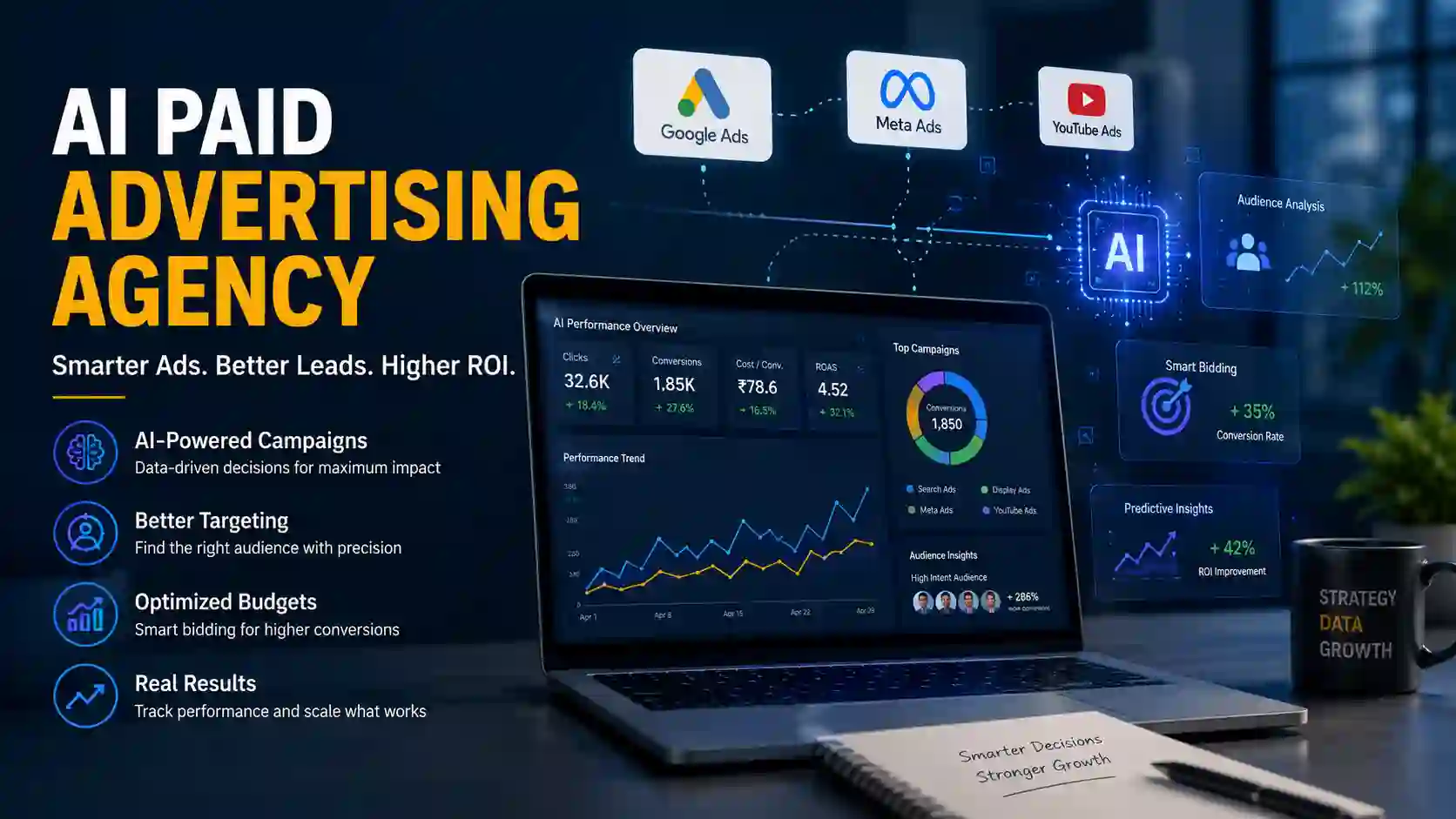
What an AI Paid Advertising Agency Actually Does for Businesses
Paid advertising looks simple from the outside. You choose a platform, put in a budget, create an advertisement and wait for leads or sales. Anyone who has actually managed campaigns for a business knows it rarely works that neatly.
An AI paid advertising agency handles the same basic advertising work, but uses artificial intelligence to analyse campaign data, identify patterns and support decisions that would otherwise take a lot of manual effort. The important point is that AI is not simply there to create advertisements. It can be involved in audience research, bidding, budget allocation, keyword analysis, creative testing, conversion tracking and campaign monitoring.
For an Indian business, this can matter quite a lot. Advertising costs can move quickly, customer behaviour differs across cities, and the same campaign can behave very differently in Delhi, Pune, Bengaluru or a smaller Tier 2 city.
A good AI paid advertising agency starts by understanding what the business actually wants from advertising. A real estate company may care about qualified site visits. A SaaS company may want product demos. A local education provider may care about admissions rather than cheap leads.
That difference is important.
Getting 500 leads does not mean much if the sales team finds that most of them are irrelevant. I have seen businesses celebrate a lower cost per lead for a few weeks and then complain that the quality of enquiries has collapsed. The advertising dashboard looked good. The sales pipeline did not.
AI can help detect such patterns faster, but it still needs proper business context.
An AI paid advertising agency may work across platforms such as Google Ads, Meta Ads and other paid channels. Depending on the business, it can also help with remarketing, shopping campaigns, lead generation campaigns, app campaigns and other paid formats.
The agency’s role is not simply to switch campaigns on and leave an algorithm to figure everything out. That approach is risky.
The better use of AI is to let technology process large amounts of campaign information while experienced marketers decide what the information actually means.
For example, suppose a B2B manufacturer in Ahmedabad is receiving enquiries through Google Ads. AI may identify that certain searches, locations, devices or times of day are producing stronger conversion patterns. The advertising team can then investigate those patterns and adjust the campaign.
Sometimes the finding is obvious. Sometimes it is not.
A campaign might generate inexpensive leads from one location but those leads may have very low purchase intent. Another location may produce fewer enquiries but much higher-value customers. Looking only at the cost per lead would lead to the wrong decision.
This is where an AI paid advertising agency can bring more depth to paid campaign management.
Why Businesses Are Moving Towards AI Paid Advertising
The biggest reason is not that businesses suddenly want more technology. It is that paid advertising has become harder to manage manually at scale.
Google and Meta already use machine learning extensively within their advertising systems. Campaigns rely on automated bidding, audience signals, conversion data and predictive models. Advertisers are therefore working with AI whether they call it AI advertising or not.
The question is how intelligently the business uses it.
A small business spending Rs 30,000 a month may not need a complicated advertising operation. But once a company starts spending several lakhs every month across different platforms, manual monitoring becomes difficult. There are too many campaigns, audiences, search terms, creatives, conversion events and performance changes to inspect one by one.
This is one reason businesses look for an AI paid advertising agency.
AI can process campaign information much faster than a person sitting in an advertising account and checking rows of numbers. It can help identify unusual changes, compare performance patterns and support decisions around budget distribution.
There is also another practical reason.
Advertising teams are under pressure to produce more creative variations. One advertisement is rarely enough anymore. Businesses need different messages for different audiences, formats and stages of the buying journey.
A jewellery brand, for example, may use different messaging for wedding jewellery, everyday jewellery and festive purchases. A single generic advertisement can easily become irrelevant to one of those audiences.
AI makes it easier to develop and test multiple variations.
But I disagree with the idea that more variations automatically mean better advertising. Sometimes ten average advertisements are worse than two carefully thought-out ones. If the underlying offer is weak, AI-generated copy will not rescue the campaign.
This is where human judgement still matters.
Indian customers can also be quite sensitive to wording. An advertisement that sounds natural to someone in Mumbai may not necessarily feel right to someone searching for a highly technical industrial product in Gujarat. Language, pricing, trust, location and buying behaviour all affect response.
AI can identify patterns in the data. It cannot always understand why a particular customer hesitated before making an enquiry.
That distinction should not be ignored.
How AI Helps Manage Google Ads, Meta Ads and Other Paid Channels
Google Ads and Meta Ads work differently, even though both are used for paid customer acquisition.
Google often captures existing intent. Someone searching for “industrial RO plant manufacturer in Delhi” already has a specific requirement. Meta advertising works differently. The person may not be actively searching for an industrial RO plant when the advertisement appears.
An AI paid advertising agency needs to understand this difference before applying automation.
On Google, AI can help analyse search terms, conversion behaviour, bidding signals, audience performance and campaign trends. It can support decisions about where money is being spent and which areas deserve more attention.
For example, if a company sells premium commercial interiors, AI may identify that searches involving specific commercial property terms produce stronger enquiries than broad searches around interior design.
That can lead to better campaign decisions.
Meta advertising brings a different challenge. Creative quality and audience signals can have a major influence on performance. AI can help compare different creative formats, hooks, headlines and audience responses.
Imagine a Bengaluru fitness business running several Meta campaigns. One advertisement talks about weight loss. Another focuses on strength training. A third promotes a free consultation.
After enough data accumulates, AI assisted analysis can help identify which combinations are generating stronger downstream actions rather than simply clicks.
The word “downstream” matters here.
A click is not a customer.
A lead is not always a customer either.
For many Indian businesses, the actual business outcome happens after the lead enters WhatsApp, receives a call, attends a meeting or speaks with a salesperson. If the advertising system only measures the first form submission, it may optimise towards the wrong people.
This is one of the areas where an AI paid advertising agency needs proper conversion tracking.
The agency should understand what happens after the advertisement generates the lead.
Other paid channels can also be evaluated depending on the business model. YouTube, shopping platforms, display networks and other advertising environments may have a role, but they should not be added simply because they are available.
I have always been cautious about businesses spreading a small advertising budget across too many platforms. It feels like diversification, but sometimes it is just fragmentation.
A focused campaign with enough useful data can be more valuable than five channels with insufficient budget and weak tracking.
Using AI to Find Better Audiences and Identify High Intent Customers
Audience targeting has changed considerably.
Advertisers once spent a lot of time manually building audience segments. Today, platforms use their own machine learning systems to identify people who are more likely to complete a desired action.
An AI paid advertising agency can work with these systems instead of trying to control every tiny targeting detail manually.
The first step is understanding what a high-quality customer looks like.
Suppose a company provides project finance consulting for infrastructure businesses. The ideal customer may not simply be anyone searching for project finance. The business may specifically want companies with sizeable projects, established promoters and a genuine financing requirement.
The difference between those two audiences can be enormous.
AI can analyse historical campaign and conversion information to find patterns associated with stronger leads. These patterns might relate to search behaviour, location, device, landing page activity, engagement or previous interactions.
But this only works properly when the underlying data is useful.
Poor data produces poor optimisation.
If a business marks every form submission as a successful conversion, the advertising system may learn to find people who submit forms, not necessarily people who are likely to buy.
This is a common problem.
A lead generation campaign for a coaching institute may receive hundreds of enquiries. But after the admissions team checks them, perhaps only a small percentage are serious prospects. If that information never reaches the advertising platform, AI has no reason to prioritise serious prospects.
This is why CRM integration and offline conversion data can become important for mature campaigns.
AI can also help identify audience overlaps and behavioural patterns that may be difficult to spot manually. A campaign might perform particularly well among a certain combination of location, device and intent signals.
The advertising team can then test the finding rather than assuming it is automatically correct.
That last part is important because AI predictions are not guarantees.
I might be wrong here if I make it sound too neat. Real advertising data is messy. Attribution can be incomplete, conversion volumes can be low and seasonal behaviour can distort what appears to be a reliable pattern.
A campaign running during Diwali can teach you very different things from a campaign running during an ordinary month.
So audience insights should be treated as evidence, not absolute truth.
AI Based Ad Copy, Creative Testing and Landing Page Decisions
Advertising creative has become one of the most visible areas where businesses use AI.
An AI paid advertising agency can use AI tools to develop different headline ideas, primary text variations, calls to action and creative concepts. These variations can then be tested against actual customer behaviour.
For a home loan company, one advertisement might focus on affordable EMIs. Another might talk about faster eligibility checks. A third may focus on buying a first home.
The best message is not always the one the marketing team personally prefers.
This is where testing becomes useful.
AI can help generate multiple variations quickly, but the campaign still needs a sensible testing process. If everything changes at the same time, it becomes difficult to know what caused the performance difference.
The same applies to visual creative.
For Meta campaigns especially, businesses may test short videos, static images, customer testimonials, product demonstrations and different opening hooks. AI can help identify which formats are getting stronger engagement or conversion signals.
But there is a trap here.
A creative can generate excellent engagement and still produce poor sales.
I have seen advertisements get plenty of clicks because the headline was interesting, while the actual offer had little relevance to the people clicking. The numbers looked exciting for a few days, then the sales team started asking uncomfortable questions.
That is the point where advertising needs to reconnect with the business.
Landing pages matter just as much.
If an advertisement promises a specific service but sends the visitor to a generic homepage, the campaign can lose momentum. AI can help analyse page behaviour, identify potential drop-off points and compare conversion patterns between different landing page versions.
For example, a Pune based B2B service company may have a landing page with six different services listed. The visitor came from an advertisement for one specific service. A more focused page may make it easier for that person to understand the offer and take the next step.
AI can support this kind of analysis, but it should not decide everything automatically.
Sometimes a page has a low conversion rate because the offer is expensive. Sometimes customers need more information before submitting an enquiry. Sometimes the traffic itself is wrong.
You have to look at the whole situation.
This is also where StratMarketer can position its AI paid advertising work around business outcomes rather than just advertising platform metrics. The useful question is not simply how many clicks an advertisement received. It is what those clicks eventually became.
A campaign generating 100 leads at Rs 500 each may appear cheaper than one generating 40 leads at Rs 1,200 each. But if the second campaign produces eight paying customers while the first produces one, the cheaper campaign is not actually cheaper in any meaningful business sense.
That is the sort of calculation that should sit behind paid advertising decisions.
And sometimes the answer is uncomfortable. A campaign may simply not deserve more money, even if the dashboard has a few attractive numbers sitting on it.
Managing Advertising Budgets, Bidding and Campaign Performance with AI
Advertising budgets are where paid campaigns become serious. A business can survive a weak headline for a while. It cannot keep wasting Rs 5 lakh every month and call it testing.
An AI paid advertising agency can use machine learning and campaign data to support budget allocation, bidding decisions and performance monitoring. Google and Meta already have automated bidding systems, so the real role of the agency is often deciding where automation should be trusted, where it should be restricted and what business signals should feed it.
Suppose an Indian ecommerce company has Rs 10 lakh available for monthly advertising. The obvious approach might be to divide the money equally between Google and Meta. But equal allocation does not necessarily make sense. If Google is producing fewer purchases but a much higher average order value, while Meta is generating plenty of low value orders, the budget needs to reflect that difference.
AI can help identify these patterns much faster.
Bidding is another area where automation can be useful. Depending on the campaign and conversion volume, automated bidding can adjust bids based on signals such as device, location, time, user behaviour and likelihood of conversion. An AI paid advertising agency can monitor whether these systems are actually moving the campaign towards the intended outcome.
But I would not blindly trust automated bidding.
That sounds slightly contradictory after everything said earlier, but it matters. Automation is powerful when it has enough reliable conversion data. When tracking is broken or conversion volume is too low, the system can optimise around the wrong signal.
A campaign may also look profitable in the advertising dashboard while the actual business numbers tell another story. For lead generation businesses, this happens regularly when sales data is not connected with advertising data.
AI can help flag unusual movements in cost per lead, conversion rate, click through rate, return on ad spend and other campaign indicators. The marketer still needs to investigate why the change happened.
Was the competition higher?
Did the landing page change?
Did a competitor launch a stronger offer?
Did the sales team stop responding to leads?
Or did the campaign simply enter a poor learning period?
There is no single number that answers all of this.
One practical habit I prefer is looking at campaign performance alongside actual sales data. If an automobile dealership in Chandigarh gets 200 leads and only 12 people actually visit the showroom, the advertising team should not celebrate the 200 leads for too long. Something further down the funnel needs attention.
Sometimes the advertising is fine.
Sometimes it is not.
That is why budget decisions should be made with some patience but not endless patience. If a campaign has consumed meaningful money without producing useful commercial signals, continuing only because “AI needs more data” can become an excuse.
Common Paid Advertising Mistakes Businesses Still Make
The first mistake is usually poor tracking.
Businesses spend money on Google Ads or Meta Ads and then realise weeks later that the conversion event was configured incorrectly. A form submission may be counted twice. A WhatsApp click may be treated as a completed lead. Purchases may not be recorded properly.
AI cannot fix a measurement problem simply by being more intelligent.
If the input is wrong, the optimisation can also go wrong.
Another common issue is chasing cheap leads. This is especially visible in Indian lead generation campaigns where businesses advertise services such as real estate, education, insurance, finance, healthcare and professional consulting.
A lead costing Rs 150 can look fantastic until the sales team starts calling.
Then the complaints come.
“Nobody is picking up.”
“They are asking for a free consultation but have no budget.”
“Most enquiries are from outside our service area.”
These are not advertising metrics alone. They are business problems that advertising has exposed.
Another mistake is changing campaigns too frequently. A business sees a poor result after three days, changes the audience, changes the advertisement, changes the budget and then changes the landing page. After two weeks, nobody knows what actually worked.
AI needs stable enough conditions to identify useful patterns.
I also dislike the habit of copying competitors too closely. Seeing another company run a particular advertisement does not mean the same offer will work for your business. Their brand reputation, pricing, audience and sales process may be completely different.
Then there is the obsession with clicks.
Clicks are easy to report. Revenue is harder.
A campaign with a high click through rate can still be commercially weak. An advertisement may be attracting curiosity instead of buying intent. This is particularly common when the creative uses exaggerated claims or overly broad messaging.
Another issue is sending every visitor to the homepage.
Someone searches for a specific service, clicks a relevant advertisement and lands on a page containing twenty different things. The visitor has to figure out what the company actually wants them to do.
That friction matters.
There is also a tendency to believe that AI generated copy is automatically better. It is not. Sometimes the copy becomes generic, over enthusiastic or strangely formal. Indian customers are not stupid. They can tell when an advertisement sounds like it was written without understanding the product.
And one more thing. Do not change a winning campaign just because the dashboard has been flat for two days.
Paid advertising has natural fluctuations.
At the same time, don’t keep calling a bad campaign a “learning phase” for months. That is where I have some irritation with the way automation is sometimes sold. Technology can assist judgement, but it cannot replace the responsibility to make a decision.
How to Choose the Right AI Paid Advertising Agency for Your Business
Choosing an AI paid advertising agency should start with the business model, not the technology.
Ask what the agency actually plans to optimise.
If the answer is simply “more leads” or “lower CPC”, I would ask a few more questions.
A good agency should want to know what happens after a lead arrives. What qualifies as a good lead? How long does the sales process take? What is the average customer value? Which products or services are more profitable? Which cities can the business actually serve?
These questions may feel unrelated to advertising at first. They are not.
Suppose a company sells industrial machinery with an average order value of Rs 25 lakh. A paid advertising strategy for that business cannot be evaluated in the same way as a D2C company selling Rs 1,000 products.
The buying cycle is different. The audience is different. The number of conversions will be different.
So the agency needs to understand the economics.
You should also ask which platforms they have experience managing. Google Ads and Meta Ads are obvious, but the right mix depends on the customer journey.
Ask how they handle tracking.
Ask how often they review campaigns.
Ask what happens when performance drops.
And ask whether you will have access to your own advertising accounts. I strongly prefer businesses retaining ownership of their Google Ads, Meta Ads and analytics assets. There is no good reason for a client to be locked out of its own advertising infrastructure.
Another useful question is how the agency reports performance.
A monthly report containing impressions, clicks and generic percentages is not enough. You should be able to understand where money went, what it generated and what changed because of the work.
The agency should also be willing to tell you when something is not working.
That sounds obvious, but it is surprisingly important.
I would rather work with an agency that says, “This campaign is not giving us enough quality leads, so we should rethink the offer,” than one that keeps sending polished reports explaining why poor performance is somehow positive.
Technology should make the analysis sharper, not the excuses more sophisticated.
How StratMarketer Supports Businesses with AI Paid Advertising
StratMarketer approaches AI paid advertising around campaign performance, customer intent and business outcomes rather than treating AI as a replacement for marketing judgement.
The work can involve Google Ads, Meta Ads and other paid advertising channels depending on where a particular business is likely to find customers.
The first area is campaign planning.
Before increasing budgets, the advertising team needs to understand the product, target market, location, pricing and conversion process. A local service business in Pune may need a very different advertising setup from an ecommerce brand selling across India.
Then comes campaign execution.
AI assisted research can help identify useful audience signals, search patterns, creative ideas and performance trends. Campaign data can be reviewed to understand which advertisements and audience combinations are producing useful responses.
Budget allocation can then be adjusted based on actual performance rather than simply dividing money equally between campaigns.
Creative testing is another part of the process. Different headlines, messages, formats and offers can be tested to understand what customers respond to. The point is not to create endless advertisements. It is to find meaningful differences between messages.
For lead generation businesses, lead quality is especially important.
If possible, advertising data should be considered alongside CRM and sales information. A lead that becomes a qualified opportunity should carry more importance than someone who submitted a form accidentally.
This is where the work becomes more connected to the business itself.
StratMarketer can also review landing page performance and conversion paths. If advertisements are getting traffic but visitors are not taking the intended action, the problem may not be the advertisement alone.
Maybe the landing page is too confusing.
Maybe the offer is weak.
Maybe the pricing information is missing.
Maybe the wrong audience is being attracted.
Those possibilities need to be tested rather than guessed.
Performance reporting should also give the business a clearer view of what is happening with its advertising spend. That means looking beyond impressions and clicks and paying attention to leads, conversions, acquisition costs and revenue where reliable data is available.
AI helps process and interpret campaign information at scale. Human experience is still needed to decide what should happen next.
That distinction matters.
A good advertising account can still perform badly if the business has an unclear offer. No amount of automation can completely solve that.
Frequently Asked Questions About Hiring an AI Paid Advertising Agency
What does an AI paid advertising agency do?
An AI paid advertising agency manages paid campaigns using advertising platforms, automation and AI assisted analysis. Its work can include audience research, campaign setup, bidding, budget management, creative testing, conversion tracking and performance analysis.
Is AI better than a human advertising manager?
Not by itself. AI is very good at processing large amounts of information and identifying patterns. A human still needs to understand the business, question the data and make practical decisions.
Can an AI paid advertising agency manage Google Ads and Meta Ads?
Yes. Many agencies manage both platforms, although the strategy should not be identical. Google often captures existing search intent, while Meta relies more heavily on creative, audience signals and user behaviour.
How much should a business spend on paid advertising?
There is no sensible universal amount. It depends on the product, customer value, sales cycle, competition and available budget. A business should have enough budget to generate meaningful data without spending money it cannot afford to lose.
Can AI reduce advertising costs?
It can help identify inefficient spending and improve campaign decisions, but lower costs are not guaranteed. Sometimes spending more on a higher quality audience produces better commercial results than chasing the lowest possible cost per click.
How long does it take to see results?
Some campaigns generate useful signals within days, while others need several weeks because the purchase cycle is longer or conversion volume is low. I would be cautious about anyone promising a fixed result within a few days.
Should businesses focus only on AI paid advertising?
Not necessarily. Paid advertising works best when it fits the wider customer acquisition process. Organic search, content, referrals, email, sales follow-up and other channels may also matter depending on the business.
What should I ask an AI paid advertising agency before hiring them?
Ask about their experience with businesses like yours, conversion tracking, reporting, account ownership, budget management, lead quality and how they respond when campaigns underperform. Also ask who will actually manage the account.
That last question is worth asking twice.
Because sometimes the person selling the service is not the person managing your campaigns, and that difference can become very obvious after the first difficult month.
Is hiring an AI paid advertising agency suitable for a small business?
It can be, but not every small business needs an agency. If your advertising budget is very limited and your campaigns are simple, managing them internally may make more sense. An agency becomes more useful when campaign complexity, competition or advertising spend reaches a point where experienced management can justify its cost.
Paid advertising is still paid advertising, even when AI is involved. Money leaves the account every time the campaign finds a click, so the fundamentals cannot be ignored.
And perhaps that is the part businesses should remain slightly uncomfortable about. The technology can become smarter, the dashboards can become more sophisticated, but someone still has to ask whether the money being spent is actually creating a business worth having.