


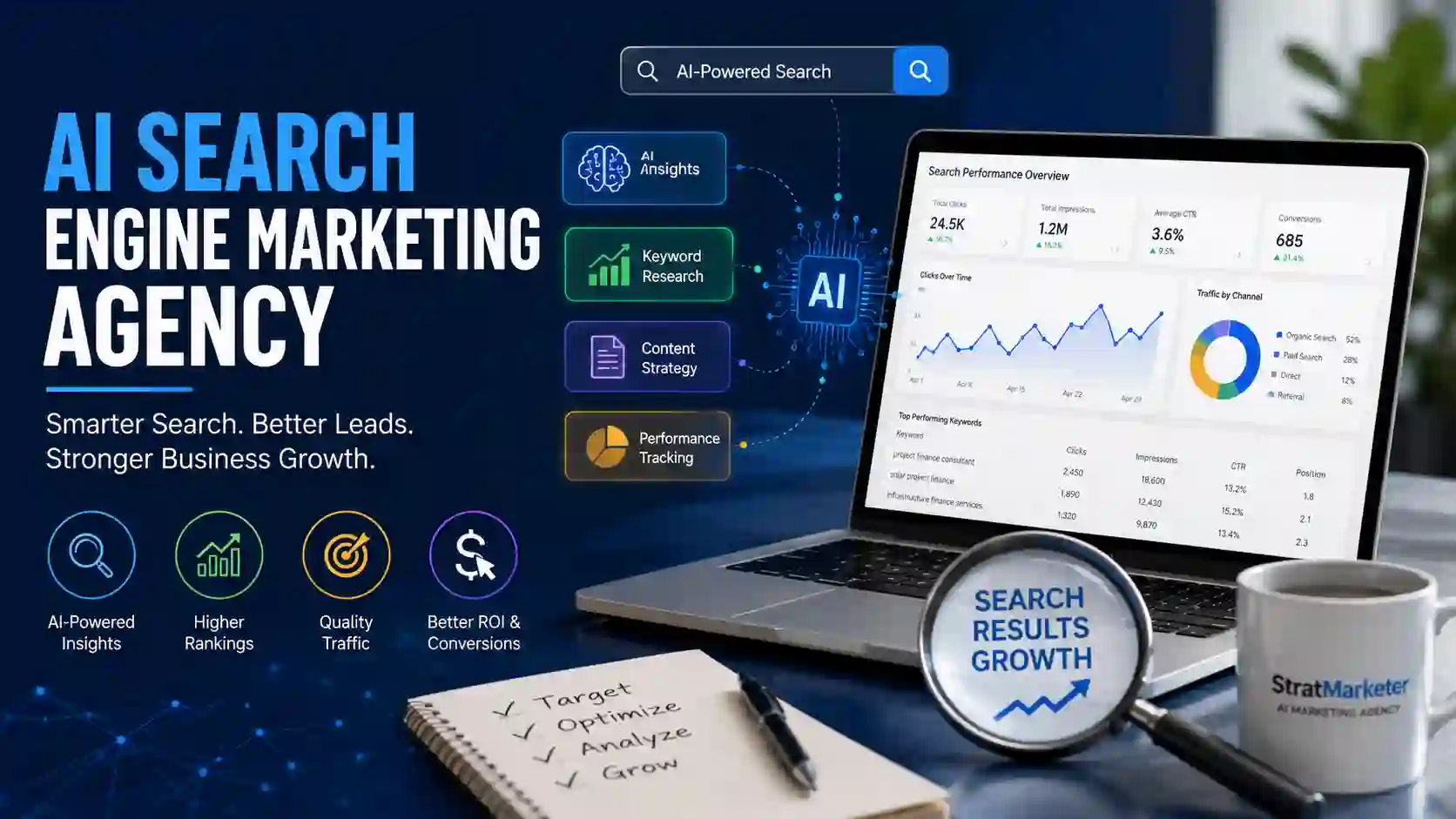
AI Search Engine Marketing Agency: How AI Is Changing Search Marketing for Indian Businesses
Search marketing used to be fairly predictable. A business would identify keywords, create landing pages, optimise website content, run Google Ads, check rankings and leads, then make changes based on what the numbers showed.
That process still works, but search itself is no longer behaving in such a simple way.
People are asking longer questions, comparing several businesses before making contact, using conversational searches, and increasingly getting answers without visiting ten different websites. At the same time, search advertising platforms are using machine learning to decide bids, audiences, placements and even which creative combinations should be shown.
This is where an AI search engine marketing agency becomes useful.
The point is not simply to put AI tools into an existing marketing process and call it modern. That rarely works well. AI can process large amounts of search data quickly, spot patterns and help marketers test ideas, but someone still has to understand the business, customers, margins, location and commercial priorities.
For an Indian business, that distinction matters. A manufacturing company in Pune does not have the same search behaviour as a D2C skincare brand selling across India. A solar project consultant targeting developers has a very different buying journey from a local dental clinic.
The technology may be similar. The marketing decisions are not.
What an AI Search Engine Marketing Agency Actually Does
An AI search engine marketing agency uses artificial intelligence and automation alongside conventional SEO and paid search methods to understand search behaviour, identify opportunities, manage campaigns and interpret performance.
That sounds straightforward until you see what actually happens behind the scenes.
Take keyword research. Traditional research might produce hundreds or thousands of keywords based on search volume and competition. AI can go further by grouping related searches around intent. Someone searching “solar project finance consultant India” is probably in a very different stage from someone searching “what is solar project finance”.
That difference affects the content, landing page and conversion strategy.
An AI search engine marketing agency may also analyse existing website content and identify pages that overlap with one another. This is particularly common on larger Indian business websites where several service pages slowly start targeting almost the same phrases.
The result can be confusing search signals.
AI can flag these relationships quickly, but I would not let software decide which page should be removed or merged without human review. Commercial context is too important. One page may be ranking for an important service variation that does not look significant in a spreadsheet.
The same principle applies to paid search.
AI based advertising systems can adjust bids, identify patterns in conversions and help allocate budget according to campaign signals. But if the tracking is wrong, the automation simply becomes very efficient at making decisions from bad information.
That is one of the things businesses often underestimate.
A campaign can look sophisticated while the underlying conversion data is completely unreliable.
An AI search engine marketing agency therefore has to work across several connected areas, including search research, SEO, paid search, content, conversion tracking, landing pages and performance analysis.
It is less about replacing marketers and more about giving them better ways to handle the volume of information involved.
How AI Is Changing Search Engine Marketing for Indian Businesses
Indian search behaviour has its own complications.
People commonly move between English and regional language searches. They may search using a service name, a location, a problem statement or a question about pricing. A business owner may search on a laptop in English during office hours and later use a much more conversational query from a phone.
AI is useful here because it can analyse large sets of queries and identify relationships that are difficult to spot manually.
For example, a financial consultancy targeting project developers might see searches around “project finance companies”, “project finance consultants”, “loan for infrastructure project”, “solar project financing” and “bankable project report”. These are not necessarily separate audiences. They can represent different stages of the same commercial journey.
An AI search engine marketing agency can map these patterns against the website and campaign structure.
This also changes how content is planned.
Instead of creating one article for every slightly different keyword, marketers can look at the underlying question and build a stronger piece of content that addresses several closely related searches. That generally makes more sense for users too.
There is another change that is easy to miss.
Search results are becoming more answer oriented. People increasingly expect search engines to understand what they mean rather than simply match exact words.
That does not mean old SEO is dead. It is not.
Technical SEO, links, page experience, crawlability, structured content and relevance still matter. But exact keyword placement by itself is becoming a weaker way of thinking about search.
An Indian B2B company can see this very clearly. Its potential customer may search five or six times before submitting an enquiry. One search might be educational. Another might compare consultants. A later search might include a location or service-specific term.
If marketing only tracks the last keyword that generated the lead, a large part of that journey disappears.
AI can help connect those signals.
Still, there is a limit. I have seen businesses become so interested in AI generated reports that nobody asks whether the leads are actually worth pursuing. That is a problem. A dashboard full of numbers does not tell you whether sales is speaking to serious buyers.
Using AI for Keyword Research, Search Intent and Content Planning
Keyword research has always been one of the more time consuming parts of search marketing.
The difficult part is not finding keywords. Most tools can generate plenty of them.
The difficult part is deciding what they mean.
Suppose a company sells industrial machinery. Searches such as “industrial machinery manufacturer”, “industrial machinery price”, “best industrial machinery”, “industrial machine suppliers India” and a very specific equipment model may all have commercial value, but not necessarily the same value.
An AI search engine marketing agency can analyse these terms together with search intent, existing rankings, competitors and the site’s current content.
AI is particularly useful for clustering.
Instead of manually sorting hundreds of phrases into groups, marketers can use machine learning and language models to identify semantic relationships. That can reveal that several seemingly separate keywords belong on one service page, while another group deserves its own page because the user intent is different.
This helps avoid a common SEO mistake.
Publishing dozens of thin pages simply because there are dozens of keyword variations.
I prefer fewer useful pages over a pile of pages that only exist to catch search traffic. It is not always the fastest way to increase the number of indexed URLs, but it tends to make more sense for a serious business.
AI can also help identify content gaps.
A competitor may have useful information about financing requirements, project costs, approval processes or industry terminology that your website does not cover. AI can compare content themes and highlight missing areas.
But there is a danger here too.
If every business uses AI to copy the same competitor topics, search results become filled with almost identical articles. The content may be grammatically fine and technically optimised, but it gives the reader very little reason to trust one company over another.
Real experience becomes important.
For an Indian consulting business, that could mean explaining why a bank rejected a project proposal because the assumptions were poorly documented. For a healthcare business, it could mean addressing a common patient concern that repeatedly comes up during enquiries. For a manufacturer, it could mean explaining a procurement mistake that costs buyers time.
Those details are difficult to manufacture convincingly.
AI can help organise the research. It cannot replace actual business knowledge.
How AI Helps Manage SEO and Paid Search Campaigns Together
SEO and paid search are often handled as separate activities.
One team works on organic rankings. Another runs Google Ads. The reports arrive separately and everyone moves on.
That is not always sensible.
Search behaviour can provide useful information for both channels. Paid campaigns can show which search terms generate enquiries quickly. Organic search can reveal questions and topics that deserve long term content investment.
An AI search engine marketing agency can bring these signals together.
Suppose a company spends heavily on a particular commercial keyword in Google Ads and discovers that it generates good leads but has an expensive cost per enquiry. That information can influence SEO priorities. If the business can eventually build strong organic visibility for the same intent, some dependency on paid traffic may reduce.
The reverse can happen too.
A page may rank organically for a keyword but generate very few enquiries. Paid search data might show that another wording converts better. That can prompt a review of the page title, copy, offer or landing page.
AI can help identify these relationships faster.
On the advertising side, machine learning is already deeply integrated into major advertising platforms. Automated bidding, audience signals, conversion optimisation and creative testing are not experimental concepts anymore.
But automation needs good inputs.
Imagine an education company tracking every brochure download as a conversion, even though only a small percentage of those people ever become genuine prospects. The advertising platform sees lots of conversions and may optimise towards the wrong behaviour.
The campaign can become cheaper per conversion while the actual business outcome gets worse.
That is why I am cautious about treating AI campaign optimisation as something that can simply be switched on.
Tracking needs to reflect commercial reality.
Lead quality, qualified enquiries, booked meetings, sales opportunities and eventually revenue can be much more useful than raw form submissions, depending on the business.
This is particularly relevant for B2B companies where one high value customer may be worth more than hundreds of low quality enquiries.
And yes, sometimes the old fashioned approach of calling the sales team and asking, “Which leads were actually useful?” tells you more than an impressive report.
AI Search Engine Marketing for Google, Bing and AI Search Platforms
Google remains central to search marketing, but businesses now have to think about a wider search environment.
People still use conventional search engines for product research, services and local businesses. At the same time, conversational AI platforms are increasingly being used for research, comparisons and recommendations.
That creates a more complicated question for marketers.
It is no longer enough to ask, “Are we ranking for this keyword?”
A better question may be, “When someone researches this problem, how does our business appear across the places where they are looking for answers?”
An AI search engine marketing agency may therefore examine conventional rankings, paid search visibility, branded searches, business information, content authority and the likelihood that useful company information can be understood by AI systems.
Google and Bing have their own approaches to search, advertising and AI features. The exact presentation of results can change over time, and marketers need to keep watching rather than assume one fixed format will remain.
This is where I might be wrong here, because AI search behaviour is still developing and it does not apply everywhere in the same way. Some industries are seeing much more conversational research than others. A person looking for a simple local service may still behave almost exactly as they did several years ago.
So businesses should not throw away conventional SEO just because AI search has become a popular topic.
That would be an expensive mistake.
A strong website still needs useful service pages, clear company information, technically sound pages and credible content. Search engines and AI systems both need reliable information to understand what a business does.
There is also a practical issue with AI generated answers. If an AI system summarises information about a company, the underlying sources still matter. Poor, outdated or contradictory information can create confusion.
For Indian businesses, consistency is especially important where company names, service descriptions, locations and contact details appear across different online properties.
A consulting company might describe itself as a “project finance consultant” on one page, “financial advisor” on another and “investment consultant” somewhere else. These phrases are not necessarily wrong, but if the core service is never explained clearly, both users and search systems have to work harder to understand the business.
That is not a keyword problem.
It is a clarity problem.
And sometimes those are the problems that take the longest to fix because nobody noticed them when the website was being built.
Common Search Marketing Mistakes Businesses Still Make
Search marketing looks easier from the outside than it actually is. A business owner sees competitors appearing on Google, notices a few ads at the top, then assumes the main job is to publish more content and increase the advertising budget.
Usually, it is not that simple.
One of the most common mistakes is chasing search volume instead of commercial intent. A keyword may receive thousands of searches but produce almost no useful enquiries. Another phrase may have modest search volume and bring three serious prospects in a month. For a B2B company, those three prospects can matter much more.
I have seen this happen with service businesses where the marketing team celebrates traffic growth while sales quietly complains that the enquiries are irrelevant. That disconnect is frustrating because both sides can technically be correct. Traffic has increased. Leads have increased. The business still has not improved.
An AI search engine marketing agency can help identify these patterns, but only if the campaign is built around meaningful business outcomes.
Another mistake is creating too many pages around almost identical keywords. Businesses sometimes publish separate pages for every city, service variation and keyword combination without adding genuinely different information. Eventually, the website becomes repetitive.
It looks busy.
It does not necessarily become useful.
There is also excessive dependence on AI generated content. AI can produce an article in minutes, but speed is not the same thing as credibility. If ten competing businesses publish nearly identical content about the same service, none of them has created much of a reason for a customer to choose them.
Indian businesses sometimes make another practical mistake by targeting the whole country when their actual service area is much narrower. A consultant serving clients in Mumbai, Pune and Bengaluru may spend money chasing national search traffic even though the sales team cannot realistically handle enquiries from every state.
Location targeting needs commercial logic.
Technical issues are another quiet problem. Slow pages, broken internal links, poor mobile experiences, duplicate content, weak page titles and incorrectly configured tracking can undermine otherwise good campaigns.
Then there is the habit of changing everything too quickly.
A campaign runs for two weeks, rankings move slightly, somebody gets nervous, keywords are changed, landing pages are rewritten and the previous data becomes difficult to interpret. Search marketing needs experimentation, but constant disturbance makes it difficult to understand what actually caused an improvement or decline.
I strongly prefer making fewer meaningful changes and giving them enough time to produce useful evidence.
That does not mean waiting forever. If an ad is wasting money, stop it. If tracking is broken, fix it immediately. The problem is changing five variables at once and then pretending the results tell a clear story.
How to Measure Leads, Rankings, Traffic and Campaign Performance
The right measurement system depends heavily on the business.
For an ecommerce company, revenue and transaction data may be relatively straightforward. For a project finance consultancy, legal firm or industrial equipment supplier, the journey can be much longer. Someone might read three pages, submit an enquiry, speak to a consultant, request documents and only become a customer several weeks later.
Looking only at traffic will miss most of that story.
An AI search engine marketing agency should ideally connect search activity with actual business outcomes. That can include qualified leads, calls, enquiry forms, booked consultations, sales opportunities and revenue where the tracking setup allows it.
Rankings still have value.
They help show whether the website is gaining visibility for relevant searches, but rankings should not become the final score. A page ranking number one for an informational query that never produces customers is not necessarily more valuable than a page ranking fourth for a highly commercial search.
Traffic is similar.
More visitors sound good, but 20,000 visitors with poor intent may be less useful than 2,000 visitors who are genuinely looking for the service.
I would normally look at several layers of information together. Search visibility tells you whether people can find the business. Organic traffic shows whether they are visiting. Engagement gives some indication of what they do after arriving. Conversion data shows whether they take meaningful actions. Sales information tells you whether those actions have commercial value.
There is another metric that deserves more attention than it gets.
Lead quality.
Imagine two campaigns. Campaign A generates 100 enquiries at a low cost. Campaign B generates 20 enquiries at three times the cost. If the first campaign produces only two serious opportunities while the second produces eight, the cheaper campaign may actually be the weaker one.
This is why an AI search engine marketing agency should not report only cost per lead.
Cost per qualified lead can be much more useful.
For paid search, businesses should also examine impression share where relevant, click through rates, conversion rates, cost per conversion, search terms and the quality of resulting enquiries. For SEO, the focus may include relevant rankings, organic conversions, indexed pages, content performance and technical health.
Not every number deserves a dashboard.
That is another mistake I see. Businesses collect dozens of metrics because analytics platforms make them available. Then nobody knows which five actually matter.
A smaller report with useful information is usually better.
Why Businesses Need Human Expertise Alongside AI Tools
AI is very good at processing information.
It can identify patterns across thousands of search queries, group related topics, compare content, summarise campaign performance and assist with repetitive optimisation tasks.
But search marketing is not only a data problem.
Suppose an AI system recommends increasing spend on a keyword because it has a strong conversion rate. A human marketer might notice that most of those conversions are low value enquiries from students, competitors or people looking for free information.
The recommendation may be statistically reasonable and commercially wrong.
This is why human judgement remains important.
Someone needs to understand what the company actually sells, how customers make decisions, which services have healthy margins and which enquiries waste the sales team’s time.
This matters even more in sectors with long buying cycles.
A manufacturing buyer may spend months evaluating suppliers. A renewable energy developer may require financial modelling, technical documents and several rounds of discussion before moving forward. A professional services firm may receive only a handful of enquiries each month, but each one could be commercially significant.
AI does not automatically understand those realities.
It can learn from historical data, but if the historical data itself reflects poor marketing decisions, the system may simply reproduce those patterns.
That is one reason I would be uncomfortable handing an entire search strategy over to automation. The technology is useful, sometimes extremely useful, but someone experienced still needs to question its recommendations.
There is also the issue of brand and reputation.
A machine can suggest hundreds of content ideas. It cannot always recognise that one topic is inappropriate for a particular company or that a technically accurate statement could sound irresponsible in the context of that business.
Human review matters.
So does restraint.
Not every opportunity identified by AI needs to be pursued. Sometimes the smartest decision is to leave a keyword alone.
How StratMarketer Supports Businesses with AI Search Engine Marketing
StratMarketer approaches AI search engine marketing as a combination of technology, search expertise and business understanding rather than as an automated publishing exercise.
The work can begin with understanding how a business currently appears across search. That means looking at relevant queries, organic visibility, paid campaigns, existing content, landing pages and conversion tracking.
From there, opportunities can be identified around keyword intent and content.
For example, a business may have strong visibility for general informational searches but very little presence around high intent service terms. Another company may have good rankings but weak landing pages that fail to turn visitors into enquiries.
Those are two very different problems.
AI can help analyse the information faster, while marketers can decide what deserves attention.
For paid search, the same principle applies. Campaign structures, search terms, bidding signals, budgets, conversion actions and landing pages need to work together. If the business is generating leads but the sales team says most of them are poor quality, the strategy needs to reflect that feedback.
StratMarketer can also use AI to support content research and planning. The goal should be to understand what people are actually asking and then produce useful information around those questions rather than stuffing articles with repeated phrases.
Search platforms are changing, and content needs to remain understandable across different forms of search.
That includes conventional Google results, Bing and newer AI assisted search experiences.
Still, there is no sensible reason to abandon basic SEO. A business needs clear information about its services, strong pages, useful content and reliable technical foundations before worrying about every new search interface.
The exact mix of SEO, paid search, content and AI assisted optimisation will depend on the business.
A local service company may need a very different approach from an Indian B2B manufacturer selling internationally.
That is where strategy matters more than the tool itself.
Frequently Asked Questions About Hiring an AI Search Engine Marketing Agency
What does an AI search engine marketing agency do?
It combines AI tools with SEO, paid search, content planning, search analysis and campaign management. The purpose is to understand search behaviour more efficiently and make better marketing decisions.
Is AI replacing SEO?
No. AI is changing how SEO is researched and managed, but technical SEO, useful content, authority, relevance and good website experience still matter.
Can AI guarantee higher Google rankings?
No. Anyone promising guaranteed rankings should make you cautious. Search results depend on many factors that cannot be controlled completely.
Is an AI search engine marketing agency suitable for small businesses?
It can be, provided the strategy matches the business size and budget. A small company does not need a complicated AI setup if it only receives a few relevant enquiries each month.
Should businesses stop using Google Ads because of AI search?
No. Google Ads remains an important source of paid search traffic for many businesses. AI changes how campaigns are managed, but paid search still has a role.
How long does SEO take to produce results?
There is no reliable universal timeline. Competition, website condition, content quality, authority and the market all matter. Some changes can produce movement relatively quickly, while meaningful organic growth may take much longer.
Can AI write all my website content?
It can assist with research and drafting, but I would not recommend publishing everything without human review. Website content needs to reflect the company’s actual expertise and customers.
What should I check before hiring an AI search engine marketing agency?
Ask how they define a qualified lead, how they measure performance, what access they need to analytics and advertising accounts, how human review is handled and how they report results.
Also ask what happens when the numbers look good but sales disagrees.
That answer tells you quite a lot about how the agency thinks.
Does every business need AI search marketing?
Not necessarily.
Some businesses have very small search demand, rely mainly on referrals or operate in markets where search contributes little to sales. AI tools can still save time, but that does not automatically justify a large search marketing programme.
What is the biggest mistake businesses should avoid?
Treating AI as the strategy.
AI is a tool. The strategy still needs to come from understanding customers, commercial priorities and the way people actually search for the service.
And that distinction is probably going to become even more important as search keeps changing.