


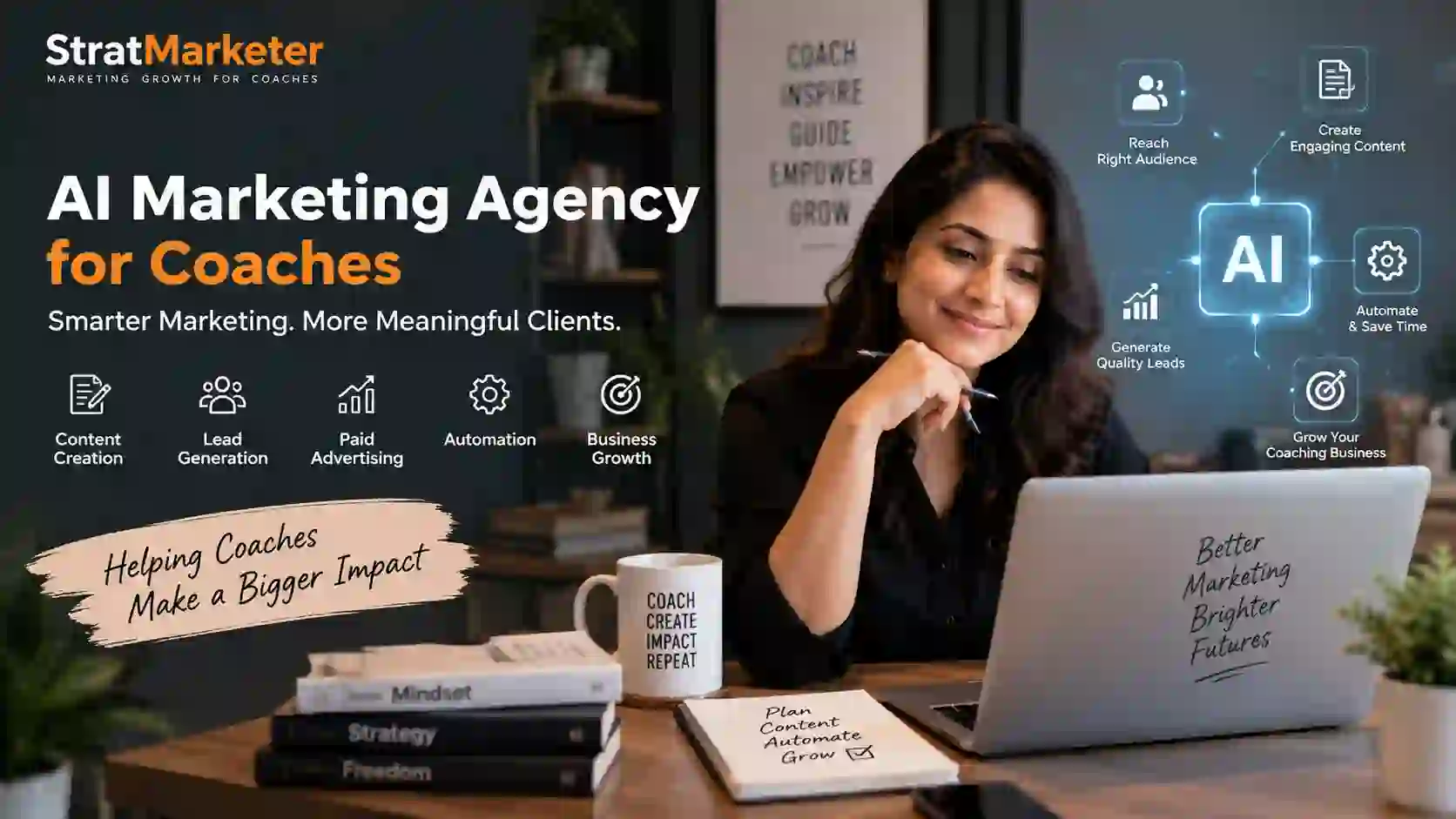
AI Marketing Agency for Coaches | Grow Your Coaching Business
Why Coaches Are Turning to AI for Marketing Support
Coaching is a personal business. People do not usually hire a business coach, life coach, fitness coach or career coach just because they saw a perfectly designed advertisement. They want to feel that the person understands their problem. This is where marketing becomes slightly uncomfortable for many coaches. They know how to help clients, but explaining their value consistently online is another matter.
An AI marketing agency for coaches can help reduce some of this pressure. AI is being used to analyse audience behaviour, generate content ideas, organise leads, personalise communication and support advertising decisions. It does not replace the coach. At least, I do not think it should. The coach still brings experience, judgement and personality.
What has changed is the amount of work that can now be handled with technology.
A coach in India might spend three hours thinking about what to post on LinkedIn, another hour replying to enquiries, and then forget to follow up with someone who attended a webinar last week. This happens more often than people admit. An AI marketing agency for coaches can bring these scattered activities into a more organised marketing process.
There is also the problem of consistency. Many coaches start marketing with energy and disappear after two weeks because client sessions take priority. Content stops. Follow-ups stop. Ad campaigns are left running without proper review. The business becomes dependent on referrals again.
Referrals are valuable, of course. But depending entirely on them can make growth unpredictable.
This is one reason coaches are looking at AI based marketing support. They are not always searching for more technology. Sometimes they simply want fewer repetitive tasks on their plate.
I have also noticed that coaches are becoming more aware that generic marketing does not work particularly well for high trust services. A life coach targeting working women in Delhi needs a different conversation from an executive coach working with startup founders in Bengaluru. AI tools can help process audience signals and content patterns, but someone still needs to understand the business behind those signals.
That human part matters more than many AI companies seem willing to admit.
An AI marketing agency for coaches can combine automation with marketing judgement. Ideally, the technology handles repetition while the marketing strategy remains connected to what real people are asking, worrying about and struggling with.
Still, AI is not a shortcut to a successful coaching business. Some agencies make it sound almost magical. Upload a few prompts, create fifty posts and leads will supposedly start arriving. In reality, weak positioning remains weak positioning, even when AI writes it faster.
That part can be frustrating.
For coaches who already have a clear offer and some understanding of their audience, though, AI can make marketing more manageable. It can help them spend less time doing repetitive promotional work and more time improving their actual coaching practice.
What an AI Marketing Agency for Coaches Actually Does
The phrase AI marketing agency for coaches can sound vague because almost every marketing company now claims to use AI in some form. Simply using an AI writing tool does not automatically make an agency an AI marketing agency.
For coaches, the role should be broader.
An agency may use AI to study search trends, identify content opportunities, review advertising performance, segment leads and automate parts of the customer journey. It may also help create content drafts, analyse which topics receive engagement and identify patterns in enquiries.
But the output should still connect to the coach’s actual business.
For example, consider a career coach receiving leads through Instagram. Some people may enquire about interview preparation, while others may be looking for long-term career guidance. Treating both groups exactly the same can lead to poor follow-up. An AI marketing agency for coaches can help create different communication paths based on the type of enquiry.
This is not complicated in theory, but implementation is where many businesses struggle.
The agency may also support areas such as:
- AI assisted content planning
- Audience research
- SEO and search content
- Paid advertising analysis
- Lead qualification
- Email automation
- WhatsApp communication workflows
- Landing page optimisation
- CRM automation
- Content performance tracking
Not every coach needs all of these.
In fact, I would be cautious of an agency that immediately pushes every possible service. A new wellness coach with a small audience may need help clarifying their offer and creating a simple lead system before investing heavily in advanced automation.
An established executive coaching business may have the opposite problem. They may already receive enquiries but struggle to manage, categorise and follow up with them properly.
The same AI solution will not fit both situations.
A good AI marketing agency for coaches should first understand where the actual bottleneck exists. Is the coach struggling to get visibility? Are people visiting the website but not booking calls? Are leads coming in but going cold? Is content being created without generating relevant enquiries?
These questions matter more than the tools being used.
There is another benefit that is sometimes overlooked. AI can make reporting and decision-making easier to understand. Coaches often receive marketing reports filled with impressions, clicks and other numbers without knowing what they actually mean for their business.
A useful agency should connect activity with practical outcomes.
Did more qualified people book calls?
Which content brought relevant enquiries?
Which advertising message attracted people who were actually suitable clients?
Those are more useful questions.
AI can process large amounts of marketing data, but numbers alone do not explain human decisions. That is where agency experience still comes in.
Where AI Can Help Coaches Find and Understand Their Ideal Audience
One of the biggest mistakes in coaching marketing is trying to speak to everyone.
A coach may say they help people improve their lives, careers or businesses. That sounds positive, but it is difficult to market. People need to understand why the coaching service is relevant to them.
An AI marketing agency for coaches can support audience research by looking at search behaviour, content engagement, enquiry patterns and customer interactions. This can help identify recurring questions and concerns.
For instance, a business coach may assume that their audience wants information about scaling revenue. After analysing search queries and social media conversations, they may find that potential clients are actually more worried about hiring their first management team.
That difference changes the marketing message.
The same applies to a fitness coach. Their audience may not be searching for “personalised fitness transformation”. They may be searching for practical problems such as how to stay consistent with exercise while working long hours.
Marketing often becomes better when the language becomes more ordinary.
AI can also help group audience patterns. A coaching website may receive visitors from different industries, locations and stages of decision-making. Instead of presenting the same message to everyone, marketing can be adapted around common audience groups.
However, this is where I have a concern.
AI can identify patterns, but it can also create false confidence. A dataset may suggest that a certain audience is interested in a topic, while the actual people behind the data have a completely different reason for engaging with it.
I might be wrong here, but I would never recommend relying only on automated audience insights.
A coach should still speak directly with prospects. Sales calls, discovery calls and client feedback often reveal things that marketing software cannot. The exact words people use when describing their problems can be more useful than a large collection of automated reports.
An AI marketing agency for coaches should ideally combine both.
The AI helps identify patterns at scale. The human side checks whether those patterns make sense in real conversations.
For Indian coaches, there can also be differences based on audience behaviour. A leadership coach working with corporate professionals in Mumbai may communicate differently from a relationship coach working with clients across smaller cities. Pricing expectations, platform preferences and even the way people ask for help can vary.
Sometimes the audience research gets messy.
That is normal.
The goal is not to create a perfect customer profile that somehow predicts every decision. It is to understand enough about the right people so that the marketing stops sounding generic.
Using AI for Content Creation Without Losing Your Personal Voice
Content is one of the most obvious areas where coaches are using AI. And also one of the areas where things can go wrong quickly.
AI can produce a blog, LinkedIn post, Instagram caption or email in seconds. The problem is that speed can create a strange sameness. Many coaches are now publishing content that sounds technically correct but could have been written by almost anyone.
For a coaching business, that is a problem.
People often choose coaches because of personality, perspective and communication style. If every piece of content sounds like generic AI generated advice, the coach becomes less memorable.
An AI marketing agency for coaches can use AI as a support system rather than a replacement for the coach’s voice.
For example, a coach can record their thoughts after a client session, without mentioning confidential details, and turn those ideas into a structured article or social media content. The original thinking comes from the coach. AI helps organise and expand it.
This usually produces better content than asking a tool to write fifty motivational posts.
I personally prefer this approach.
A leadership coach might have an interesting observation from working with a mid-sized manufacturing company where senior managers kept delaying decisions because no one wanted to take responsibility. That small observation can become meaningful content about leadership behaviour.
It feels real because it came from somewhere.
AI can help turn the idea into different formats. A detailed blog can become LinkedIn content, email topics and short video scripts. The core message remains connected to the coach’s actual experience.
An AI marketing agency for coaches can also review existing content to identify repeated themes, missing topics and opportunities for improvement. This can be useful for coaches who have been publishing regularly but have no clear understanding of what their audience responds to.
Still, there is a mild contradiction here. Earlier, I said consistency matters, and it does. But publishing consistently is not automatically useful if the content has no original thought behind it.
Ten average posts every week can be less effective than one strong piece based on genuine experience.
This may not apply everywhere. Some coaching businesses do benefit from frequent educational content, especially when they have a large audience. But for many independent coaches, quality and relevance matter more than content volume.
AI should also be used carefully with personal stories. Coaching content often involves sensitive experiences. A generic AI rewrite can sometimes remove the emotion and replace it with polished language that feels distant.
Sometimes slightly imperfect writing is better.
A sentence does not always need to sound impressive to make someone feel understood.
How AI Can Support Lead Generation for Coaching Businesses
Getting attention is one thing. Turning attention into qualified conversations is another.
Many coaches generate enquiries but struggle with the next stage. A person downloads a resource, attends a webinar or sends a message, and then nothing happens for several days. By then, the person’s interest may have changed.
An AI marketing agency for coaches can help create better lead handling systems.
AI and automation can support lead capture, initial responses, segmentation and follow-up communication. A person interested in executive coaching can receive information relevant to their needs, while someone looking for interview coaching can follow a different communication journey.
The idea is not to automate every conversation.
That would be a mistake.
High value coaching services often require personal interaction before a client makes a decision. Automation should help move people towards the right conversation, not pretend to replace it.
For example, a business coach running a webinar could use an automated system to follow up with attendees based on their level of engagement. Someone who attended the full session and downloaded an additional resource may be more ready for a consultation than someone who registered but never joined.
This helps the coach prioritise follow-up.
An AI marketing agency for coaches may also use AI to review advertising and lead quality. Instead of looking only at how many leads an advertisement generated, the focus can move towards which campaigns produced people who actually booked calls or became clients.
That distinction matters.
Cheap leads are not always good leads.
I have seen businesses become excited about a large number of enquiries and then realise that very few people are suitable customers. For coaching businesses, qualification can be particularly important because services are often based on trust, compatibility and specific client needs.
AI can help score leads based on available information and behaviour, but the system should be reviewed regularly. A poorly configured automation can exclude good prospects or prioritise the wrong ones.
There is no perfect formula here.
For coaches who depend heavily on personal consultations, the best setup may be simple. A clear landing page, useful lead magnet, organised CRM, sensible follow-up and personal interaction at the right stage can sometimes work better than a complicated system filled with unnecessary automation.
The point is not to make the coaching business look more technological.
It is to make the marketing less chaotic.
A well-planned AI marketing agency for coaches can help create this balance by using technology where it genuinely saves time while keeping the human relationship at the centre of the business.
And perhaps that is the part worth thinking about. If AI makes marketing easier but the coach gradually sounds less like themselves, has the system really helped?
AI Powered Paid Advertising for Coaches and Consultants
Paid advertising can work well for coaches and consultants, but it is also one of the easiest places to waste money.
A coach launches a Meta Ads campaign, gets a few clicks, perhaps some form submissions, and assumes something is working. After a month, they realise none of those leads became clients. The problem is not always the advertisement itself. Sometimes the targeting is too broad. Sometimes the offer attracts people who are only curious. Sometimes the landing page asks for too much too soon.
An AI marketing agency for coaches can use AI supported analysis to study campaign performance beyond basic metrics such as reach and clicks.
For example, AI tools can help identify patterns in:
- Which audience groups respond to certain messages
- Which ad creatives generate stronger engagement
- What type of leads are more likely to book consultations
- Which keywords or audience interests produce poor quality enquiries
- How performance changes across campaigns over time
This can make paid advertising more practical, particularly for coaches who do not have time to check campaigns every day.
But AI does not automatically make advertising successful.
That needs to be said clearly.
A poorly positioned offer will not become valuable simply because AI is managing the campaign. If a business coach is advertising “Transform Your Business Today” to a broad audience, the message is still too vague. AI may optimise delivery, but it cannot completely fix an unclear value proposition.
An AI marketing agency for coaches should first understand what the coach is actually selling and who is likely to need it.
A leadership consultant targeting HR teams will need a different advertising approach from a personal coach selling one-to-one sessions. A consultant working with manufacturing companies may benefit from LinkedIn advertising and account-focused targeting, while a fitness or wellness coach may find better opportunities through Meta platforms.
The platform should follow the audience.
Not the other way around.
AI can also support creative testing. Instead of relying on one advertisement for several months, agencies can test different messages, hooks and formats. One advertisement may focus on a problem. Another may use a client outcome. A third may explain a common mistake.
The important part is learning from the results.
I have a slight preference for testing simpler advertising messages before making campaigns complicated. Sometimes agencies create too many audience segments and automated rules at the beginning. For a coaching business with a limited budget, this can become difficult to manage and understand.
Start with a clear offer.
Then see how real people respond.
AI can help process campaign data and suggest patterns, but the final decisions should still consider the coach’s actual business objectives. More leads are not always better. More relevant conversations are usually better.
There is a difference.
Improving the Coaching Sales Funnel with AI and Automation
A sales funnel sounds like a marketing term, and many coaches dislike the idea because their work is based on relationships. That reaction is understandable.
But a funnel is simply the journey between someone first hearing about the coach and eventually deciding whether to work with them.
For some people, that journey is short. They see a coach’s content, attend a consultation and sign up.
For others, it takes months.
An AI marketing agency for coaches can help organise this journey so that potential clients are not forgotten or pushed towards a sales call before they are ready.
The first stage may involve educational content, search visibility or paid advertisements. A person then visits a website or landing page and downloads a resource, attends a webinar or requests more information.
This is where many coaching businesses lose potential leads.
The person shows interest but receives no useful follow-up.
AI and automation can help respond based on what the individual has done. Someone downloading information about executive coaching could receive relevant emails. Someone attending a group coaching webinar may receive different communication.
This makes the process more organised.
However, I would not automate the entire sales journey. That can feel cold, particularly in coaching.
Imagine a person sharing a serious career problem through a form and receiving three generic messages immediately. Technically, the automation worked. Emotionally, it may have done the opposite.
An AI marketing agency for coaches should decide where automation is useful and where a real person should take over.
Lead scoring can also help. AI systems may analyse factors such as website activity, email engagement and form responses to identify people who appear more interested. The coach or sales team can then prioritise those conversations.
This is useful, although it is not perfect.
Someone who rarely opens emails may still be an excellent client. Another person may engage with every piece of content and never purchase anything. Human behaviour does not always follow a scoring model.
I might be wrong here, but I think lead scoring should be treated as a suggestion rather than a final judgement.
Automation can also help reduce common mistakes. A coach may forget to follow up after a consultation because client work becomes busy. A simple automated reminder can prevent leads from disappearing without anyone noticing.
Sometimes the biggest marketing problem is not traffic.
It is poor follow-up.
Personalisation and Follow Up in the Coaching Client Journey
People expect more relevant communication now than they did a few years ago.
A potential client who has shown interest in career coaching does not necessarily want general motivational emails. Someone exploring business coaching may be at a completely different stage from another entrepreneur visiting the same website.
Personalisation helps address this difference.
An AI marketing agency for coaches can use available data and audience behaviour to make communication more relevant. This may include content recommendations, email sequences, follow-up messages and offers based on the person’s interests.
For example, suppose a coach offers career coaching, leadership coaching and interview preparation.
A visitor interested in interview preparation can receive information about interview strategies and session options. A visitor reading articles about workplace leadership can receive different content.
The business is still communicating with both people, but not in exactly the same way.
That is the practical value of personalisation.
AI can also help analyse enquiries and conversations to identify recurring needs. If many potential clients are asking similar questions before booking a consultation, those questions may need to be addressed earlier through website content or email communication.
This can reduce confusion and make the decision process easier.
But there is a line that should not be crossed.
Personalisation can become uncomfortable when businesses use information in ways that make people feel watched. Coaching often involves personal subjects, so agencies should be careful about privacy, consent and how customer information is handled.
An AI marketing agency for coaches should never treat sensitive client information as just another marketing dataset.
This is particularly important for life coaches, relationship coaches, mental wellness coaches and other professionals working around deeply personal conversations.
The client journey should feel helpful.
Not invasive.
Follow-up also needs balance. Too little communication can make people forget about the coach. Too much can create irritation. AI can help manage timing, but automated systems still need human judgement.
I have seen follow-up sequences where a person receives multiple messages within a few days simply because they opened an email or clicked a link. The automation interpreted engagement as buying intent.
Sometimes someone is just reading.
This is where experience matters.
A better approach is to create follow-up systems that remain flexible. Automation can handle reminders and routine communication, while important conversations are handled personally.
The human side should become stronger as the relationship becomes more serious.
What Coaches Should Check Before Hiring an AI Marketing Agency
There are many agencies now offering AI based marketing services. Some have genuine experience with automation, analytics and AI supported campaigns. Others simply use AI tools to create content and present the service as something much bigger.
A coach should look beyond the terminology.
Before hiring an AI marketing agency for coaches, it is worth asking how the agency actually uses AI. What parts of the marketing process are automated? Who reviews the output? How is client information handled?
These questions may sound basic, but they reveal a lot.
The coach should also consider whether the agency understands service businesses. Marketing coaching services is different from marketing a physical product. People often take longer to make decisions, and trust plays a major role.
The agency should understand that a consultation booking does not always happen immediately after someone sees an advertisement.
Another important area is content quality.
Ask how the agency plans to protect the coach’s personal voice. If all content is generated automatically, there is a risk that the marketing starts sounding generic.
A good AI marketing agency for coaches should use the coach’s experience, opinions and client insights as part of the content process.
Transparency also matters.
The agency should explain what is being done and why. Marketing can become difficult when clients receive dashboards filled with numbers but do not understand whether those numbers are connected to real business growth.
Coaches should know what they are paying for.
They should also check whether they will own their advertising accounts, website assets, content and customer data. These details are sometimes ignored during the excitement of starting a new marketing relationship.
I am quite firm about this point. A business should not become completely dependent on an agency simply because the agency controls every digital asset.
That creates problems later.
It is also worth checking whether the agency is recommending services based on the actual situation. A new coach with no defined offer may not need advanced AI automation. An established consulting business with hundreds of leads each month may need it badly.
The solution should match the problem.
And sometimes the answer is that AI is not the first problem to solve. Poor positioning, weak messaging or an unclear coaching offer may need attention before automation.
This is where an honest agency becomes more valuable than an agency that says yes to everything.
How StratMarketer Supports Coaches with AI Based Marketing
StratMarketer works with businesses looking to combine practical marketing with AI based systems and automation. For coaches, the objective should not simply be to use more AI. The objective is to make marketing activity more organised, relevant and easier to manage.
As an AI marketing agency for coaches, StratMarketer can support different areas of the marketing process based on the needs of the coaching business.
This may include AI assisted content marketing, SEO, paid advertising, lead generation, social media marketing, marketing automation, CRM support, landing page optimisation and AI based communication systems.
The approach can begin with understanding the coach’s service, audience and current marketing challenges.
For example, a coach may already have a good social media following but receive very few enquiries. Another coach may receive leads but struggle with follow-up. A consultant may have strong industry experience but limited online visibility.
These situations need different responses.
StratMarketer can help create marketing systems that connect content, advertising, lead capture and follow-up rather than treating every activity as a separate task. AI can support research, automation and performance analysis, while human marketing judgement remains part of the process.
Content can be developed around the coach’s expertise and audience concerns. Paid campaigns can be reviewed based on lead quality rather than simply the number of form submissions. Automation can help ensure that genuine prospects receive timely communication.
That is usually where the practical value appears.
An AI marketing agency for coaches should not make a coaching business feel automated from the outside. Clients still want to know the person they are considering working with. They want to understand the coach’s perspective, experience and approach.
Technology should work quietly in the background.
StratMarketer can support coaches who want to use AI without losing the personal side of their business. The focus can remain on building relevant visibility, attracting suitable leads and creating more organised communication systems around the client journey.
Not every coaching business needs the same amount of automation. Some may need better content and lead generation first. Others may already have demand and need stronger systems to manage it.
That distinction is important.
AI can save time, organise marketing activity and help agencies notice patterns that would otherwise be missed. But there is still one uncomfortable question worth keeping in mind.
If a coaching business becomes more efficient but less personal, has the marketing actually moved in the right direction?
Our Services
Contact Us
- Paonta Sahib, Himachal Pradesh, India
- +91-8700998508
- support@stratmarketer.com
Start From Here
These two options make it easy for you to get the information you want.