


AI Marketing Agency for Dentists | Grow Your Dental Practice
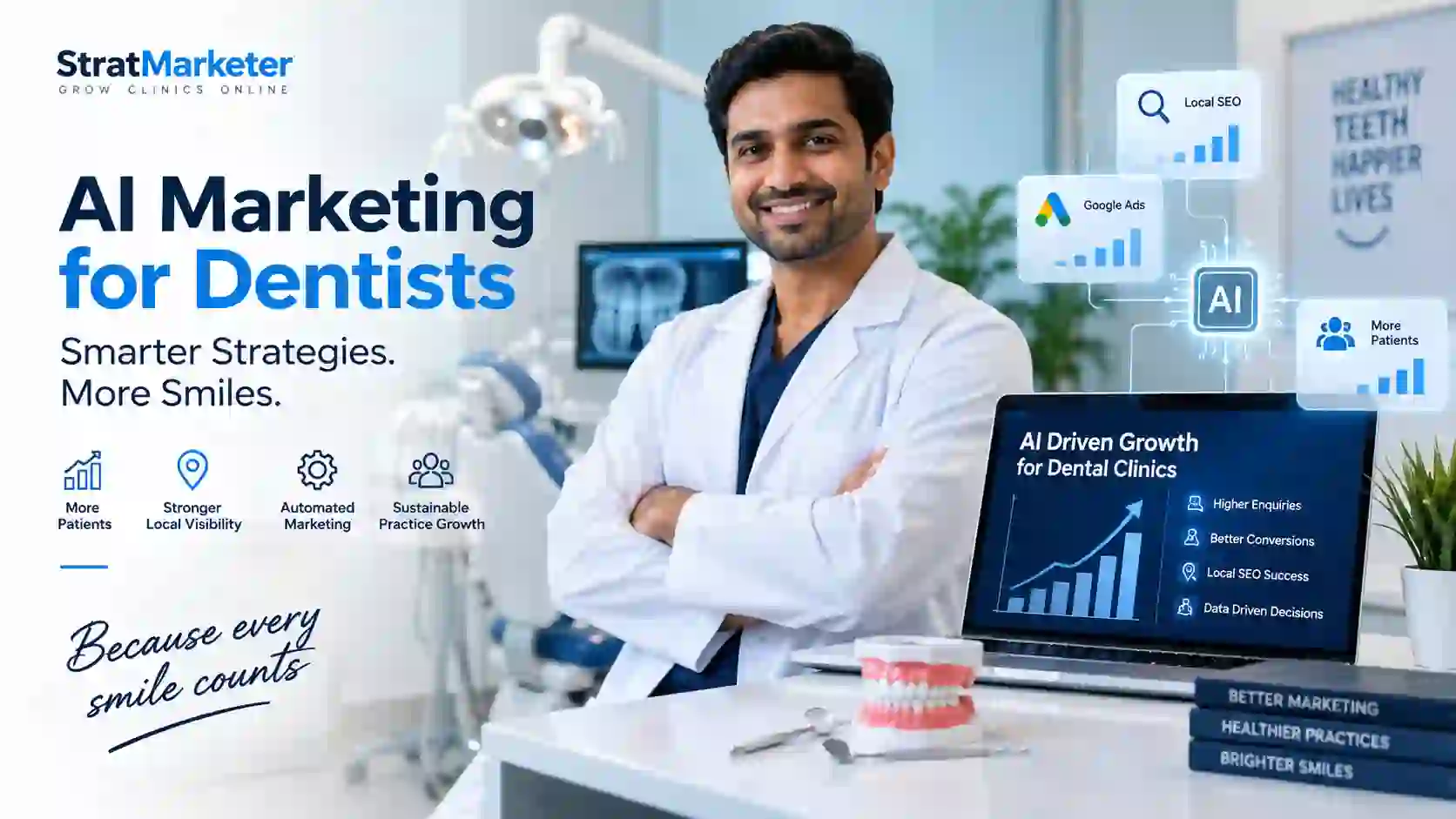
Why Dentists Are Turning to an AI Marketing Agency for Dentists
Dentists are dealing with a marketing environment that has changed quite a bit over the last few years. Earlier, a well-maintained clinic website, some local listings and occasional advertising could bring a steady flow of enquiries. That still works to some extent, but patient behaviour has become more complicated. People compare clinics, read reviews, search for specific treatments, ask AI search tools questions and often take time before booking an appointment.
This is one reason more dental practices are considering an AI marketing agency for dentists.
The interest is not really about using AI just because it is popular. Most dentists are concerned about something much simpler. They want more relevant enquiries, better use of their advertising budget and fewer gaps between a patient searching online and actually booking an appointment.
An AI marketing agency for dentists can use automation and AI-supported analysis to understand search patterns, advertising performance, website behaviour and patient interactions. The dentist still needs professional judgement, of course. Healthcare marketing cannot be left entirely to software. But AI can reduce the amount of manual guesswork involved.
For example, a dental clinic in a competitive area may receive website traffic but very few appointment enquiries. Earlier, someone might simply suggest running more advertisements. An experienced AI marketing agency for dentists would look deeper. Are visitors leaving on the treatment page? Are mobile users struggling with the appointment form? Are people searching for dental implants but landing on a general dentistry page?
These small gaps can affect patient acquisition more than many clinics realise.
I have also seen businesses spend money on marketing activity without properly understanding what is producing actual enquiries. There is something particularly frustrating about looking at a report full of impressions, clicks and reach when the clinic owner only wants to know one thing: how many genuine patients contacted us?
That is where AI-supported analysis can become useful.
An AI marketing agency for dentists can help identify patterns that are difficult to notice when data is reviewed manually. It can support keyword research, advertising optimisation, content planning, local search analysis and lead tracking. It does not mean every recommendation made by AI should be accepted without question. In fact, that is one of my concerns with current AI marketing. Healthcare requires context, and machines do not always understand why a patient might choose one dentist over another.
Still, when used carefully, AI can make marketing decisions more informed.
Dental practices are also facing greater competition in local search results. A patient searching for a dentist may see Google Business Profiles, advertisements, review platforms, maps and AI-generated search summaries before even reaching a clinic website. Being present somewhere online is no longer enough. The clinic needs to appear at the moment when a potential patient is actively looking for treatment.
This is why the role of an AI marketing agency for dentists is gradually becoming broader than basic SEO or advertising. It can involve understanding how patients search, what treatment terms they use, which questions create hesitation and what happens after someone visits the website.
Some clinics need aggressive patient acquisition. Others already receive enquiries but need better quality leads. The marketing approach should not be identical.
And that is where AI becomes useful, but also slightly overhyped.
How AI Is Changing the Way Dental Practices Attract New Patients
Patient acquisition in dentistry has traditionally depended on reputation, referrals, location and local visibility. These factors still matter. A dentist with poor clinical service cannot expect technology to solve the problem.
But the way potential patients discover clinics has changed.
Someone experiencing a toothache may immediately search for an emergency dentist. Another person considering braces might spend several weeks comparing treatment options. A parent searching for a paediatric dentist may focus heavily on reviews and clinic location. Someone considering dental implants may research the procedure for months before contacting anyone.
These are completely different patient journeys.
An AI marketing agency for dentists can help analyse these different behaviours instead of treating every website visitor as the same person. AI-supported systems can examine patterns across search data, advertising campaigns and website interactions to identify what type of information different users are looking for.
For example, a person searching for “root canal treatment cost” may not be ready to book immediately. They are still comparing options and trying to understand affordability. A person searching for “root canal dentist open today” has a much stronger immediate need.
The same advertising message should probably not be shown to both.
This is where AI can help segment search intent and support more relevant marketing activity. An AI marketing agency for dentists may use these insights when planning content, landing pages or advertising campaigns.
AI can also speed up the analysis of large amounts of marketing data. Earlier, marketers often spent hours reviewing spreadsheets and campaign reports. Now, AI-supported tools can identify unusual patterns faster. For instance, they may highlight that enquiries increase significantly on particular days or that a certain treatment page attracts traffic but produces very few appointment requests.
That information still needs a human interpretation.
A clinic may receive fewer online enquiries during a festival period because patients are travelling. AI may identify the drop, but understanding why it happened requires local context. This is one of the limitations that gets ignored when people talk about automation.
An AI marketing agency for dentists should not simply automate everything. It should know when automation is useful and when human judgement matters more.
Another major change is the speed of content creation. Dental clinics need educational content for websites, social media and advertising campaigns. AI can assist with research, topic identification and early content drafts. However, dental content created without medical review can become inaccurate very quickly.
I would personally avoid publishing completely automated healthcare content without professional oversight. The risk is simply not worth it.
Patients often search for information about symptoms, procedures, pain, recovery and costs before choosing a dentist. If a clinic provides misleading or overly simplified information, it can damage trust.
The purpose of an AI marketing agency for dentists should therefore be to support the marketing process, not replace professional expertise.
AI can help a dental practice identify common questions. The dentist or qualified professional can ensure the answers are accurate.
That combination makes more sense.
There is also growing interest in conversational tools and automated enquiry handling. A patient may visit a dental website late at night and have questions about appointment availability or treatment options. Automated systems can help capture basic information and direct the person towards the next step.
But this can break down if the system starts behaving like a dentist.
Healthcare communication has limits. Marketing automation should not make clinical diagnoses or give treatment advice that requires professional examination. An experienced AI marketing agency for dentists should understand this distinction.
Attracting patients is becoming more personalised, faster and more dependent on digital behaviour. But personal does not always mean automated.
Sometimes a quick call from the clinic receptionist still converts better than an elaborate automated sequence.
Using AI for Local SEO and Google Visibility for Dental Clinics
For many dental practices, local visibility is where the real competition happens.
A dentist does not necessarily need visitors from across the country. A clinic in Chandigarh, Pune or Delhi usually needs visibility among people living or working within a practical travelling distance. The challenge is that local search results can be highly competitive, particularly for treatments such as dental implants, orthodontics, cosmetic dentistry and emergency dental care.
An AI marketing agency for dentists can support local SEO by analysing search patterns, location-based keywords, competitor activity and patient questions.
A simple example is useful here.
People may search using different terms for the same requirement. One person searches for “dentist near me”. Another searches for “best dental clinic in Mohali”. Someone else searches specifically for “dental implant specialist in Chandigarh”.
Each search indicates a slightly different intention.
AI-supported keyword analysis can help identify these variations and understand which topics deserve dedicated website content. It can also help dental clinics recognise emerging search patterns that may not be obvious when keyword research is done occasionally.
However, local SEO is not only about inserting city names into website pages. That approach has been abused for years.
Google visibility depends on several factors, including the quality and relevance of the clinic website, treatment information, business profile accuracy, reviews, local reputation and overall consistency.
An AI marketing agency for dentists can assist in reviewing large numbers of pages and identifying gaps. For example, it may detect that a clinic has information about general dentistry but very little useful content about specific treatments patients are searching for.
AI can also support review analysis.
Reviews often contain useful information beyond star ratings. Patients may repeatedly mention friendly staff, short waiting times, painless procedures or transparent pricing. On the other hand, complaints may reveal recurring problems.
These patterns can influence both marketing and clinic operations.
I might be wrong here, but I think many businesses still treat reviews mainly as a reputation score. They can also be a source of patient behaviour information.
For a dental practice, repeated review patterns may indicate what patients genuinely value. If many positive reviews mention that the dentist explained the procedure clearly, this may be an important point to communicate on the website.
Local SEO also requires regular monitoring. Search rankings can move because competitors update their websites, new clinics open nearby or search behaviour changes.
AI can help monitor some of these changes faster, although rankings should not become an obsession. A clinic ranking first for a keyword is useful, but not if the page attracts visitors who never contact the clinic.
An AI marketing agency for dentists should look beyond rankings.
The bigger question is whether local visibility produces relevant patient enquiries.
Google Business Profile optimisation is another important area. Accurate information, clinic hours, treatment categories, photographs and reviews all contribute to how patients evaluate a dental practice. AI can help organise and analyse content, but the profile still needs real information from the clinic.
There is no useful automation for pretending a clinic has better reviews or experience than it actually does.
That part should remain very human.
AI Powered Google Ads and Paid Advertising for Dentists
Paid advertising can bring faster visibility to a dental practice, particularly for treatments where patient demand already exists.
But it can also waste money surprisingly quickly.
A dentist may invest in Google Ads and receive plenty of clicks without receiving enough appointment enquiries. This often happens because advertising campaigns are built around broad keywords without enough attention to patient intent.
An AI marketing agency for dentists can use AI-supported campaign analysis to identify which searches, audiences and advertising combinations are more likely to produce meaningful enquiries.
Suppose a clinic offers dental implants. A broad advertising campaign may attract people researching implants, students studying dentistry, people looking for free information and users searching for unrelated products.
Not every click has value.
AI-supported advertising tools can help identify patterns in search behaviour and campaign performance. They can also assist with bid management, keyword analysis and creative testing.
But automated bidding is not magic.
I have seen businesses assume that once automated bidding is activated, the advertising system will somehow understand exactly what a valuable customer looks like. It depends heavily on the quality of data provided to the platform.
If the system receives poor conversion data, it may optimise towards poor results.
For a dental practice, this means tracking the right actions matters. A website visit is not necessarily valuable. An appointment enquiry may be more valuable. A confirmed consultation may be even more important.
An AI marketing agency for dentists should work with the clinic to define what a genuine lead actually means.
Paid advertising can also be useful for testing demand.
For example, if a dental clinic plans to promote clear aligners more actively, advertising campaigns can help identify how local users respond to different messages. One campaign may focus on appearance. Another may focus on convenience. A third may address concerns about traditional braces.
The response can provide useful marketing insight.
Still, healthcare advertising requires care. Treatment claims should be responsible and not create unrealistic expectations. Promising guaranteed outcomes is not only a trust issue, it can create serious problems.
AI can generate advertising copy very quickly. That does not mean every line it produces should be published.
I feel strongly about this because automated marketing sometimes produces confident language without understanding the consequences. Dentistry involves health decisions. The advertising needs to remain commercially useful without becoming irresponsible.
An AI marketing agency for dentists can bring efficiency to campaign management, but the dentist should remain involved in important treatment-related messaging.
The best results usually come when marketing expertise and clinical knowledge meet somewhere in the middle.
How AI Can Help Dentists Understand Patient Search Behaviour
Understanding what patients search for is more complicated than finding a list of keywords.
Search behaviour often reveals uncertainty.
A patient may begin by searching about a symptom, then look for treatment information, compare costs and eventually search for a dental clinic. These searches can happen over several days or even weeks.
An AI marketing agency for dentists can analyse search patterns and identify the questions patients ask at different stages.
Someone searching for “does root canal hurt” is looking for reassurance. Someone searching for “root canal treatment cost in Delhi” is comparing options. Someone searching for a nearby dental clinic may be ready to contact a dentist immediately.
These differences matter when planning marketing.
AI can help group related searches and identify common themes. This can support website content, FAQs, advertisements and patient communication. It can also reveal questions that dental clinics may not have considered answering.
Patients do not always use professional medical terminology. They search in the language they understand.
A dentist may refer to a specific dental condition, while a patient searches for “black spot on tooth” or “sharp pain while eating”. An AI marketing agency for dentists can help identify these natural search patterns and support content that speaks more closely to how people actually ask questions.
In India, language behaviour can become even more interesting. Some patients search in English, some use Hindi words written in English letters, and others combine both. Local context matters here.
This does not apply everywhere, though. A high-end clinic targeting a particular audience may see very different search behaviour compared with a family dental practice in a residential area.
AI analysis can identify patterns, but it cannot fully understand the individual person behind every search.
That distinction is important.
There is also a risk of over-analysing data. Not every keyword deserves a separate page. Not every search trend requires a new advertising campaign. Sometimes marketing teams create too much content simply because AI tools can generate endless topic suggestions.
More content is not always better.
I would rather see a dental clinic publish a smaller number of genuinely useful pages than hundreds of weak pages created from keyword variations.
An AI marketing agency for dentists should use AI to reduce guesswork, not create more digital clutter.
The most useful outcome is often quite simple. Understand what patients are concerned about. Answer those concerns clearly. Make it easy to contact the clinic.
Everything else sits around that.
And sometimes the marketing reports get very complicated for something that is, at its centre, still about a person feeling uncomfortable about a dental problem and trying to find someone they trust.
Personalisation and Automation in the Dental Patient Journey
The dental patient journey rarely begins and ends with one search.
A person may see a clinic on Google, visit the website, leave without contacting anyone, return after a few days, read reviews and finally send an enquiry. Someone else may click a Google Ad because of severe tooth pain and call the clinic within minutes.
Both are potential patients, but their needs are completely different.
This is where an AI marketing agency for dentists can use personalisation and automation more carefully. The objective should not be to send automated messages simply because automation is available. Patients are already receiving enough generic messages from businesses. The real value comes from making communication relevant to where the person is in their decision-making process.
For example, a patient who downloads information about dental implants may still be researching treatment options. Sending them repeated messages asking them to book immediately can feel irritating. A more sensible approach may involve providing useful information about the treatment process, consultation requirements or questions they may want to ask their dentist.
On the other hand, someone who submits an appointment request should receive a quick response. This is an area where automation can genuinely help.
An AI marketing agency for dentists may help set up systems that organise enquiries, send initial acknowledgements, route leads to the appropriate team member and reduce delays in follow-up. Many clinics lose potential patients simply because enquiries are not handled quickly enough.
A receptionist may be busy with patients at the front desk. The phone may be ringing. Someone fills out a website form at the same time. These small operational gaps are common.
Automation can reduce some of that pressure.
However, personalisation in healthcare marketing needs boundaries. A dental clinic should not create the impression that automated software is providing personalised medical advice. There is a difference between reminding a patient about an enquiry and advising them about a treatment.
That distinction matters.
An AI marketing agency for dentists can also help connect marketing systems with lead management processes. If a patient arrives through a specific campaign, the clinic may be able to understand which service they were interested in and what information they viewed before submitting an enquiry.
This can make follow-up conversations more relevant.
For example, if someone has spent time on pages related to orthodontic treatment, the clinic team should not need to begin by asking completely unrelated questions. But even here, assumptions can be wrong. Website behaviour gives clues, not certainty.
I might be wrong here, but excessive personalisation can sometimes feel uncomfortable rather than helpful. Patients should feel that a clinic understands their requirements, not that every movement on the website is being watched.
The best automation often stays in the background.
It saves time without making the interaction feel automated.
A reminder message can help a patient remember a consultation. An automated enquiry response can confirm that the clinic has received the request. Follow-up workflows can reduce the chances of leads being forgotten. These are practical uses.
Not everything needs to become an AI conversation.
Common Challenges Dentists Face When Using AI for Marketing
AI can make marketing faster, but faster does not automatically mean better.
One of the biggest challenges dentists face is the volume of tools and claims surrounding AI marketing. Almost every platform now describes itself as AI-powered. It can become difficult to understand what is genuinely useful and what is simply a new label attached to an existing marketing service.
An AI marketing agency for dentists should be able to explain exactly how AI is being used.
If the answer remains vague, that should raise questions.
A common problem is over-reliance on automatically generated content. AI can create articles, social media posts and advertising copy quickly, but dental content requires accuracy. A poorly written post about symptoms or treatment can create confusion among patients.
This is particularly important in healthcare.
AI does not automatically understand the policies, ethical responsibilities and clinical context surrounding every dental procedure. Content should be reviewed before publication, especially when discussing treatment outcomes, medical concerns or patient expectations.
Another challenge is poor data quality.
AI tools can analyse information only if the available information is reasonably accurate. If a dental clinic does not properly track appointment enquiries, phone calls or campaign conversions, the AI system may optimise marketing activity around incomplete data.
A campaign might appear successful because it produces many form submissions. But what if half of those enquiries are irrelevant? What if many patients never answer follow-up calls?
The numbers can look good while the actual results are disappointing.
This is one area where I strongly prefer practical lead quality discussions over impressive dashboards.
Dentists can also face challenges with unrealistic expectations. Some agencies or software providers create the impression that AI will automatically produce patients without the need for proper marketing strategy.
It will not.
A weak website remains weak. Poor reviews still affect trust. Slow enquiry responses still cause problems. AI cannot completely repair a poor patient experience.
There is also the issue of too much automation. Automated messages can become repetitive, impersonal or badly timed. A patient who has already booked an appointment should not continue receiving repeated booking reminders from the same campaign.
These things happen more often than people think.
An AI marketing agency for dentists should regularly review automation workflows instead of setting them up and forgetting about them. Patient behaviour changes, advertising platforms change and the clinic itself may introduce new treatments.
What worked six months ago may no longer work properly.
AI can also produce incorrect recommendations with complete confidence. That is probably one of the more uncomfortable aspects of using it for marketing. The language can sound convincing even when the underlying assumption is weak.
Human review is not optional.
And then there is privacy. Dental practices need to be careful about the information handled through marketing and automation systems. Patient information should not be casually copied into every AI tool or marketing platform.
This may not apply everywhere in exactly the same way, depending on the systems being used and the information being processed, but caution is necessary.
Sometimes the smartest use of AI is deciding not to automate something.
What to Look for Before Hiring an AI Marketing Agency for Dentists
Choosing an AI marketing agency for dentists should involve more than asking whether the agency uses AI tools.
Almost every marketing agency can now generate content with AI or use automated advertising features. That alone does not show expertise.
A dentist should first understand what marketing problem needs to be solved.
Is the clinic struggling to appear in local search results? Are Google Ads producing expensive clicks with few enquiries? Is the website receiving visitors but failing to generate appointment requests? Are leads coming in but not being followed up properly?
The answer should influence the marketing approach.
I have seen businesses hire agencies without clearly identifying the actual problem. They end up purchasing a large collection of services and later wonder why the results are difficult to measure.
An AI marketing agency for dentists should begin with the existing situation rather than immediately recommending every possible marketing service.
Experience in healthcare and dental marketing also matters. Marketing a dental clinic is different from marketing a clothing brand or software company. Patients make decisions based on trust, location, urgency, treatment concerns and personal comfort.
The agency should understand these differences.
Ask how the agency uses AI.
This is worth asking directly.
Does AI help analyse marketing data? Does it support keyword research? Is it used for campaign optimisation? Does it assist with content research? How is AI-generated content reviewed? What information is handled through automated systems?
Specific answers are more useful than broad promises.
The agency should also be comfortable discussing limitations. I would actually trust an agency more if it explains where AI should not be used. Anyone claiming that automation can solve every marketing problem is probably simplifying the situation too much.
Another important area is reporting.
A dental clinic does not necessarily need a huge monthly report filled with technical metrics. The reporting should help the clinic understand what is happening with website enquiries, advertising performance, local visibility and lead quality.
There is a difference between receiving information and receiving useful information.
Transparency also matters when managing advertising budgets. Dentists should understand where money is being spent and what the agency is doing. If paid campaigns are part of the service, there should be clarity around advertising costs and management charges.
The technology itself should not become the centre of the relationship.
The clinic’s goals should.
An AI marketing agency for dentists should also be willing to work with the clinic team. The dentist understands patients, treatment concerns and local competition in ways that an outside agency may not immediately understand. Good marketing often develops through these conversations.
Sometimes the most useful information comes from a dentist casually saying, “Patients keep asking us this before booking.”
That one observation can lead to better website content, advertisements or follow-up communication.
I am not completely sure every agency will see it this way, but I think listening is still one of the most valuable marketing skills, even when AI is involved.
How StratMarketer Supports Dental Practices with AI Based Marketing
StratMarketer works with businesses that want to combine established digital marketing methods with AI-supported processes.
For dental practices, the approach can involve understanding the clinic’s existing online presence before deciding where AI and automation can actually be useful. Not every dental practice needs the same marketing setup.
A clinic that already receives strong local search traffic may need better enquiry conversion. Another clinic may need stronger visibility for specific dental treatments. A newer practice may need to build its local online presence from the beginning.
StratMarketer can support these different requirements through areas such as SEO, local SEO, Google Business Profile optimisation, paid advertising, content marketing, lead generation, website optimisation and AI-supported marketing analysis.
As an AI marketing agency for dentists, the focus should remain on understanding the patient journey rather than simply adding AI tools to every marketing activity.
AI can assist with analysing search behaviour and identifying patterns. It can support advertising optimisation and campaign analysis. It can help identify content opportunities and automation gaps. But decisions still need to be reviewed in the context of the dental practice.
This is particularly important when marketing involves healthcare-related communication.
StratMarketer can also help dental practices improve the connection between marketing and lead handling. Attracting website traffic is only one part of the process. The patient must be able to find relevant information, make an enquiry and receive an appropriate response.
That journey often has small gaps.
A slow contact form. An unclear appointment page. An advertising campaign sending visitors to a general website page. Enquiries that are not followed up consistently.
Small things, but they add up.
An AI marketing agency for dentists can help identify these gaps using data and automation while keeping the communication practical. The aim should not be to make the clinic appear more technological than it really is. Patients are usually more interested in whether the dentist is trustworthy, the clinic is accessible and their concerns will be taken seriously.
AI can support the process behind the scenes.
That is often enough.
Frequently Asked Questions About an AI Marketing Agency for Dentists
What does an AI marketing agency for dentists do?
An AI marketing agency for dentists uses AI-supported tools and marketing expertise to help dental practices analyse search behaviour, manage campaigns, improve local visibility, create relevant marketing content and automate selected parts of the patient enquiry process.
The exact work depends on what the dental practice needs.
Can an AI marketing agency for dentists help generate more patient enquiries?
It can help improve the marketing systems that contribute to patient enquiries. This may include local SEO, Google Ads, website optimisation and better lead follow-up.
However, no agency can honestly guarantee a fixed number of patients in every situation.
Is AI-generated content safe for dental marketing?
AI can be useful for research and content preparation, but healthcare-related content should be reviewed for accuracy before publication. Dental treatment information should not be published blindly because it was generated automatically.
Can AI help with Google Ads for dentists?
Yes. AI-supported advertising tools can help analyse campaign performance, optimise bidding and identify useful search patterns. The results still depend on campaign strategy, tracking quality, competition and the services being advertised.
Should every dental clinic use automation?
No. Automation is useful for repetitive tasks such as enquiry acknowledgements, reminders and lead organisation. Human communication remains important, especially when patients have specific concerns.
How should a dentist choose an AI marketing agency for dentists?
Look at the agency’s understanding of dental marketing, transparency, reporting methods and practical explanation of how AI is being used. Ask about limitations too.
That answer can tell you a lot.
Can AI replace a dental marketing professional?
No, at least not in any reliable way at present. AI can process information and identify patterns quickly, but it does not fully understand patient trust, local context or clinical responsibility.
Our Services
Contact Us
- Paonta Sahib, Himachal Pradesh, India
- +91-8700998508
- support@stratmarketer.com
Start From Here
These two options make it easy for you to get the information you want.