


What an AI Ecommerce Lead Generation Agency Actually Does for Online Businesses
For an ecommerce business, getting traffic is not usually the biggest headache anymore. The difficult part is getting the right people to take the next step. A visitor may browse five products, add something to the cart, leave the website, watch an Instagram video and then disappear for two weeks. Another person may visit once and buy within ten minutes. Treating both customers in exactly the same way is where many ecommerce marketing efforts go wrong.
This is where an AI ecommerce lead generation agency comes into the picture.
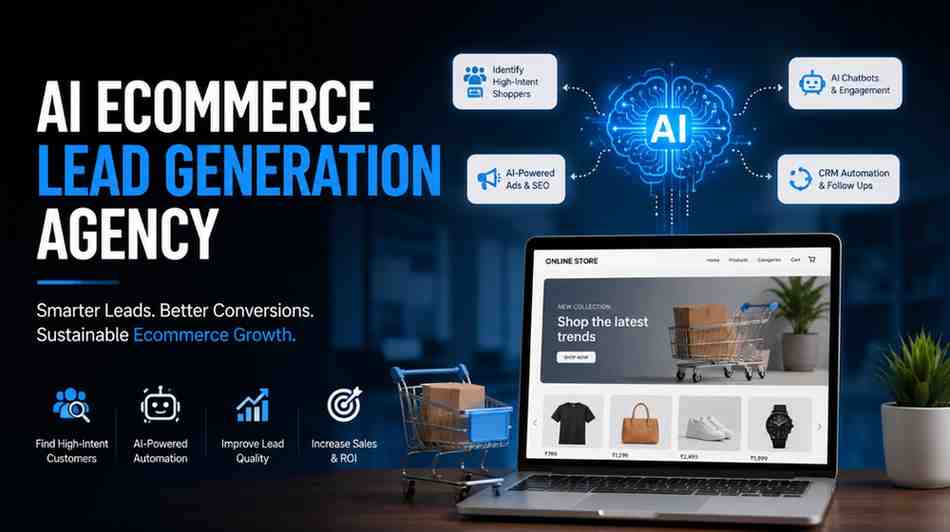
An AI ecommerce lead generation agency uses customer behaviour, website activity, advertising data, search patterns and automation to find people who are more likely to become customers. The idea is not simply to collect more names, email addresses or WhatsApp enquiries. It is to understand which visitors have a genuine buying interest and what should happen next.
That difference matters.
Suppose an Indian skincare brand is selling products for acne-prone skin. The website may receive thousands of visitors every month. Some come through Google while searching for solutions. Some arrive from Instagram reels. Others click a Meta advertisement because the product looks interesting. A traditional campaign may count all of these visitors as traffic and then run a broad remarketing campaign.
An AI ecommerce lead generation agency can look deeper.
It can identify that one visitor has read three product pages, spent several minutes comparing ingredients and returned to the website twice. Another visitor may have opened a discount page but never looked at a product. Their intent is clearly different.
The first person deserves a different follow up.
AI does not magically know who will purchase. That is an important point, because I have seen businesses treat AI scoring as if it were some kind of crystal ball. It is not. The quality of the result depends heavily on the data, tracking, website experience and rules being used behind it.
A good agency therefore connects several parts of ecommerce marketing rather than putting an AI tool on top and calling the work complete.
Search data can show what customers are actively looking for. Paid advertising can bring relevant visitors. Website tracking can show what they do after arriving. CRM systems can record previous interactions. AI can then help interpret these signals and decide which leads need attention first.
For example, imagine a furniture ecommerce company receiving enquiries for customised wardrobes. A customer who only reads a blog about wardrobe designs is still early in the buying process. Someone who checks dimensions, opens the pricing page, downloads a catalogue and submits a consultation form is much closer to a commercial conversation.
The second lead should not sit inside the same generic email sequence as everyone else.
This is one of the practical areas where an AI ecommerce lead generation agency can make a difference. Instead of depending entirely on manual follow ups, the system can help segment prospects according to their behaviour and interest.
It can also support automated responses, lead scoring, remarketing audiences, email sequences, WhatsApp follow ups and CRM updates. The exact combination depends on the ecommerce model. A fashion store selling products at Rs. 799 needs a different process from a B2B equipment ecommerce business where one enquiry could be worth several lakhs.
That distinction is often missed.
AI ecommerce lead generation is not only about selling more products immediately. For many brands, the bigger benefit is understanding why certain visitors convert while others do not. Once that information becomes clearer, advertising, content and website decisions become less dependent on guesswork.
And yes, sometimes the answer is uncomfortable. A business may believe its ads are generating poor leads when the real issue is that the product page gives customers too little information. Or the leads may be perfectly relevant, but nobody follows up quickly enough.
I have seen this happen with businesses where the marketing team celebrates the number of enquiries while the sales team quietly complains that nobody is responding to them properly. More leads did not solve the problem.
Better handling did.
Why Ecommerce Brands Are Moving Beyond Traditional Lead Generation Methods
Traditional lead generation still has a place in ecommerce. Search ads, social media advertising, SEO, email marketing and remarketing are not suddenly useless because AI has arrived.
The problem starts when these channels operate separately.
An ecommerce brand may have one agency handling SEO, another person managing Meta Ads, a CRM team working on customer data and someone else responding to WhatsApp enquiries. Everyone may be doing their assigned task, but nobody is looking at the entire customer journey.
That creates gaps.
A person might click an advertisement after searching for a particular product, visit the website and leave. Two days later, the same person searches the brand name on Google. The following day, they open an email. Later, they visit the pricing page again.
Traditional reporting may show these as separate interactions.
The customer sees it as one buying journey.
An AI ecommerce lead generation agency can connect these signals more intelligently, provided the tracking setup and data permissions are handled properly. The system can help recognise patterns across customer interactions and create more relevant follow up actions.
This is particularly useful because ecommerce behaviour has become messy. Customers rarely move neatly from advertisement to product page to purchase. They compare prices, read reviews, ask friends, check YouTube videos, search on Google, look at Instagram comments and sometimes leave a product in the cart for weeks.
Indian consumers are especially price conscious in many categories. A customer may like a product but still check three competitors before purchasing. A discount shown at the right moment might convert that customer. The same discount shown to someone who was never interested simply reduces the margin.
That is why volume alone is becoming a weak measure of lead generation.
An ecommerce brand should care about lead quality, buying intent, customer value and the cost involved in acquiring that customer.
Traditional lead generation often relies heavily on broad audience targeting and predefined campaigns. AI can introduce more flexible segmentation. For instance, customers can be grouped based on recent activity, purchase history, product interest, engagement level or probability of conversion.
Consider an online nutrition brand.
A visitor who reads an article about protein intake is not necessarily ready to buy whey protein. Another visitor who checks whey protein products, compares flavours and reaches the checkout page has shown stronger commercial intent.
The marketing response should not be identical.
The first customer may need useful educational content. The second may need reassurance about delivery, payment options, ingredients, reviews or a simple reminder to complete the purchase.
This sounds obvious when explained manually. The problem is doing it across tens of thousands of visitors.
That is where automation becomes useful.
An AI ecommerce lead generation agency can help businesses create rules and workflows that respond to different customer behaviours. Someone abandoning a cart can enter one journey. Someone requesting product information can enter another. A previous customer browsing a related product can receive a different recommendation altogether.
But there is a warning here.
I would not recommend automating every customer interaction. Some businesses get excited about AI and start sending messages for every tiny action a visitor takes. The result feels intrusive very quickly. Customers are not data points waiting to be chased every fifteen minutes.
Good ecommerce marketing still needs judgement.
AI should help decide where human attention is useful, not remove human thinking from the process.
There is also the issue of poor data. If the tracking is broken, AI simply becomes very efficient at interpreting unreliable information. That sounds clever until the advertising budget starts disappearing.
I might be wrong here for certain very simple ecommerce businesses, because a straightforward product, strong demand and a clean checkout can still perform extremely well with conventional campaigns. Not every store needs an elaborate AI system.
But when customer journeys become complicated, product ranges grow and advertising costs increase, relying only on broad targeting becomes harder to justify.
How AI Helps Identify High Intent Ecommerce Customers
Not every lead has the same value.
This is probably one of the most important things an ecommerce business needs to understand before investing heavily in lead generation. A website can generate thousands of enquiries or interactions and still produce disappointing sales if those interactions are coming from people with very little buying intent.
AI helps by examining behavioural signals at a scale that would be difficult for a person to monitor manually.
A visitor who lands on a product page and leaves after ten seconds tells you very little. Someone who visits the same product three times, reads the specifications, checks delivery information and adds the item to the cart is giving stronger signals.
Then there are even stronger signals.
A customer may start checkout, enter an email address, choose a payment method and leave before completing the transaction. Another may submit a product enquiry asking whether a particular size is available.
These behaviours can be assigned different levels of intent.
An AI ecommerce lead generation agency can use such signals to help create lead scoring models. The model may consider page visits, product interactions, repeat sessions, search queries, email engagement, cart activity, previous purchases and other available information.
The scoring does not need to be complicated.
For a D2C fashion brand, someone who repeatedly views a particular collection and adds products to the cart could be classified as a warmer prospect. For a high value industrial ecommerce business, downloading technical specifications and requesting a quotation may matter much more than simply spending five minutes on the website.
The signals have to match the business.
This is why copying another company’s AI lead scoring model rarely works properly. Customer behaviour for a Rs. 500 product is not the same as customer behaviour for a Rs. 2 lakh product.
Search intent can also provide useful clues.
Someone searching for “best running shoes” is still exploring. Someone searching for “buy running shoes size 9 online” is much closer to a transaction. AI can help marketers interpret large volumes of search and behavioural information so that advertising and content can respond to different stages of intent.
The same principle applies inside the website.
A visitor reading a blog post about choosing a laptop may simply be researching. A visitor comparing two laptop models, checking EMI options and opening the delivery page is behaving differently.
The second visitor should probably receive more commercial messaging.
This does not mean bombarding them with popups.
Sometimes the best response is simply making the information easier to find.
I have seen ecommerce websites spend heavily on lead generation while hiding basic details such as return conditions, delivery timelines or product specifications several clicks away. Then the team blames the traffic quality when customers hesitate at checkout. That is frustrating because the problem is not always the lead.
Sometimes the website is creating the hesitation.
An AI ecommerce lead generation agency can help identify these patterns by connecting campaign data with website behaviour and conversion information. If a certain audience produces many clicks but very few meaningful actions, that audience may need to be reconsidered. If another segment has fewer visitors but a much higher conversion rate, the campaign strategy may need to give that segment more attention.
This is where AI becomes genuinely useful rather than simply fashionable.
It can process a large amount of behavioural information, spot recurring patterns and help marketers prioritise their next action. Human judgement still matters because the system cannot always understand context.
For example, a customer may visit a product page repeatedly because they are interested. Or they may be comparing prices before buying from another website. The behaviour looks similar from a distance.
That is why high intent should never be treated as a guaranteed purchase.
It is a probability.
And probabilities change.
For StratMarketer, the more sensible way to approach an AI ecommerce lead generation agency model is to connect intent signals with SEO, paid advertising, landing pages, CRM workflows and follow ups instead of treating AI as a separate marketing department. A lead becomes useful only when the business knows what to do with it.
Otherwise it is just another number in a report.
There is also something less technical that matters. Customers can sense when every interaction has been automated. A perfectly timed message can still feel annoying if it arrives without context. Sometimes a simple human reply to a genuine question does more than five automated sequences.
That part of ecommerce marketing is still difficult to measure.
And perhaps that is why it keeps getting ignored.
Using Customer Data, Behaviour Signals and AI to Improve Lead Quality
Most ecommerce businesses already have more customer data than they realise. The issue is usually not collecting it. The issue is understanding what is actually useful.
Website visits, product views, search queries, cart activity, previous purchases, email clicks, ad interactions and customer enquiries all leave small signals behind. Individually, many of these signals do not mean much. When several of them appear together, they can tell a different story.
An AI ecommerce lead generation agency can use these signals to help separate casual visitors from people who are showing genuine buying interest.
Take a simple example. A person lands on an online furniture store from a Facebook advertisement. They look at a sofa, leave the website and return the next evening through Google. This time they check the dimensions, delivery information and customer reviews. They then visit the same sofa again two days later.
That is not the same visitor behaviour as someone who opened the homepage and left.
A good lead generation system should recognise the difference.
AI can process these patterns much faster than a marketing team sitting in front of a spreadsheet. It can help identify groups of visitors who behave similarly and flag certain actions as stronger indicators of intent.
But there is a practical problem here.
Poor data creates poor decisions.
I have seen ecommerce businesses install several tracking tools without properly checking whether events are firing correctly. One campaign showed hundreds of add to cart actions, while the actual ecommerce platform showed far fewer. Everyone was happy with the advertising report until someone compared it with the sales figures.
The excitement disappeared quickly.
Before an AI ecommerce lead generation agency starts talking about scoring models and predictive systems, the basics need to be checked. Are product views being recorded properly? Are purchases attributed correctly? Are returning users being understood? Are duplicate leads entering the CRM? Is the same customer appearing as three different contacts?
These things sound boring. They matter more than fancy dashboards.
Customer data can also help with segmentation.
A skincare brand, for example, might separate customers who purchased moisturisers from those who purchased acne care products. A fitness brand could identify people interested in protein supplements separately from those looking for workout accessories. A fashion store may have completely different buying patterns among first time visitors, repeat buyers and customers who only purchase during sales.
AI can help detect these patterns and support more relevant marketing.
This is where lead quality often improves without increasing the total number of leads.
Suppose a campaign brings 1,000 enquiries. Only 100 show strong purchase behaviour. Another campaign brings 400 enquiries, but 120 of them show strong intent.
The second campaign may look smaller in the monthly report. It could still be much more valuable.
This is why I prefer looking beyond raw lead counts. Numbers can make a campaign look successful while the sales team is struggling with irrelevant enquiries.
There is another layer that ecommerce businesses sometimes overlook. Customer behaviour changes depending on the product price.
A person buying a T shirt may make a decision in minutes. Someone purchasing a premium mattress, jewellery, electronics or commercial equipment may take days or weeks. AI models need enough context to understand that difference.
The same behavioural signal cannot mean the same thing across every business.
That is also why customer data should not be collected just because a tool allows it. Businesses need to be sensible about consent, privacy and how customer information is used. Customers may accept personalised recommendations, but that does not mean they want every movement on a website turned into an aggressive sales message.
There is a line.
Good AI ecommerce lead generation should help a business understand customers better without making the customer feel watched.
How SEO, Paid Ads and AI Work Together for Ecommerce Lead Generation
SEO and paid advertising are often discussed as separate channels. In actual ecommerce operations, the customer does not care which channel brought them in.
They simply want to find the right product, understand it and decide whether it is worth paying for.
This is where combining SEO, paid ads and AI becomes useful.
SEO can bring people who are actively searching for products, comparisons, solutions and information. Paid advertising can place products in front of people at different stages of their buying journey. AI can help analyse the behaviour generated by both channels and identify which audiences, searches and interactions are producing stronger leads.
An AI ecommerce lead generation agency can bring these pieces together rather than evaluating every channel in isolation.
For example, an online electronics business may rank organically for searches related to wireless headphones. At the same time, it may run Meta campaigns promoting specific models. Google Ads may target commercial searches such as people looking for particular brands or price ranges.
The data from these campaigns can reveal something interesting.
Perhaps organic visitors from comparison searches spend more time on the website and have a higher purchase rate. Paid visitors from broad social campaigns may generate more traffic but fewer transactions. AI can help identify this pattern when enough reliable data is available.
The answer is not necessarily to stop paid advertising.
Maybe the paid campaign is useful for creating demand earlier in the journey. Those visitors may return later through Google search and purchase organically.
Attribution becomes messy here.
Anyone who has worked seriously with ecommerce data knows this. One platform says it generated the sale. Another platform says it did. Google Analytics tells a slightly different story. The customer, meanwhile, has no idea that three marketing platforms are arguing about who gets credit.
This is one reason I would be cautious about believing any single attribution report completely.
AI can assist with pattern recognition, but it cannot remove the basic limitations of tracking.
SEO also gives AI systems useful information about customer intent. Search queries often reveal what people are trying to solve. Product pages reveal commercial interest. Blog content can answer questions before the customer is ready to buy.
A good strategy connects these stages.
Someone searching for “best office chair for back support” may not be ready to purchase immediately. An ecommerce website can provide useful information and introduce relevant products. Later, that same person may search for a specific chair model. Paid advertising and remarketing can then support the decision.
The process is not always so neat, of course.
Some customers read nothing and buy immediately. Others compare products for three weeks and still ask their friends before paying.
AI ecommerce lead generation can help marketers work with these different behaviours rather than forcing everyone into the same funnel.
There is also a useful relationship between SEO data and paid campaigns. Search terms that consistently produce valuable organic visitors can reveal topics or product categories worth testing in paid advertising. Similarly, paid search data can show which commercial terms deserve stronger organic content.
This creates a feedback loop.
Not a perfect one.
I have seen businesses waste months creating content around keywords with good search volume but almost no commercial relevance. The traffic looked impressive in Search Console. Sales did not care.
That experience made me more cautious about celebrating traffic as a success metric.
For ecommerce, the better question is often simple. Did the visitor show enough interest to become a customer, and did the marketing system recognise that interest at the right time?
That is where AI has a useful role.
AI Chatbots, CRM Automation and Faster Follow Ups for Ecommerce Leads
A lead can be perfectly qualified and still be lost because nobody responded.
This happens more often than businesses like to admit.
Someone asks about product availability on a Sunday evening. The reply comes Monday afternoon. Another customer asks whether a particular size is available and receives an automated message that does not answer the question. Someone else submits an enquiry twice because the first submission gives no confirmation.
These are not AI problems.
They are process problems.
An AI ecommerce lead generation agency can use chatbots, CRM automation and automated follow ups to reduce some of these gaps.
AI chatbots are particularly useful when customers repeatedly ask similar questions. Product availability, delivery areas, return policies, payment methods, sizing information and basic product comparisons can often be handled immediately.
But the chatbot should know when to stop.
If a customer asks a complicated question about a customised product, sending them through twelve automated questions is irritating. At that point, a human should probably take over.
I strongly prefer this approach. Automation for repetitive questions, human involvement when the conversation actually needs judgement.
CRM automation helps with another issue, which is lead organisation.
Imagine an ecommerce company receiving enquiries through its website, WhatsApp, Instagram and email. Without a proper system, some leads will be answered quickly while others will be forgotten. A CRM can bring these interactions into one place and assign follow up actions.
An AI ecommerce lead generation agency can also help prioritise leads according to their behaviour.
Someone who has only downloaded a catalogue may receive an educational email. Someone who has asked for pricing may be moved to a more direct follow up. A customer who has already purchased may receive product recommendations rather than another introduction to the brand.
Timing matters.
A follow up after ten minutes can have a completely different effect from a follow up after ten days.
But faster is not always better.
This is another area where ecommerce brands sometimes overdo automation. They assume that because technology allows instant messages, every customer should receive one.
That can make the brand feel desperate.
A sensible system should consider the context of the interaction. If someone asks a direct question, answer it. If someone abandons a cart, a reminder can make sense. If someone simply visits a product page once, sending three messages in the next hour is probably unnecessary.
CRM automation is most useful when it removes administrative work from the team.
For example, when a customer submits an enquiry, the system can record the source, product category, previous activity and contact details. It can assign the enquiry to the right person and trigger a suitable first response. If there is no response from the customer, another follow up can happen later.
The sales team gets a cleaner process.
And the customer does not have to repeat the same information every time.
For higher value ecommerce products, this becomes even more important. A business selling industrial equipment online may not have thousands of customers, but each enquiry could be commercially significant. Here, AI ecommerce lead generation can support the sales team by helping them understand what the prospect has already viewed and asked about.
Still, I would never allow automation to completely replace customer service.
People remember bad support.
They may forget the advertisement that brought them to the website, but they remember being ignored after making a serious purchase enquiry.
Personalised Content and Product Recommendations That Support Lead Conversion
Personalisation is often discussed as if every customer wants a completely different website.
That is not necessary.
Sometimes a small change is enough.
A returning customer may see products related to their previous purchase. Someone browsing men’s running shoes may see relevant accessories rather than random promotional products. A customer who previously bought a particular skincare product may receive information about compatible products.
AI can help identify these relationships.
An AI ecommerce lead generation agency can analyse previous purchases, browsing behaviour, product categories, search activity and engagement patterns to support more relevant content and recommendations.
For example, a customer who purchases a coffee machine may later be interested in coffee beans, filters or cleaning products. A simple recommendation engine can recognise the connection.
But personalisation should make sense.
I have seen ecommerce websites recommend products that had absolutely no connection with what the customer was doing. It makes the recommendation system look broken, even if the underlying technology is sophisticated.
Context matters more than complexity.
Content can also be personalised according to where the customer is in the buying journey.
A first time visitor may need an explanation of the product. A returning visitor may need comparisons or reviews. Someone who has reached checkout may need reassurance about delivery, returns or payment security.
These are different information needs.
AI can help identify them at scale.
For example, an ecommerce brand selling expensive mattresses may find that customers spend considerable time reading about firmness, material quality and warranty conditions before purchasing. Instead of showing another generic discount banner, the website could surface content answering those questions.
That can support conversion without pushing the customer.
There is a difference between helping someone decide and repeatedly asking them to buy.
This distinction becomes especially important for products that require consideration. Electronics, furniture, premium beauty products, fitness equipment and specialised products often need more explanation than a low priced impulse purchase.
AI can help marketers understand which content is being consumed before conversion. If customers who read a particular comparison article convert at a higher rate, that information is useful.
Maybe that article deserves more attention.
Maybe it should be linked from the product page.
Maybe the paid campaign should send users to it earlier.
This is where an AI ecommerce lead generation agency can connect content with actual customer behaviour instead of judging content only through page views.
Product recommendations can also increase the value of existing customers. Someone who has already purchased is not necessarily a finished lead. They may be the most useful audience for another product.
A customer who purchased running shoes may eventually need socks, insoles or another pair of shoes. A customer who bought a laptop may need accessories. The recommendation should come from a reasonable relationship between the products.
Otherwise it feels like the website is throwing products at the customer.
There is one thing I remain slightly doubtful about here. More personalisation does not automatically mean more sales. Sometimes customers simply want to browse without the website trying to predict every move.
That may sound obvious, but it gets forgotten when businesses start chasing personalisation metrics.
Common Mistakes Ecommerce Brands Make When Using AI for Lead Generation
The first mistake is believing that AI itself will generate qualified leads.
It will not.
AI works with the information, campaigns, content and processes around it. If the website attracts the wrong audience, an AI system will still receive the wrong audience. If the product page is confusing, AI cannot magically make customers trust the product.
It can help identify the problem.
It cannot always solve it.
Another common mistake is buying too many tools.
One tool for AI chat. Another for customer scoring. Another for email automation. Another for product recommendations. Another dashboard for campaign reporting. After some time, the marketing team spends more effort maintaining the tools than understanding customers.
I have seen this happen with mid sized ecommerce businesses where three different systems were storing overlapping customer information. Nobody was fully sure which database was correct.
That creates unnecessary confusion.
A good AI ecommerce lead generation agency should first understand the existing marketing setup before recommending more technology.
Another mistake is chasing lead volume.
Suppose an ecommerce campaign generates 5,000 leads in a month. It sounds impressive. But if most of those people are asking for coupons, submitting fake details or showing no further buying behaviour, the number is not particularly useful.
A smaller group of serious prospects can be worth much more.
Businesses also make the mistake of using one scoring model for every customer. A first time visitor buying a Rs. 1,000 product behaves differently from a customer considering a Rs. 1 lakh purchase.
The model needs context.
Poor follow up is another major issue.
There is little point in spending heavily to identify high intent customers if nobody contacts them properly. Sometimes the lead is handed to a sales representative who is already managing fifty other enquiries. By the time the response arrives, the customer has purchased elsewhere.
This is where marketing and sales need to work together.
Another concern is over automation.
Not every customer needs a chatbot. Not every abandoned cart needs three reminders. Not every product view deserves a WhatsApp message.
Customers are becoming more aware of automated marketing. When the communication feels excessive, the brand can lose trust instead of gaining a sale.
There is also the temptation to believe AI predictions without questioning them.
A lead scoring system may assign a high score to a customer because their behaviour resembles previous buyers. That does not mean the customer will purchase. Perhaps they are researching for somebody else. Perhaps they are comparing prices. Perhaps they have no intention of buying this month.
The score is a signal.
It is not a fact.
I might be wrong here in some highly predictable ecommerce categories where historical data can become extremely accurate, but I would still prefer human review for important decisions.
Another mistake is ignoring SEO while focusing heavily on paid traffic and automation. AI can help improve campaign efficiency, but an ecommerce brand still needs useful product pages, category pages and content that answer real customer questions.
The website remains important.
Finally, some brands start using AI before fixing basic ecommerce problems. Slow pages, unclear pricing, poor product images, weak descriptions, complicated checkout processes and confusing return policies can all reduce conversion.
No lead generation technology can compensate for every one of those problems.
Sometimes the uncomfortable answer is that the marketing system is not the main issue.
The store itself needs attention first.
And that is probably where the conversation about AI ecommerce lead generation should really begin, before another software subscription is purchased.
How StratMarketer Builds an AI Ecommerce Lead Generation System Around Business Goals
There is a temptation to start with the technology.
A business owner says, “We need AI for lead generation,” and suddenly the conversation becomes about chatbots, automation platforms, predictive scoring and dashboards. I think that is the wrong starting point.
At StratMarketer, the first question should be much simpler. What does the ecommerce business actually want more of?
For one brand, the answer may be more qualified enquiries. For another, it could be higher repeat purchases. A premium product company may want fewer but better leads, while a new ecommerce brand may be trying to understand which audience is responding to its products.
The system should be built around that commercial reality.
An AI ecommerce lead generation agency can use the same broad technologies for different businesses, but the way those technologies are connected should not be identical.
For example, consider an Indian D2C skincare company selling products through its own website. The brand may already be getting traffic from Google, Instagram and paid campaigns, but the conversion rate is inconsistent. Instead of immediately increasing the advertising budget, StratMarketer would need to look at where customers are dropping off.
Are visitors finding the right products?
Are they reading the ingredients?
Are they checking reviews?
Are they adding products to the cart but leaving before payment?
Are enquiries being answered quickly?
Is the same customer being counted multiple times?
These questions sound basic, but they often uncover more useful information than another marketing report.
The next part is understanding the customer data available to the business. Website activity, product interactions, campaign responses, previous purchases and CRM information can help create a clearer picture of customer intent.
The purpose is not to collect everything.
It is to identify useful signals.
Someone who visits a product page once is not necessarily a lead. Someone who compares products, returns several times, checks delivery information and submits an enquiry is giving stronger signals.
An AI ecommerce lead generation agency can help organise these signals and use them to prioritise different customer groups.
SEO becomes part of the same system.
Search behaviour tells us what customers are looking for. Product and category pages answer commercial queries. Informational content can support customers who are still researching. AI can help analyse which searches and content interactions are associated with better quality prospects.
Paid advertising then adds another layer.
Campaign data can show which audiences, products and messages are generating useful actions. Instead of judging campaigns only on clicks, the focus can move towards meaningful engagement and eventual sales.
This does not mean SEO and paid advertising should become completely dependent on AI.
They should not.
Experience still matters, particularly when interpreting unusual changes in customer behaviour. A campaign can suddenly perform poorly because of a competitor’s discount, a stock issue, a payment failure or a seasonal change. AI may identify the pattern, but someone still needs to understand why it happened.
CRM automation comes after this.
When a prospect takes a meaningful action, the system should know what happens next. A product enquiry may need a quick response. An abandoned cart may need a reminder. A returning customer may be better served with a relevant product recommendation.
The workflow should feel logical.
Not robotic.
For higher value ecommerce enquiries, StratMarketer can also use lead scoring and customer segmentation to help sales teams decide which prospects deserve immediate attention. A customer asking about a customised product should not sit in the same queue as somebody who simply downloaded a catalogue.
This becomes even more important when an ecommerce company starts receiving hundreds or thousands of interactions every month.
Human teams cannot manually inspect every customer journey.
That is where AI earns its place.
But I would still keep one thing under human control. The rules for what counts as a valuable lead should be reviewed regularly. Customer behaviour changes. Products change. Pricing changes. Advertising platforms change. A scoring model that worked six months ago may gradually become less reliable.
I have seen businesses continue using old campaign assumptions simply because the dashboard still looked normal. That is risky.
An AI ecommerce lead generation agency should be willing to question the system rather than blindly defend it.
There is also the question of reporting. At StratMarketer, the useful reporting approach is not simply showing how many leads came in. The business needs to understand where those leads came from, what they did, how many became meaningful opportunities and where customers dropped out.
Sometimes the result will show that a campaign needs more budget.
Sometimes it will show the opposite.
Maybe the website needs better product information. Maybe the landing page is attracting the wrong audience. Maybe the sales team is taking too long to respond. Maybe a certain product is generating attention but very little commercial interest.
That is useful information too.
The goal is not to make AI look impressive.
The goal is to make the ecommerce system easier to understand and manage.
And honestly, some businesses do not need a complicated AI setup at all. If the store has 20 products, modest traffic and a straightforward customer journey, a well managed SEO and paid advertising system with basic CRM automation may be enough.
I might be wrong about how much technology some businesses need, because every ecommerce category behaves differently. But I would rather start small and learn from real customer behaviour than install ten tools on day one.
That approach usually gives cleaner information.
How to Choose the Right AI Ecommerce Lead Generation Agency for Long Term Growth
Choosing an AI ecommerce lead generation agency should not begin with asking which agency uses the most AI tools.
That is probably one of the least useful questions.
The better question is whether the agency understands how your ecommerce business actually makes money.
An agency may know how to set up automation but have little understanding of product margins, repeat purchases, customer acquisition costs or the buying behaviour within your category. Another agency may be excellent at paid advertising but weak at SEO and CRM integration.
Ecommerce lead generation sits between all these areas.
So the first thing I would check is experience with businesses similar to yours.
A fashion ecommerce store has a different customer journey from a premium furniture company. A beauty brand behaves differently from an industrial product seller. A subscription business has different retention problems from a one time purchase store.
The agency should understand these differences.
Then look at how they define a lead.
This is important.
If the agency says success means generating more enquiries, ask what happens after the enquiry. How many are qualified? How many purchase? What is the average order value? What is the customer acquisition cost?
If those questions are avoided, I would be cautious.
An AI ecommerce lead generation agency should be able to explain how customer behaviour, campaign data and CRM information are connected.
Ask about tracking too.
Can the agency identify where leads are coming from? Can it connect website behaviour with conversion data? Can it distinguish new customers from returning customers? How does it handle duplicate leads?
These questions may not sound exciting during an agency meeting, but they matter later when the monthly reports arrive.
Another important factor is how the agency handles AI.
Be careful with promises that sound too perfect.
AI cannot guarantee that every lead will convert. It cannot remove every marketing problem. It cannot replace a weak product, poor customer service or a confusing website.
A responsible agency should be comfortable saying this.
I would also ask what happens when the AI system gets something wrong.
For example, if a lead is given a high score but repeatedly fails to convert, does the agency review the scoring model? If a chatbot gives an incorrect answer, who checks it? If an automated campaign starts attracting low quality enquiries, how quickly is it changed?
There should be human oversight.
The next question is integration.
Your AI lead generation system should not sit separately from your SEO, paid advertising, website, CRM and customer support processes. If these systems cannot communicate properly, the business may end up with several disconnected data sets.
That creates more work.
Look at the agency’s reporting style as well.
A useful report should tell you what happened and what the team thinks should happen next. A spreadsheet filled with impressions, clicks and automated scores may look detailed but still tell the business very little.
I prefer reports that connect marketing activity with actual commercial movement.
For example, if organic traffic increased but qualified enquiries stayed flat, that needs discussion. If paid traffic decreased while revenue remained stable, that also needs investigation. Numbers are useful when they lead to a better decision.
Do not ignore communication.
This sounds like a soft factor, but it is not.
Ecommerce campaigns change quickly. Products go out of stock. Prices change. Offers expire. A competitor launches something new. A tracking issue can distort a campaign within a few days.
If the agency takes a week to respond to every important question, the technology will not save the relationship.
There is also a practical question about ownership.
Ask who owns the advertising accounts, customer data, analytics properties, creative assets and automation workflows. The business should not become dependent on an agency simply because nobody else can access the systems.
That arrangement becomes uncomfortable when the relationship ends.
Pricing needs similar attention.
Do not compare agencies only on monthly fees. Compare what you are actually getting, what systems need to be maintained and what level of involvement is expected from your internal team.
A cheaper agency that produces poor quality leads can become expensive very quickly.
At the same time, expensive does not automatically mean better.
This is where businesses sometimes get confused by long proposals filled with technical terms. If the agency cannot explain the plan in simple language, I would ask more questions before signing.
For StratMarketer, the sensible approach is to connect AI with the parts of ecommerce marketing that already matter: SEO, paid advertising, customer behaviour, CRM, content, automation and conversion.
The AI layer should support those activities.
It should not become the entire strategy.
A good working relationship also needs room for adjustment. The first version of an AI ecommerce lead generation system will not be perfect. Customer behaviour will reveal things that were not obvious during planning. Some assumptions will prove wrong. Some audiences will perform better than expected. Some automated workflows will need to be removed.
That is normal.
What matters is whether the agency notices these changes and acts on them.
Before choosing an AI ecommerce lead generation agency, I would ask one final question.
If the AI tools disappeared tomorrow, would the agency still understand how to generate customers for your business?
If the answer is no, I would be concerned.
Technology changes. Customer behaviour changes too. The underlying understanding of the customer, the product and the buying process is what remains useful.