


What Is an AI Inbound Marketing Agency and How Does It Work?
An AI inbound marketing agency helps businesses attract potential customers through useful content, search, social platforms, automation, email, websites and other digital touchpoints, while using artificial intelligence to understand what people are looking for and what they are likely to do next. The basic idea is not very complicated. Instead of chasing every prospect with cold calls or advertisements, the business creates reasons for the right people to come looking for it.
The difference is in how much of this process can now be understood and managed with AI.
An AI inbound marketing agency can study search behaviour, website interactions, content performance, enquiry patterns and customer questions much faster than a traditional team working manually. This does not mean AI suddenly knows why every customer behaves in a particular way. It does not. Human judgement is still needed, particularly when the product is expensive, technical or unfamiliar.
For example, consider an industrial machinery company in Pune. A potential buyer may not search directly for the company’s name. They may search for terms related to machine capacity, operating cost, maintenance, installation or suppliers. A good AI inbound marketing agency looks beyond the obvious commercial keyword and studies the questions that appear before a purchase decision.
That changes the content plan.
Instead of publishing ten generic articles about the company, the agency may create detailed pages around machine selection, cost considerations, technical comparisons, applications and common purchasing mistakes. Someone who finds one of these pages through Google is already showing some level of interest.
This is where inbound marketing differs from simply putting an advertisement in front of people.
The customer starts the conversation.
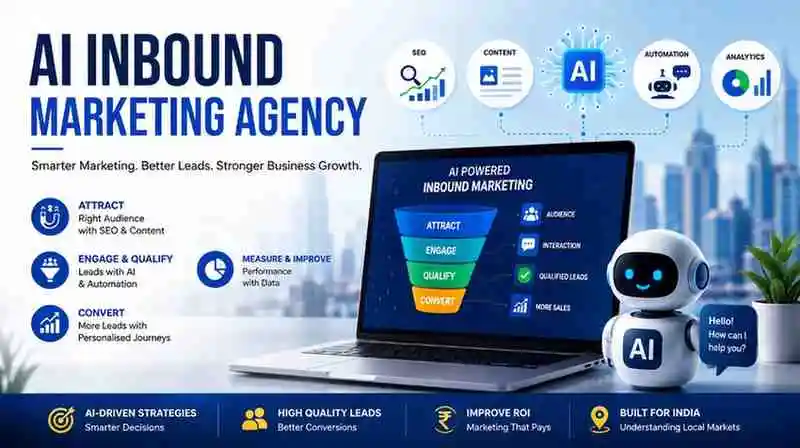
An AI inbound marketing agency typically works across several connected activities. SEO brings relevant searchers to the website. Content answers their questions. Landing pages help them understand the offering. AI tools can assist with analysing behaviour and identifying useful follow up opportunities. Chatbots can handle basic questions. CRM automation can organise enquiries. Email sequences can continue the conversation when someone is not ready to buy immediately.
The technology is useful, but I would not put AI at the centre of everything.
I have seen businesses spend too much time discussing AI tools while their website still has unclear service pages, weak calls to action and content that sounds like it was written for a search engine rather than a customer. That is a frustrating mistake because no software can repair a confusing business proposition.
An AI inbound marketing agency should therefore begin with the business, not the tool.
What does the company sell? Who actually buys it? What makes people hesitate? What questions do sales teams hear repeatedly? Which products have healthy margins? Which leads are worth following up? What happens between the first website visit and the final enquiry?
These questions matter because inbound marketing is not simply about bringing more visitors.
It is about bringing people who have a genuine reason to continue the conversation.
For StratMarketer, this distinction is particularly relevant when working with Indian businesses. A manufacturing company, education provider, healthcare business, real estate company and SaaS firm may all need inbound marketing, but their customer journeys are very different. A person looking for a ₹20,000 service may take a few days to decide. Someone considering an industrial project worth several crores may spend weeks or months researching before contacting a company.
An AI inbound marketing agency has to account for that difference rather than applying the same content and automation process everywhere.
Why Indian Businesses Are Moving Towards AI Inbound Marketing
Indian businesses have traditionally depended heavily on referrals, sales teams, distributors, local relationships and paid advertising. Those methods are still important. In fact, for many businesses they remain essential.
But customer research has changed.
A prospective customer may now search Google before speaking to a salesperson. They may watch videos, compare service providers, read reviews, check a company’s website, look at LinkedIn activity and ask an AI search tool for recommendations. Sometimes this happens before the business even knows that the prospect exists.
That is one reason demand for an AI inbound marketing agency is increasing.
A business wants to be present during that research process.
Take a simple example. A business owner in Ahmedabad wants to install solar systems for a commercial property. Before contacting a supplier, they may search for installation costs, system capacity, subsidy information, maintenance requirements, expected savings and suitable suppliers. If a solar company has useful content covering these questions, it has a chance of becoming part of the buyer’s consideration set.
If the website only says, “We provide the best solar solutions,” there is very little for the searcher to learn.
This is where inbound marketing becomes practical.
An AI inbound marketing agency can help identify the questions people are asking and organise them around the stages of the buying process. AI can analyse large amounts of keyword and content information, identify patterns and help marketers find gaps. The final content still needs human editing because Indian audiences are particularly quick to notice vague claims and exaggerated promises.
There is another reason businesses are paying attention to AI inbound marketing.
The cost of acquiring attention has become a concern.
Paid advertising can produce enquiries quickly, but the business continues paying for traffic. SEO and content can take longer, sometimes considerably longer, but a useful page can continue attracting visitors after the initial publishing cost.
I generally prefer combining the two rather than treating SEO and paid advertising as competing choices. Paid campaigns can help test offers and landing pages. Organic content can build a longer term source of enquiries. AI can sit across both processes and help identify patterns.
Still, this does not mean every company needs an elaborate AI system.
A local service business with five employees may need a well structured website, good local SEO, useful service pages, WhatsApp follow ups and a simple CRM. Building a complicated AI stack for that business would be unnecessary.
A larger B2B company with several salespeople, hundreds of enquiries and multiple service categories is a different situation.
This is where an AI inbound marketing agency can become more useful.
Indian buyers also tend to research heavily before making larger purchases. Price matters, but so do trust, reviews, experience, location, technical capability and after sales support. For high value services, a prospect may read several pages before filling out a form.
The website has to answer those doubts.
AI can help marketers identify common questions from search queries, website behaviour, sales conversations and customer interactions. The human team then turns those findings into useful pages, articles, case studies, comparison content and FAQs.
There is a small but important difference here.
The goal is not to make the website look intelligent.
The goal is to make the buyer’s research easier.
How AI Changes the Way Inbound Leads Are Generated
Traditional inbound marketing already had a basic process. Create useful content, attract visitors, convert some of them into leads and pass those leads to sales.
AI changes the speed and depth of the analysis around that process.
An AI inbound marketing agency can look at hundreds or thousands of interactions and find patterns that would be difficult for a marketing executive to notice manually. Which pages are visited before an enquiry? Which search terms bring people who actually submit forms? Which content attracts traffic but almost no business enquiries? Which service pages are generating calls?
These are much more useful questions than simply asking how many visitors a website received.
Suppose a digital marketing company receives 1,000 organic visitors from informational blog posts but only five enquiries. Another service page gets 250 visitors and produces 18 enquiries.
The second page may be far more valuable.
AI can help identify this relationship by combining traffic, engagement, conversion and CRM information. It can also help segment visitors according to their behaviour. Someone reading an introductory article is not necessarily at the same stage as someone who spends five minutes on a pricing page and then visits a case study.
The follow up should not be identical.
This is one of the strongest uses of an AI inbound marketing agency.
AI can support lead qualification.
A website visitor may interact with a chatbot and ask about pricing, service availability, delivery timelines or technical specifications. Instead of treating every chat as an equal lead, the system can collect relevant information and pass stronger enquiries to the sales team.
For example, a B2B software company may ask about company size, current software, business requirement and expected implementation timeline. A sales executive can then see the context instead of receiving a message that simply says, “Please call this customer.”
That saves time.
It also reduces one of the irritating problems with inbound lead generation: sales teams receiving enquiries that were never likely to become customers.
AI can also help with content personalisation. A visitor interested in SEO services does not necessarily need to see the same content as someone researching paid advertising. Website recommendations, email sequences and follow ups can be adjusted based on the interaction history.
But there is a limit.
AI should not pretend to understand a prospect when the available information is weak. I have more confidence in AI helping classify a lead based on clear behaviour than in AI making sweeping assumptions about a person’s intentions.
I might be wrong here, and this may not apply everywhere, but businesses sometimes become too enthusiastic about automated lead scoring. A prospect who spends ten minutes on a website is not automatically a better lead than someone who spends two minutes and calls directly.
Human behaviour is messy.
Another major change is content production. An AI inbound marketing agency can research topics, identify related questions, analyse existing content and assist writers with first drafts much faster. But publishing large volumes of generic AI written articles is not the answer. Google has become better at understanding content quality, and readers are also becoming better at recognising pages that say a lot without actually helping.
For StratMarketer, the useful role of AI is therefore not simply producing more articles.
It is helping understand what deserves to be written.
A good inbound strategy may involve service pages, location pages, expert articles, comparison pages, case studies, FAQs, videos, downloadable resources and lead forms. Each piece has a job. Some attract attention. Some build trust. Some answer objections. Some generate the enquiry itself.
AI can help connect these pieces.
There is also a practical advantage for Indian businesses operating across multiple cities. A company serving Hyderabad, Bengaluru, Pune and Delhi may receive different search behaviour in each market. AI can help identify local variations in queries and customer interests, but the pages still need genuine local relevance. Simply changing the city name throughout a template is not enough.
That approach usually creates thin pages and eventually becomes a headache.
The better approach is to understand what people in each market actually need and then build useful content around those differences.
Inbound lead generation has always depended on relevance. AI does not change that basic truth.
It simply gives marketers more information to work with, more quickly, and sometimes that information exposes uncomfortable things. A company may discover that its most visited content brings almost no commercial value. Or that customers are repeatedly asking a question the website has ignored for two years. Or that the sales team is spending half its time following leads that should have been filtered earlier.
Those findings are not always pleasant.
But they are useful.
And that is probably where an AI inbound marketing agency has its real role. Not in making marketing look futuristic, but in helping a business understand what potential customers are doing before they finally decide to make contact.
SEO, Content and AI Working Together for Better Organic Leads
SEO still sits at the centre of inbound marketing because people usually do not begin their research by looking for a particular company’s website. They begin with a problem.
A manufacturer may search for “industrial RO plant manufacturer in India”. A hospital may look for a treatment or specialist. A startup founder may search for software pricing, while a business owner may type something as simple as “best digital marketing company for lead generation”.
This is where an AI inbound marketing agency can bring SEO and content closer together.
Earlier, keyword research often meant collecting a list of phrases, checking search volume and creating articles around those phrases. That process still has value, but it is not enough by itself. Search intent has become more important because one keyword can represent several different needs.
Someone searching for “CRM software” could be researching options, comparing prices, looking for implementation advice or simply trying to understand what CRM means.
The content should not assume too much.
AI can help marketers analyse related searches, existing search results, frequently asked questions, content gaps and patterns across large keyword sets. The human SEO team then decides what deserves attention and what does not.
This distinction matters.
I have seen businesses publish dozens of blog posts because a keyword tool suggested them, while their main service pages remained weak. That is the wrong priority in many cases. If the commercial page cannot explain the service properly, another fifty blogs will not magically solve the lead generation problem.
A better approach is to connect content with the actual buying journey.
Someone at the early research stage might need an educational article. A person comparing suppliers may need a detailed comparison or case study. Someone who already understands the requirement may be looking for pricing, implementation details, service coverage or a consultation.
An AI inbound marketing agency can use these signals to build a more connected content system.
For StratMarketer, this can mean looking at SEO from three angles. What are people searching for? What information do they need before contacting a business? What type of content can move a genuinely interested visitor closer to an enquiry?
AI can assist with all three.
Content also becomes easier to update. If an article is bringing traffic but no enquiries, the team can review its intent, internal links, calls to action and relationship with relevant service pages. Sometimes the problem is not the article itself. It is what happens after the visitor reads it.
A reader should have somewhere useful to go next.
That could be a service page, a case study, a consultation form, a pricing explanation or another article answering the next obvious question.
This sounds simple, but websites often miss it.
Organic lead generation is rarely one article leading directly to one enquiry. More often, the customer visits several pages over time and gradually becomes comfortable with the business.
That is where SEO, content and AI start working as one system rather than separate activities.
Using AI to Understand Search Intent and Customer Behaviour
Search intent is often discussed as if it fits neatly into four boxes. In actual business situations, it is rarely that clean.
A person can have more than one intention.
For instance, someone searching for “AI inbound marketing agency in India” may want to understand the service, compare agencies, check pricing, see what AI actually does and find out whether the service is suitable for their business. The same search can contain research and commercial intent at the same time.
An AI inbound marketing agency can use AI tools to identify these overlapping patterns by examining search queries, related questions, content engagement and website behaviour.
The useful part is not simply knowing what someone searched.
It is understanding what happened afterwards.
Did the visitor read one paragraph and leave? Did they visit three service pages? Did they return two days later? Did they download something? Did they start a form but not complete it? Did they call the business after reading the article?
These signals tell a different story.
Imagine a company selling industrial equipment. Its article about “types of industrial boilers” receives thousands of visits. At first glance, that looks successful. But the sales team reports that hardly any enquiries come from that traffic.
Another article about “industrial boiler installation cost” receives much less traffic but generates serious enquiries.
Which article is more valuable?
The answer is obvious once the business looks beyond traffic.
AI can help surface this kind of pattern across large amounts of data. It can group visitors, identify pages commonly visited before conversions and highlight content that attracts commercially useful audiences.
Still, I would be careful with behavioural interpretation.
A person reading five pages is not necessarily ready to buy. Someone visiting only once may already know exactly what they need and simply want a phone number. Automated scoring can help, but it should support judgement rather than replace it.
This is one area where I think some businesses expect too much from AI.
Customer behaviour is influenced by budget, urgency, internal approvals, previous experiences and sometimes simple personal preference. A model cannot know all of that from a few website clicks.
The stronger use of AI is pattern recognition.
An AI inbound marketing agency can analyse thousands of interactions and help marketers ask better questions. Which topics attract business owners? Which pages are common among qualified leads? Which source brings enquiries that sales teams actually value? Which landing pages have high form completion but poor lead quality?
These questions are much closer to revenue than simply asking how many people visited the website.
Search intent can also influence the content format.
An informational query may need an article or explainer video. A comparison query may need a detailed comparison page. A transactional query may require a strong service page with clear proof, pricing information and an easy way to contact the business.
AI can help identify these patterns faster.
But the final judgement should remain with people who understand the market.
For an Indian business, that local understanding is important. Search behaviour can differ between a manufacturing buyer in Gujarat, a startup founder in Bengaluru and a local service customer in Lucknow. Language, trust, price sensitivity and preferred communication channels can all affect the journey.
AI sees patterns.
People understand context.
Both are needed.
How AI Chatbots and Automation Help Qualify Inbound Leads
Generating an enquiry is only the beginning.
Many businesses discover this after increasing their website traffic. The marketing report looks better, but the sales team starts complaining that the leads are irrelevant.
A construction company might receive enquiries from people looking for small residential work when it actually handles large commercial projects. A B2B software company may receive enquiries from students. A consultant may get messages asking for free advice instead of serious business discussions.
More leads can create more work without creating more sales.
This is where an AI inbound marketing agency can use chatbots and automation to qualify enquiries before they reach the sales team.
A chatbot can ask basic questions such as what service the visitor needs, where the business is located, approximate requirement, expected timeline and whether they are ready for a consultation.
The questions should be sensible.
There is no point asking a visitor twelve questions before allowing them to contact a company. That is not qualification. That is making the visitor tired.
A better system asks only what the sales team genuinely needs.
Suppose a company provides commercial interior design services. The chatbot might ask about property type, approximate area, city, project stage and expected timeline. A visitor with a 20,000 square foot office project requiring work within three months is clearly different from someone casually asking about a small home renovation.
The sales team can respond accordingly.
Automation can also handle simple requests outside business hours. If someone submits an enquiry at 11:30 pm, they do not have to wait until the next morning to receive basic information.
This does not mean the chatbot should pretend to be a human.
I strongly prefer clear communication here. If a customer is interacting with an automated assistant, it should behave like one and provide useful information without pretending to have personal experience it does not have.
Poor chatbots are irritating.
They keep asking the same question, fail to understand simple language and force customers through menus when a phone number would have been easier.
A good AI inbound marketing agency should know when automation is useful and when it should simply get out of the way.
Lead qualification can also connect with CRM systems. Once a visitor provides information, the details can be organised automatically and assigned to the right sales person. Follow up reminders can be created. Leads can be grouped based on service interest or buying stage.
This becomes especially useful for companies receiving enquiries from multiple channels.
A prospect may first find a blog through Google, return through a paid advertisement, interact with a chatbot and finally submit a form after reading a case study. Without proper tracking, the business may see these as separate interactions.
With connected systems, the journey becomes easier to understand.
The purpose is not to automate every human interaction.
It is to remove the repetitive work that does not require one.
Personalised Content and Follow Ups Across the Customer Journey
Not every visitor needs the same information.
A person who has just discovered a problem needs education. Someone comparing suppliers needs evidence. A prospect who has already requested a quotation needs clarity about the next step.
This is where personalisation becomes useful.
An AI inbound marketing agency can use behavioural information to decide which content, emails or follow ups are more relevant to different groups of visitors.
Consider a business selling accounting software to Indian SMEs.
A visitor reading an article about GST compliance may be interested in compliance features. Another visitor comparing accounting software pricing may be much closer to a purchase decision. Sending both people the same five email sequence would not make much sense.
Their concerns are different.
AI can help organise these audiences and recommend suitable follow ups.
A person who downloads an accounting checklist might receive educational content first. Someone who visits the pricing page several times could receive an invitation for a product consultation. A business that has already spoken to sales may need implementation information rather than another introductory blog.
This is where automation can feel less mechanical when it is based on genuine context.
But personalisation can also go too far.
Nobody likes the feeling that a website knows too much about them. If an email says, “We noticed you looked at our pricing page three times this week,” it may technically be personalised, but it can also feel uncomfortable.
Use judgement.
For StratMarketer, the better approach is to use behavioural signals quietly. The customer should receive more relevant information without feeling watched.
Follow ups also need timing.
Someone requesting a quotation may need a quick response. Someone downloading an educational guide may not want a sales call five minutes later.
An AI inbound marketing agency can help create different workflows for these situations. Leads can be segmented based on their actions, interests and stage in the buying process. Email content can then change accordingly.
The same principle applies to website content.
Returning visitors can be guided towards deeper information. Existing leads can be directed towards case studies or service details. Visitors from a particular campaign can land on pages related to that campaign instead of being sent back to the homepage.
Small changes can make the journey easier.
Sometimes the best personalisation is simply showing the right page at the right moment.
Measuring Lead Quality, Conversion Rates and Marketing Performance
This is where inbound marketing becomes serious.
Traffic numbers are easy to report. They are also easy to misunderstand.
A business can receive 100,000 website visits and still struggle to generate sales. Another business may receive 5,000 visits and generate a steady flow of qualified enquiries.
An AI inbound marketing agency should therefore look beyond traffic and basic engagement metrics.
Lead quality matters.
A useful measurement system should connect marketing activity with what happens after the enquiry. How many leads were qualified? How many became sales opportunities? How many reached a proposal stage? How many became customers?
The exact metrics will vary by business.
For a local service company, phone calls and consultation requests may matter most. For a SaaS business, product demonstrations and trial registrations may be more important. For a manufacturing company, a qualified project enquiry may be worth far more than hundreds of low intent form submissions.
AI can help identify these differences.
It can analyse patterns between traffic sources, landing pages, keywords, content and eventual conversions. Over time, this gives the marketing team a better understanding of which activities are actually contributing to business enquiries.
One of the most useful metrics is often overlooked.
Lead to customer conversion rate.
Suppose SEO generates 200 enquiries and paid advertising generates 80. It may appear that SEO is performing better. But if only five SEO leads become customers while 15 paid leads convert, the picture changes completely.
That is why an AI inbound marketing agency should ideally work with CRM and sales data rather than relying only on Google Analytics or search reporting.
The uncomfortable part is that this can expose weak marketing decisions.
An article may rank well and bring traffic but generate nothing commercially useful. A campaign may produce cheap leads that waste the sales team’s time. A landing page may have a good conversion rate but attract people who cannot afford the service.
Those numbers are not failures by themselves.
They are signals.
The real question is what the business does after seeing them.
At StratMarketer, an AI inbound marketing approach can be used to connect SEO, content, paid campaigns, website interactions, lead qualification and follow ups into a more understandable customer journey. The purpose is not to produce impressive dashboards. It is to help answer a practical question: are the right people finding the business and moving towards a genuine enquiry?
I might be wrong about how much automation every company needs. It depends heavily on the sales cycle, team size and nature of the product. A small local business may get better results from a clean website and fast human follow up than from an expensive automated system.
That is worth saying clearly.
AI is useful when there is enough activity and information for it to make a meaningful difference. If there are only ten enquiries a month, manually understanding those ten conversations may sometimes be more valuable than building a complicated scoring model.
The numbers should decide that, not the excitement around the technology.
And there is another thing businesses sometimes forget. A lead is still a person who has a question, a concern, a budget and probably some hesitation. No dashboard changes that.
How StratMarketer Approaches AI Inbound Marketing for Indian Businesses
The biggest mistake with AI inbound marketing is starting with AI.
It sounds strange because the phrase itself puts AI first, but in practical work, the business problem should come before the technology. If a company has unclear services, weak positioning, poor website content or a sales team that does not follow up properly, adding automation will not suddenly fix everything.
At StratMarketer, the more sensible starting point is understanding how the business actually gets customers.
Who searches for the service? What do they ask before making contact? Which products or services are commercially important? Where do existing leads come from? What happens after someone fills out a form? Which enquiries are useful and which ones waste the sales team’s time?
These questions shape the inbound strategy.
For an Indian business, this matters because customer journeys can be quite different across sectors. A manufacturing company in Ahmedabad may have a long B2B sales cycle. A healthcare provider may depend heavily on trust and location. An education company may receive large volumes of enquiries but struggle with lead quality. A software company may need content that works for both Indian and international buyers.
There is no sensible reason for all of them to follow the same AI inbound marketing process.
StratMarketer can use SEO and content to attract people who are already researching a problem or service. AI can assist with analysing search patterns, related queries, content gaps and customer questions. Those insights can then be turned into useful website pages and content rather than simply producing articles because a keyword tool suggested them.
This difference is important.
A business does not need more content just for the sake of publishing more content.
It needs content that answers the questions which appear before a commercial conversation.
Suppose an Indian solar company wants enquiries for commercial solar installation. A generic article about renewable energy may bring traffic, but a detailed page covering commercial installation costs, system sizing, payback considerations, maintenance and project requirements may be much closer to the buyer’s actual decision process.
That is the kind of thinking an AI inbound marketing agency should bring to the table.
SEO remains a major part of the approach. But the focus should move beyond rankings alone. Search visibility is useful only when it brings relevant people to pages that help them take the next step.
AI can help identify opportunities faster.
It can analyse large keyword sets, group related searches, identify content gaps and assist with competitor research. It can also help review existing pages and identify places where a business is answering a question poorly or not answering it at all.
The final judgement still needs a person who understands the business.
I would not allow AI to decide the entire content strategy for a technical Indian company without human review. It can miss industry terminology, misunderstand buyer priorities or produce perfectly grammatical information that is simply wrong for the market.
That happens more often than people admit.
The next part is lead qualification.
Getting 500 enquiries sounds impressive until a sales manager tells you that most of them are irrelevant.
An AI inbound marketing agency can help businesses introduce forms, chatbots and automated workflows that collect useful information before a lead reaches the sales team. The questions depend on the business. A B2B company may need company size, requirement, project stage and expected timeline. A service provider may need location, service type and approximate budget.
The idea is not to create a long questionnaire.
It is to collect enough information for the sales team to know what they are dealing with.
AI can also support follow ups. Someone who downloaded an educational guide may not be ready for a sales call. Someone who requested a quotation is in a different position. Someone who has visited pricing and service pages several times may need a direct consultation option.
These signals can be used to make follow ups more relevant.
There is still a human element here that cannot be automated away.
Salespeople know things that analytics does not show. They hear objections. They notice hesitation. They know when a customer says “send me the details” but actually means “I am not convinced yet”.
That information should feed back into marketing.
If sales teams repeatedly hear the same objection, the website should eventually answer it. If prospects keep asking about pricing, timelines or implementation, those subjects probably deserve better content.
This creates a useful loop between marketing and sales.
The AI inbound marketing agency is not just generating leads and passing them over. It should help the business understand what happens before and after an enquiry.
Measurement is another part of this process.
At StratMarketer, looking only at traffic would not be enough. The more useful questions are which sources produce qualified leads, which pages influence enquiries, which leads become sales opportunities and which campaigns attract customers rather than just clicks.
A blog bringing 20,000 visitors may look successful.
If a service page bringing 2,000 visitors produces more qualified enquiries, the second page deserves more attention.
This is why inbound marketing needs commercial thinking.
SEO, content, AI, automation and analytics should support the sales process rather than exist as separate marketing activities. And sometimes the best decision is not to automate something. If a business receives a small number of high value enquiries each month, personal follow up may be more effective than building an elaborate automated workflow.
I might be wrong here for some businesses, but that distinction is important.
AI is a tool.
The business model comes first.
How to Choose the Right AI Inbound Marketing Agency for Your Business
Choosing an AI inbound marketing agency should not start with asking which agency uses the most AI tools.
That is probably the least useful question.
Almost every marketing company can now mention AI somewhere in its service offering. The more important question is what the agency actually does with it.
Ask how they understand your customer.
If the answer is mainly about generating blog posts, creating social media captions and automating emails, I would be cautious.
Inbound marketing is much broader than content production.
The agency should be able to explain how it plans to attract the right audience, understand search intent, create useful content, convert website visitors, qualify enquiries and measure what happens after the lead is generated.
A good AI inbound marketing agency should also ask you questions.
What is your average customer value? Which services are most profitable? What locations do you serve? How long does a typical sale take? Where do your best customers currently come from? Which leads do you reject? What objections does your sales team hear?
If an agency does not ask these questions, it may be thinking more about marketing activity than business outcomes.
Look carefully at their SEO approach too.
Ask how they decide which keywords to target. Ask how they distinguish informational searches from commercial searches. Ask how they plan service pages and supporting content. Ask how they will measure whether organic traffic is producing meaningful enquiries.
Be wary of anyone promising immediate organic rankings for competitive terms.
SEO takes time, particularly when the website is new or competing against established businesses. An agency can make improvements quickly, but no honest professional can guarantee exactly when Google will rank a page in a particular position.
The same caution applies to AI.
AI can make research, analysis and content workflows faster. It does not guarantee high quality content.
Ask who reviews AI assisted content before publishing.
For industries such as finance, healthcare, manufacturing, legal services and technical consulting, human review becomes especially important. A small factual error can damage trust, and sometimes it can create a much bigger problem than a missed keyword opportunity.
Another thing worth checking is how the agency handles lead qualification.
A good AI inbound marketing agency should understand that not every form submission has equal value.
Ask whether the agency can connect website forms, chatbots and marketing systems with the CRM or sales process. Ask how qualified leads will be identified. Ask what happens when someone submits an enquiry outside working hours. Ask how the team plans to prevent salespeople from being flooded with irrelevant enquiries.
These questions reveal whether the agency understands what happens after marketing.
Reporting also deserves attention.
A monthly report showing impressions, clicks and website traffic is not necessarily enough.
You should be able to understand which activities generated enquiries, what quality those enquiries had and what happened to them later. Depending on your business, useful measures could include qualified lead volume, conversion rate, cost per qualified lead, opportunity creation and customer acquisition.
The exact numbers will vary.
Do not let an agency force your business into a generic reporting template.
I would also look for evidence of actual thinking rather than impressive presentation slides. Ask for examples where an agency changed its strategy because the original approach was not producing good leads.
That question is revealing.
Every serious marketing programme has weak experiments. Some content does not perform. Some keywords attract the wrong audience. Some landing pages convert poorly. A good agency should be comfortable talking about these things.
If everything in their case studies looks perfect, I would be slightly suspicious.
For Indian businesses, local market understanding can matter as well. Search behaviour, price expectations, trust signals and communication preferences vary across sectors and regions. An agency working with an Indian B2B manufacturer should understand the difference between a genuine procurement enquiry and someone simply downloading a catalogue.
Similarly, a local service business may need strong local SEO, reviews and fast enquiry handling rather than a huge national content campaign.
The right AI inbound marketing agency should be able to explain why a particular approach suits your business.
Not just what they are going to do.
There is also the question of communication. If the marketing team is generating leads but the sales team takes three days to respond, the problem is not entirely a marketing problem. The agency should be willing to identify that gap rather than continue reporting more leads every month.
Sometimes marketing exposes problems inside the sales process.
That can be uncomfortable.
But it is useful.
For StratMarketer, the opportunity is to bring SEO, content, AI, automation and lead management closer together so that inbound marketing becomes connected to actual business enquiries. The exact mix will depend on the company, its audience and its sales cycle.
One business may need stronger service pages and SEO. Another may need content and lead nurturing. Another may have enough traffic already but poor qualification. Another may need better tracking before spending another rupee on acquisition.
So before hiring an AI inbound marketing agency, ask one final question.
What exactly will happen after the lead arrives?
If the agency has a thoughtful answer to that, you are probably having the right conversation.