


What Is an AI Marketing Agency and Why Businesses Are Considering It
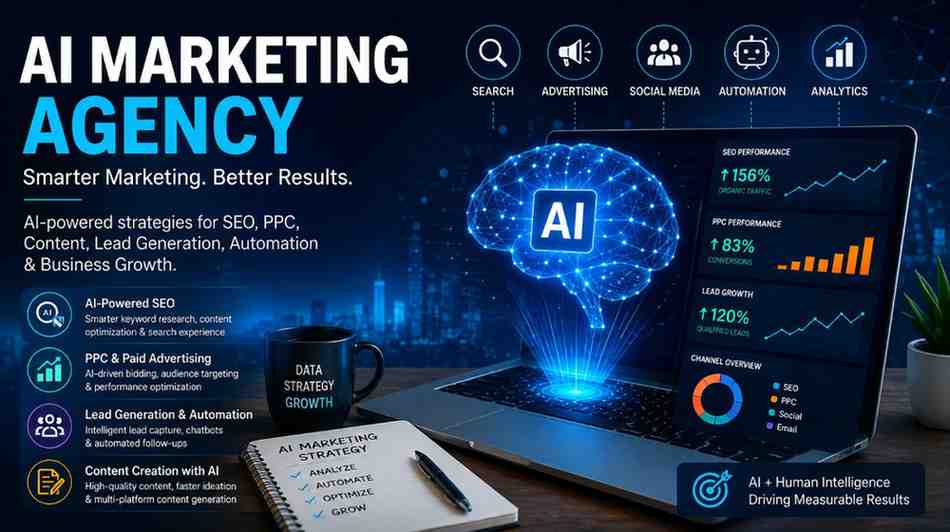
An AI marketing agency uses artificial intelligence alongside established digital marketing practices to help businesses plan, create, analyse and manage their online marketing activities. The important point is that AI does not replace SEO specialists, content writers, media buyers or marketing strategists. It gives them additional tools to work with customer data, search behaviour, content patterns, advertising performance and repetitive marketing tasks.
This distinction matters because the term AI marketing agency is being used quite loosely now. Some companies simply add an AI writing tool to their existing workflow and call themselves an AI marketing agency. That alone does not make much difference to a business.
A serious AI marketing agency looks at where AI can actually help.
For one company, that could mean analysing thousands of search queries and identifying patterns that would take a human team several days to review. For another, it may involve automated lead qualification through a website chatbot. An ecommerce business may use AI to test different ad messages, product angles and audience segments. A B2B company may need AI assisted content research and CRM follow ups instead.
The requirement is different in every case.
This is particularly relevant for Indian businesses because digital marketing has become much harder to manage through isolated activities. A company may be doing SEO, running Google Ads, posting on Instagram, collecting leads through WhatsApp and following up through a sales team. If these activities are managed separately, useful information gets lost between them.
An AI marketing agency can bring some of these activities closer together.
For example, suppose a manufacturer in Ahmedabad receives enquiries through Google search, paid advertising and its website. The marketing team may know which keywords generate traffic, while the sales team knows which enquiries actually become customers. Those two pieces of information are often sitting in different places.
AI can help analyse the relationship between them.
But I would not recommend using AI simply because it sounds modern. I have seen businesses spend money on automation before fixing basic issues such as poor landing pages, slow websites or unclear offers. The result is usually more activity, not better marketing.
That is where the human judgement of an AI marketing agency becomes important.
The agency still needs to understand the business, its customers, pricing, competitors and sales process. AI can process information quickly, but it does not automatically understand why a customer in Jaipur behaves differently from a customer in Bengaluru, or why a particular industrial buyer may need three conversations before sharing an enquiry.
An AI marketing agency is therefore better understood as a marketing partner that combines human strategy with AI assisted research, execution and analysis.
How an AI Marketing Agency Changes the Way Digital Marketing Is Managed
Traditional digital marketing often works in separate departments.
The SEO person looks at rankings. The content writer produces blogs. The PPC manager watches advertising campaigns. The social media person handles posts. Someone else manages leads and CRM follow ups.
There is nothing inherently wrong with this arrangement. It worked for many businesses for years.
The problem starts when these teams do not share enough information.
An AI marketing agency can connect these activities more closely because AI tools can analyse large amounts of information across different marketing channels. Instead of looking only at website traffic, the team can examine search queries, landing page behaviour, ad engagement, lead quality and customer interactions together.
Consider a simple example.
A business may notice that a particular service page receives 2,000 monthly visitors but generates very few enquiries. A conventional report might simply say traffic is increasing but conversions are low.
An AI marketing agency can go deeper by analysing the search queries bringing visitors to that page, the wording used on the page, the type of visitors arriving, the sections where people leave and the relationship between the traffic source and actual enquiries.
The problem may not be SEO at all.
Perhaps the page ranks for informational searches while the business expects commercial enquiries. Or the page explains the service but does not answer pricing, process or delivery questions. Or the call to action is buried at the bottom.
AI helps identify patterns faster, but someone still has to interpret what those patterns mean.
This is one area where I disagree with the idea that AI can run digital marketing on autopilot. It cannot, at least not reliably for most businesses. Marketing involves judgement. A machine may notice that one campaign has a lower cost per lead, but a sales manager may know that those leads are mostly poor quality.
That difference is critical.
An AI marketing agency can use automation to reduce repetitive work while keeping strategic decisions with experienced people. Campaign reports can be generated faster. Large keyword sets can be grouped. Customer questions can be classified. Ad variations can be produced for testing. Leads can be scored according to defined criteria.
The marketing team then spends more time deciding what should actually happen next.
There is another change happening quietly.
Marketing teams are becoming more experimental.
Earlier, creating ten versions of an advertisement could involve designers, copywriters and several rounds of approvals. With AI assisted workflows, creating and testing multiple variations can be much quicker. The same applies to email subject lines, landing page copy, social posts and content ideas.
But more variations do not automatically mean better marketing.
I have seen teams produce dozens of ad variations when the real problem was the offer itself. The creative was not the bottleneck. Nobody wanted the offer.
That kind of mistake becomes more frustrating when AI makes production extremely easy.
The better approach is to use AI where it removes unnecessary manual effort while keeping business thinking at the centre.
For Indian companies, this can be especially useful when marketing teams are small. An MSME may not have separate specialists for SEO, PPC, content, analytics and automation. Working with an AI marketing agency can give that business access to a wider range of capabilities without requiring every task to be handled manually.
There is also a practical advantage in speed.
Search behaviour changes. Advertising platforms change. Customers ask different questions. Competitors publish new content. A marketing team that takes two weeks to understand a campaign problem may already be behind.
AI can shorten the time between collecting information and acting on it.
Not every decision should be made quickly, though. Some should be questioned twice.
SEO, Content and Search Experience With AI Marketing
SEO is probably one of the areas where AI has created the most confusion.
Businesses often hear about AI generated content, AI search, generative search results, AEO, GEO and changing search behaviour, then assume traditional SEO is becoming irrelevant.
It is not that simple.
An AI marketing agency still needs to understand search fundamentals such as technical SEO, crawlability, internal linking, search intent, topical relevance, backlinks, content quality and website experience.
What has changed is the amount of information marketers can process.
Suppose a business wants to rank for a service such as industrial project consultancy. There may be hundreds of related searches around project reports, feasibility studies, bank requirements, project monitoring, financial assessment and consultant selection.
A human SEO specialist can research these topics manually. AI can help group the searches into related themes and identify relationships between them much faster.
The specialist can then decide which topics deserve individual pages, which should become supporting articles and which are simply variations of the same search intent.
That distinction is important.
Creating a separate article for every tiny keyword variation is not necessarily good SEO. A real customer does not think in keyword lists. They have a problem and search for an answer.
A good AI marketing agency uses AI to understand that behaviour rather than writing articles simply to insert keywords.
Content quality matters even more now because search engines are increasingly capable of understanding context. A page that repeats the phrase “AI marketing agency” fifty times may technically contain the keyword, but it will not necessarily deserve trust or visibility.
The content needs to answer the actual question.
For example, someone searching for an AI marketing agency may want to know what services are included, how AI is actually used, whether the agency handles SEO and paid advertising, how leads are qualified, what kind of businesses it works with and how success is measured.
Those questions should naturally appear in the content.
This is where search experience becomes important.
Search experience is not only about getting a visitor onto a website. It is about what happens after the click.
Does the page answer the question quickly?
Does the visitor understand what the company actually does?
Can they find supporting information?
Is there evidence of experience?
Can they contact the business without searching around for ten minutes?
These details influence whether SEO traffic becomes useful business traffic.
An AI marketing agency can use AI tools to analyse content gaps, search intent, competitor coverage and user behaviour, but the final content still needs human judgement.
For StratMarketer, this distinction is particularly relevant when working with Indian businesses. Search behaviour varies considerably across industries and locations. A local service company in Hyderabad may need a different content strategy from a manufacturing company in Raipur. A B2B consultant may need detailed educational pages, while an ecommerce brand may depend more heavily on product pages, comparison content and buying guides.
There is no single AI content formula that works for all of them.
AI can also assist with content briefs, topic clustering, entity research, competitor analysis, content refreshes and identifying unanswered customer questions. It can help an SEO team find patterns that are difficult to notice when reviewing hundreds of pages manually.
But publishing everything AI produces is a mistake.
I might be wrong here, but I think businesses will become much less impressed by the fact that content was created with AI. They will care more about whether the content actually helped someone make a decision.
That is already visible in the way search is evolving.
People are increasingly asking longer and more specific questions. They want comparisons, explanations, examples and practical answers. Search engines and AI systems are also becoming better at interpreting these questions.
So an AI marketing agency has to think beyond rankings.
A page might rank well and still fail commercially. Another page might receive less traffic but bring highly relevant enquiries every month. Which one is better?
For most businesses, the second one.
This is also why content should not be treated as a publishing target. Twenty average blogs every month may look impressive in a report, but if none of them addresses the questions customers actually ask during sales calls, the effort is questionable.
Sometimes the most valuable content comes from a sales conversation.
A customer asks, “How long does the implementation take?” Another asks, “Can this work with our existing CRM?” Someone else wants to know why your service costs more than a cheaper provider. Those questions are often better content topics than whatever generic keyword tool happens to suggest.
An AI marketing agency can collect and organise these questions at scale. The human team can turn them into useful pages with real examples, proper context and an honest explanation of limitations.
That combination is where AI marketing becomes practical.
And there is one uncomfortable part of this. AI can make poor content look polished enough to pass a quick review. That makes editorial judgement more important, not less.
Sometimes a slightly imperfect explanation from someone who has actually dealt with the problem is more useful than a perfectly formatted article that has never touched a real customer situation.
That difference is small on a spreadsheet.
It is not small when someone is deciding whether to contact your business.
Using AI for Paid Advertising, PPC and Performance Marketing
Paid advertising is one of the areas where an AI marketing agency can make a practical difference, mainly because advertising platforms generate huge amounts of data. Campaigns have keywords, audiences, placements, devices, locations, search terms, creatives, bids, conversions and costs to review. A human can analyse all this, but it takes time.
AI can help find patterns much faster.
For a Google Ads campaign, an AI marketing agency can analyse search terms and identify irrelevant queries, repeated themes, high performing commercial phrases and areas where the budget is being wasted. The same thinking can be applied to Meta Ads, LinkedIn campaigns and other paid channels.
But there is a catch.
AI does not know your profit margin unless someone gives it that information. It may identify a campaign with a low cost per lead as successful, while the sales team knows those leads rarely become paying customers.
I have seen this happen with service businesses. A campaign generated enquiries at what looked like a reasonable cost, but many people were only asking for a quotation and never had any serious buying intention. The dashboard looked healthy. The sales team was irritated.
That is why an AI marketing agency should not judge paid advertising only through clicks, impressions or cost per lead.
The real question is what happens after the lead arrives.
AI can help with bid adjustments, audience analysis, creative testing, keyword grouping and performance forecasting. It can also help create multiple ad variations much faster. This is useful when a business needs to test different messages for different customer groups.
For example, an Indian solar company may want separate messaging for homeowners, commercial property owners and industrial buyers. The product may be similar, but the reason for buying is not.
One audience may care about electricity savings. Another may care about project payback. Another may be concerned about installation, maintenance and financing.
An AI marketing agency can help identify these differences from historical campaign and customer data.
Still, I would never hand over the entire advertising account to automation and simply hope for the best. There are too many situations where business context matters more than a platform recommendation.
Sometimes the right decision is to spend less.
Sometimes a campaign needs to stop completely.
Sometimes the problem is not the advertisement but the landing page.
That judgement remains human.
AI Lead Generation, Chatbots and Automated Customer Follow Ups
Generating a lead is only half the job.
The uncomfortable part for many businesses starts after the form is submitted.
Someone fills in an enquiry form at 11:30 at night. The sales team sees it the next morning. By then, the customer may have already contacted three competitors.
An AI marketing agency can help businesses reduce this delay through chatbots, automated responses and lead qualification systems.
A website chatbot can answer common questions, collect basic information and guide visitors towards the appropriate service. It can ask what the customer is looking for, their location, approximate requirement and preferred contact method.
That does not mean the chatbot should pretend to be a human salesperson.
I dislike that approach.
If someone is speaking to an automated system, it is better to make the interaction useful rather than trying too hard to hide the automation.
For a B2B company, the chatbot might collect details such as company type, project requirement, expected quantity and timeline. A high intent enquiry can then be sent to the sales team while basic queries are handled automatically.
An AI marketing agency can also use lead scoring.
A person downloading a general industry guide may not be ready to buy. Someone requesting a quotation or asking about implementation timelines is likely further along in the buying process.
These leads should not necessarily receive the same follow up.
AI can classify leads based on defined signals and help decide what happens next.
Automated follow ups are useful too. A prospect may receive an email after submitting an enquiry, followed by a WhatsApp message or another relevant communication after a suitable period.
But automation can become irritating very quickly.
We have all experienced businesses sending five messages after one enquiry. The customer asked for information, not a daily reminder.
Good automation should know when to stop.
This is one area where businesses need to be careful with AI marketing. The technology can make communication faster, but poor rules can also make a company look careless.
A good AI marketing agency should therefore connect lead generation with the actual sales process. If the sales team uses a CRM, the automation should work around it instead of creating another isolated system.
The goal is not to collect the maximum number of leads.
It is to help the right leads reach the right person at the right time.
Social Media Marketing and Content Creation With AI
Social media has become difficult to maintain consistently, especially for businesses that do not have an in house content team.
There are posts to write, creatives to prepare, comments to respond to, videos to edit, customer questions to answer and performance reports to review.
AI can reduce some of this workload.
An AI marketing agency can use AI tools to generate content ideas from customer questions, product information, previous posts and current conversations. It can also help create first drafts, repurpose long form content into social posts and produce different versions for different platforms.
That is useful.
But posting generic AI written content every day is not a social media strategy.
Customers can usually tell when a company has no real point of view.
A local Indian business may have interesting stories that no AI system could invent properly. A manufacturer may have a production issue that taught the team something. A doctor may repeatedly answer the same patient question. A restaurant owner may know exactly why customers complain about delivery times.
Those details make content believable.
AI can help organise and repurpose those experiences, but someone inside the business still needs to provide the substance.
For StratMarketer, this kind of workflow can make sense when social media, SEO and paid advertising are connected. A detailed blog can become several social posts. A customer question can become a short video script. A successful advertising message can inform organic content.
One idea can then work across multiple channels instead of starting from zero every time.
AI is also useful for analysing social media performance. It can identify which topics generate meaningful interactions and which posts are receiving attention without creating any business value.
That distinction is easy to miss.
A funny post may receive thousands of views and no enquiries. Another technical post may get 200 views but generate three serious conversations.
Which one matters more?
Usually the second one, unless brand awareness is the actual objective.
I might be wrong on how every business should measure this because social media behaves differently across industries. A consumer fashion brand and a specialist engineering consultancy cannot be judged by the same numbers.
That is exactly why context matters.
How AI Marketing Agencies Use Customer Data and Search Intent
Customer data is where AI marketing can become genuinely useful, provided the underlying data is reliable.
An AI marketing agency can analyse website behaviour, search queries, CRM records, campaign performance and customer interactions to identify patterns.
The interesting part is often not what customers clicked.
It is what they were trying to accomplish.
Someone searching “best CRM for small business” is asking a different question from someone searching “CRM implementation consultant in Pune”. Both searches relate to CRM, but their buying stages are different.
Search intent helps marketers understand that difference.
AI can process large sets of search queries and group them according to intent. It can also analyse questions appearing in customer conversations and identify recurring concerns.
Suppose a business receives repeated enquiries about pricing.
That could indicate strong buying intent.
Or it could mean the website does not explain the service clearly enough.
The answer depends on context.
This is where an AI marketing agency needs experienced people who can interpret the information rather than simply accept an automated recommendation.
Customer data can also help identify patterns in existing customers. Perhaps customers from one industry convert at a higher rate. Perhaps one city produces more valuable enquiries. Perhaps customers who visit certain pages before contacting sales have a higher chance of closing.
These patterns can influence SEO, paid advertising and content decisions.
Privacy also needs attention.
Businesses should not collect or process customer information casually just because AI tools make it technically possible. Consent, access controls, data handling and applicable privacy requirements need to be considered.
AI marketing is not a licence to use every piece of customer information available.
That should be obvious, but it is worth saying because some businesses are rushing into automation without thinking through what happens to the data.
Common Mistakes Businesses Make When Choosing an AI Marketing Agency
The first mistake is choosing an agency because it uses the word AI everywhere.
AI is a tool.
It does not automatically tell you whether the agency understands SEO, advertising, content, analytics or your industry.
The second mistake is asking only about the number of tools the agency uses.
A long list of software does not prove marketing ability.
I would be more interested in how the agency decides which tool to use, what information it feeds into the system and how a human reviews the output.
Another common mistake is expecting immediate results from SEO because AI can create content quickly.
Content production has become faster. Search growth has not magically become instant.
A website still needs authority, useful information, technical health and time to establish credibility.
The opposite mistake happens with paid advertising. Some businesses expect AI to fix poor campaign economics.
It cannot.
If the product has weak demand, the offer is unclear or the landing page does not build confidence, automation will not solve the underlying problem.
Then there is the issue of reporting.
Be careful when an agency talks mostly about impressions, clicks and traffic but avoids discussing qualified enquiries, sales opportunities and revenue.
Marketing numbers should eventually connect to business numbers.
Not every campaign will produce immediate sales, of course. Brand campaigns and early stage content can have a longer effect. But the agency should still be able to explain why a particular activity exists and what it is expected to contribute.
Another mistake is handing over everything without understanding the process.
Businesses do not need to become AI experts. They should, however, understand what is being automated, what is being reviewed by people and what happens to their customer data.
Ask simple questions.
Who checks the content before publishing?
Who decides which leads are qualified?
Who reviews advertising performance?
What happens when the AI gives a wrong recommendation?
The answers tell you a lot.
And perhaps the biggest warning sign is an agency promising that AI will replace the need for experienced marketers.
I would be concerned about that claim.
AI can process information, generate variations, identify patterns and automate repetitive tasks. Marketing still involves understanding people, markets, businesses and uncomfortable decisions where there is no clean answer.
Sometimes the best marketing decision is not the one that the dashboard recommends.
That is where experience earns its place.
How StratMarketer Approaches AI Marketing for Indian Businesses
At StratMarketer, AI marketing is not treated as a separate activity that sits beside SEO, PPC or social media. The idea is to use AI where it genuinely helps a marketing team understand customers better, work faster and make more informed decisions, while keeping business judgement with people.
This matters for Indian businesses because the market is not uniform.
A local service provider in Jaipur, a SaaS company in Bengaluru, a manufacturer in Pune and a healthcare business in Hyderabad can all have completely different customers, buying cycles and marketing problems. An AI marketing agency that applies the same workflow to all four is likely to miss something important.
StratMarketer starts by looking at the business itself.
What is being sold? Who usually buys it? What questions do prospects ask before contacting the company? Which services have the strongest margins? Which locations matter? Where are existing leads coming from? What is happening after an enquiry reaches the sales team?
These questions sound basic, but they often reveal problems that technology alone cannot solve.
For example, a business may believe it needs more website traffic when the actual problem is that existing traffic is not being converted. Another company may be spending heavily on Google Ads while receiving enquiries from people looking for a cheaper service. A third may have good rankings but very little content addressing the questions customers ask during the final buying stage.
AI can help investigate these situations much faster.
For SEO, StratMarketer can use AI assisted research to understand search intent, group related queries, identify content gaps and examine how people are searching for a service. The output is then reviewed from a practical SEO perspective rather than simply publishing whatever an AI tool suggests.
This difference is important.
Search engines are becoming better at understanding meaning, context and useful information. Simply producing hundreds of pages around slightly different keyword combinations is becoming less sensible.
Content needs to answer real questions.
A customer searching for an AI marketing agency may not only want to know what AI means. They may want to know how an agency uses AI for SEO, PPC, lead generation, content, reporting and customer follow ups. They may also want to know what remains under human control.
Those are the questions a useful service page or article should address.
Paid advertising is handled in a similar way. AI can help analyse campaign data, search terms, audience behaviour and creative performance. It can identify patterns that may take a marketing team considerable time to find manually.
But StratMarketer does not treat an automated recommendation as a final business decision.
Suppose one campaign generates leads at a lower cost. That sounds positive until the sales team reports that most of those leads are not serious buyers.
The cheaper campaign may actually be the worse campaign.
This is why marketing data needs to be connected with business context.
Lead generation is another area where AI can be useful. Website enquiries, chat interactions and customer questions can be classified and routed based on defined criteria. Businesses can use automation to respond faster and reduce the amount of repetitive work handled manually by sales teams.
Still, the human conversation remains important.
A customer considering a high value service may have concerns that cannot be resolved through a chatbot. AI can collect information and answer routine questions, but the sales team should step in when the conversation becomes commercially important.
Social media and content production can also benefit from AI assisted workflows. A long form article can be repurposed into social content. Frequently asked customer questions can become video ideas. Advertising messages that perform well can provide insights for organic content.
This creates a more connected marketing process.
There is also room for AIO, AEO, GEO and search experience optimisation as search behaviour continues to change. Businesses are no longer dealing only with traditional search results. People increasingly ask detailed questions through AI powered interfaces and expect direct answers.
That does not mean abandoning conventional SEO.
It means creating information that is clear enough to be useful across different search environments.
For an Indian business, local context matters here. The way people search for a service in Delhi may not be identical to the way a customer searches in Indore or Kochi. Language, location, pricing expectations, industry terminology and buying behaviour all affect the search journey.
An AI marketing agency should account for those differences.
StratMarketer’s approach is therefore less about making everything automated and more about deciding where automation actually makes sense.
Some tasks should be automated.
Some should be assisted by AI.
Some should remain firmly human.
That line is not always fixed either. It changes as the business, customer behaviour and available technology change.
How to Choose the Right AI Marketing Agency for Your Business
Choosing an AI marketing agency can be surprisingly confusing because almost every agency now talks about artificial intelligence.
The first question should not be, “Which AI tools do you use?”
Ask what problem they are going to solve.
If your website receives traffic but very few qualified enquiries, the agency should be able to explain how it would investigate that problem. If your PPC costs are rising, ask how it would determine whether the issue is bidding, targeting, creative, search intent or the offer itself.
A good conversation will usually become specific quite quickly.
Be cautious when the discussion remains at the level of buzzwords.
Ask how AI will actually be used in your marketing process. Will it assist keyword research? Analyse search intent? Help with content planning? Review campaign data? Qualify leads? Support CRM follow ups? Analyse customer conversations?
You do not need every one of these services.
In fact, you probably should not buy every one of them.
The right AI marketing agency should first understand what your business needs and then decide where AI has a useful role.
Experience also matters.
A marketing team that understands your industry can often spot something that an automated system misses. An agency working with B2B manufacturing companies, for example, should understand that a lead may take weeks or months to convert. A person downloading a technical document cannot be judged in the same way as someone buying a low cost consumer product.
Ask how the agency measures success.
Traffic is useful. Rankings are useful. Click through rates are useful. But they should eventually connect with business outcomes such as qualified enquiries, sales opportunities, customer acquisition cost and revenue.
Not every marketing activity can be tied directly to a sale, and agencies should not pretend otherwise. SEO, brand building and educational content often take time. Still, there should be a clear explanation of what each activity is expected to accomplish.
I would also ask about content review.
Who checks AI generated content before it reaches your website?
This question gets ignored too often.
AI can produce grammatically correct content that is completely wrong for the business. It can misunderstand an industry term, invent a claim or explain something in a way that sounds convincing but lacks practical depth.
Human review is not optional when the content affects trust.
The same applies to customer data.
Ask where your data goes, who can access it and how customer information is handled when AI tools are involved. You do not need a highly technical answer, but the agency should have a clear process.
Then look at communication.
If you have to chase the agency every month to understand what happened, the technology will not save the relationship.
A good AI marketing agency should be able to explain results in ordinary business language. Not just provide a dashboard full of numbers.
For example, instead of saying that organic impressions increased by 42 percent, the agency should be able to explain which pages contributed to that increase, whether the new traffic matches the intended audience and whether enquiries have changed.
That is a much more useful conversation.
There is also the question of scale.
A startup may need a completely different marketing setup from an established manufacturer. A local business may need strong local SEO and lead management. A national ecommerce company may need paid advertising, product content, conversion optimisation and creative testing.
So do not choose an AI marketing agency purely because it has a large service list.
Choose one that understands the commercial problem you are trying to solve.
And I would be careful with guarantees.
No honest agency can guarantee a specific Google ranking for competitive keywords. No agency can promise that every AI generated lead will become a customer. Marketing depends on the market, competition, website, offer, pricing, sales process and many other factors.
An agency can control its process.
It cannot control the entire market.
That distinction becomes important after the contract is signed.
The right AI marketing agency should make your marketing team more capable, not more dependent on mysterious technology. You should understand what is being done, why it is being done and what the numbers actually mean.
AI can make marketing faster.
It can make analysis deeper.
It can also make bad decisions happen much faster if nobody is paying attention.
That last part is probably the one businesses should remember when they compare agencies. The technology matters, but the judgement behind it matters more.