


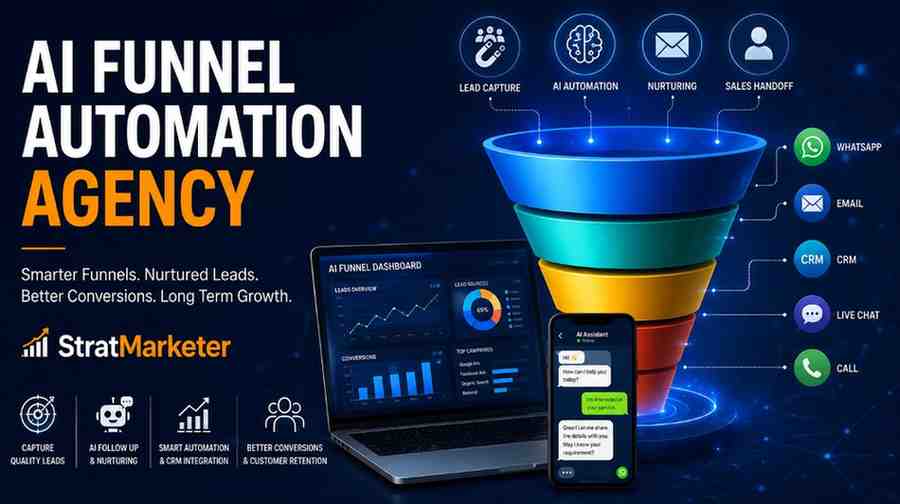
What Is an AI Funnel Automation Agency and Why Does It Matter for Modern Businesses?
A lot of businesses have leads coming in, but the actual problem starts after the enquiry arrives. Someone fills out a form, sends a WhatsApp message, clicks an ad, or asks for pricing, and then the business has to decide what to do next. Who should respond? How quickly? Is the person genuinely interested or just comparing prices? Should the lead go to sales immediately, or should someone first share more information?
This is where an AI funnel automation agency can become useful.
An AI funnel automation agency helps businesses connect different parts of their customer journey using artificial intelligence, automation tools, CRM systems and communication platforms. Instead of treating lead generation, follow up and sales as separate activities, the agency works on the entire funnel and looks at what happens from the first interaction until the person becomes a customer.
That distinction matters.
A business can spend a good amount on Google Ads or Meta Ads and still lose potential customers because nobody follows up properly. I have seen this happen with service companies where a lead arrives at 11 in the morning, the salesperson calls at 5 in the evening, and by then the customer has already spoken to three competitors.
The marketing campaign gets blamed.
Sometimes the real problem is the funnel after the click.
An AI funnel automation agency typically helps businesses identify these gaps and build automated workflows around them. AI can classify enquiries, understand basic intent, personalise messages, trigger follow ups, update CRM records and help sales teams decide which prospects need attention first.
But there is a point worth making here. Automation should not mean sending twenty messages because a person once downloaded a brochure. That kind of automation creates irritation very quickly.
Good automation knows when to stop.
For an Indian business, this becomes even more relevant because customers often move between channels. A person may first search on Google, visit a website, check Instagram, send a WhatsApp message and then call the business directly. Another person may fill in a form and expect a call within ten minutes.
The journey is rarely neat.
An AI funnel automation agency tries to make sense of this messy behaviour and connect those interactions into one workable system.
What Actually Happens Inside an AI Automated Funnel?
The word funnel sometimes makes the customer journey sound more orderly than it really is.
A typical funnel may begin with an advertisement, search result, social media post or referral. The visitor then reaches a website or landing page. They might submit a form, start a WhatsApp conversation, book a consultation or simply browse the service pages.
AI can start working at this point.
For example, suppose a company sells commercial solar installation services. One website visitor asks for a quotation for a factory. Another asks about a small residential system. A third visitor wants information about dealership opportunities.
All three are leads.
They are not equally valuable.
An AI funnel automation system can use the information provided by the visitor to classify these enquiries. The commercial factory enquiry could be marked as high priority because the potential project value is much higher. The residential enquiry could follow a different workflow. The dealership enquiry could be sent to a separate business development team.
This is one of the more practical uses of AI.
It is not about making the funnel look clever. It is about helping the business make fewer unnecessary manual decisions.
An AI funnel automation agency may build rules around lead source, location, service requirement, budget, company size, enquiry type, previous interactions and buying intent. AI can then interpret information that does not always fit neatly into predefined fields.
For example, a prospect may write:
“I run a manufacturing unit in Pune and need a system for our new plant. Please tell me approximate pricing and installation time.”
That sentence contains useful information even though the person has not filled every CRM field.
AI can identify the business type, location, likely requirement and buying intent and pass that information into the sales workflow.
The salesperson gets context instead of a blank lead record.
That small difference can change the quality of the conversation.
How an AI Funnel Automation Agency Connects Marketing, Sales and Customer Follow Up
Marketing and sales teams often work with different priorities.
Marketing wants enquiries. Sales wants qualified opportunities. Customer support wants clear information. Management wants to know where money is being spent and what is actually converting.
When these systems are disconnected, the customer ends up carrying the burden.
A person may submit the same details three times because the website, CRM and sales team are not connected properly. Someone from sales may call a prospect who has already purchased. Another salesperson may contact the same lead again the next morning.
These things sound basic, but they happen.
An AI funnel automation agency connects the stages so that information can move between them without someone having to manually copy and paste everything.
A simple workflow might look like this.
A visitor clicks a Google advertisement and lands on a service page. They fill out a form. The CRM creates a lead record. AI analyses the enquiry and assigns a lead category. If the enquiry appears urgent or commercially valuable, the system alerts the appropriate salesperson.
If the person does not respond, an automated follow up can be triggered.
If they reply, the workflow can change.
If they book a meeting, promotional follow ups should stop.
If they become a customer, the sales nurturing sequence should end and the customer onboarding workflow should begin.
This sounds straightforward when written down. Building it correctly is not always straightforward.
The difficult part is deciding what should happen in each situation.
I strongly prefer businesses to start with a few useful workflows rather than automate every possible action from day one. I have seen companies spend weeks creating complicated sequences that nobody in the sales team understands. After launch, salespeople simply bypass the system and start using WhatsApp manually.
That is an expensive lesson.
AI funnel automation works best when it supports the existing sales process rather than trying to replace human judgement completely.
Connecting Marketing Data With Sales Conversations
A useful AI funnel does not only know that a lead arrived.
It should know where that lead came from and what the person did afterwards.
Imagine two prospects.
One came from a Google search for “industrial RO plant manufacturer in India”. They visited three service pages and requested a quotation.
The second came from a broad social media advertisement, spent thirty seconds on the website and submitted a form with only a name and phone number.
Treating both leads exactly the same may not make sense.
AI can help interpret these signals and assign different follow up paths.
The first prospect may receive a direct sales call quickly. The second may enter a short educational sequence before a salesperson spends significant time on the enquiry.
This is where the relationship between marketing and sales becomes important.
The marketing team gets feedback about which leads actually become opportunities. Sales gets information about which campaigns are producing serious enquiries.
Without this connection, businesses often optimise for lead volume rather than lead quality.
That can create misleading reports.
A campaign producing 500 enquiries may look better than one producing 80 enquiries, until someone checks how many of those leads actually became paying customers.
An AI funnel automation agency can connect campaign data, CRM activity and customer outcomes so businesses can examine the funnel beyond the first conversion.
Follow Up Without Making Customers Feel Chased
Follow up is one of the simplest parts of sales and one of the easiest to get wrong.
A prospect may need three days to discuss a purchase internally. Another may need three weeks. Someone else may have simply forgotten to respond.
A rigid automated sequence treats all three people the same.
That is not ideal.
AI can make follow up more contextual.
Suppose someone asks for a quotation and then replies, “I will discuss this with my partner and get back to you.”
Sending another sales pitch the next morning is poor judgement.
A better system can recognise the response and pause the aggressive follow up. It might schedule a softer reminder after a suitable period.
The same principle applies to WhatsApp.
WhatsApp is extremely useful for Indian businesses because customers are comfortable using it for enquiries, documents, quotations and quick questions. But it also makes poor automation very obvious.
A customer who receives a generic “Dear Sir, are you interested in our services?” message after already having a detailed conversation can lose confidence immediately.
The system needs context.
An AI funnel automation agency can connect WhatsApp conversations with CRM records and use previous interactions to determine what should happen next. Depending on the setup, AI may help answer routine questions, collect missing information or hand the conversation to a human salesperson when the enquiry becomes more complicated.
The handoff is important.
AI should know when it has reached its limit.
AI Lead Capture and Qualification Across Different Funnel Stages
Lead capture sounds simple. Put a form on a website and collect names and phone numbers.
But a name and phone number alone do not tell a salesperson much.
A stronger lead capture process gathers information that helps determine whether the enquiry is worth immediate attention.
This does not mean asking visitors fifteen questions before allowing them to contact the company. That can reduce conversions.
The right information depends on the business.
For a B2B consulting firm, company size and project requirement may matter. For a real estate business, location, budget and property type could matter more. For a private label nutraceutical manufacturer, product category, expected quantity, formulation requirement and packaging preference may be useful.
An AI funnel automation agency can design lead capture around these differences.
The first stage may be deliberately simple.
Name, phone number, email and basic requirement.
Once the lead enters the CRM, AI can ask additional questions through a chatbot or WhatsApp conversation.
For example:
“Which product are you looking to manufacture?”
The prospect replies.
“Protein supplement.”
The system may then ask about expected monthly quantity, packaging type or whether the business already has a formulation.
This creates a gradual qualification process instead of presenting the visitor with a huge form.
There is another advantage.
AI can analyse free text.
A prospect may type a long message describing their requirement instead of selecting options from a form. AI can interpret the message and identify useful details for the sales team.
That information can then be attached to the CRM record.
Qualification Is Not the Same as Rejecting Leads
This distinction gets missed quite often.
Lead qualification should help a business prioritise attention. It should not automatically decide that a person is worthless because they do not meet a certain condition.
Suppose an engineering consultancy receives an enquiry from a small company. The project value is modest, so the system marks it as medium priority.
That does not necessarily mean the lead should be ignored.
The business might have a smaller consulting package, or the client could have another larger project six months later.
I prefer qualification systems that allow sales teams to override AI decisions.
AI can suggest that a lead is high priority. A salesperson should still be able to change the classification.
This matters because customer intent is not always visible in a form.
Someone might enter a low budget because they genuinely do not know the market price.
Another person may give a high budget simply because they want to appear serious.
AI is useful here, but it is not magic.
Different Funnel Stages Need Different Automation
A person who has just discovered a company should not receive the same communication as someone who has already requested a proposal.
The early stage is usually about understanding.
The middle stage is about evaluation.
The later stage often involves pricing, objections, approvals and decision making.
An AI funnel automation agency can create different workflows for each stage.
At the awareness stage, the system may provide educational content or answer basic questions.
At the consideration stage, it may recommend relevant services, case studies, product information or consultation options.
At the decision stage, the system may notify a salesperson, schedule a call, send required documents or remind the prospect about an unfinished action.
The important thing is that automation should follow customer behaviour.
If a prospect repeatedly visits the pricing page, downloads a brochure and returns to the website after receiving a quotation, that behaviour may indicate stronger intent than a simple form submission.
AI can bring these signals together.
At least, that is the idea.
I might be wrong here in saying behaviour signals always indicate purchase intent. They do not. A researcher, student or competitor can produce the same activity. This is why behavioural data should support human judgement rather than replace it.
Where StratMarketer Can Fit Into the Funnel
For businesses working with multiple acquisition channels, the bigger challenge is often not generating leads. It is keeping the journey connected.
StratMarketer can approach AI funnel automation from this broader perspective, connecting marketing activity with lead capture, qualification, CRM workflows and follow up instead of treating automation as a standalone chatbot project.
That distinction matters when a business is already running SEO, PPC, social media, content marketing, WhatsApp campaigns and email marketing.
Each channel can produce enquiries.
The customer does not care which department generated the lead.
They simply expect someone to understand their requirement when they make contact.
And when that part fails, the irritation is real. I have seen sales teams complain that marketing sends poor leads, while marketing teams complain that sales never follows up. Usually, both sides have a piece of the problem.
An AI funnel automation agency can help expose where the handoff is failing.
Sometimes the issue is lead quality.
Sometimes it is response time.
Sometimes the CRM has become a dumping ground where leads disappear after the first call.
Sometimes the business simply has no defined follow up process.
AI cannot fix every one of these problems by itself. The underlying sales process still needs sensible decisions.
There is also the uncomfortable question of cost. Not every business needs an elaborate AI funnel. A company receiving twenty enquiries a month may be perfectly fine with a simple CRM and disciplined follow up. Building a complicated AI system in that situation could be unnecessary.
The value becomes clearer when lead volume, sales complexity or response workload starts creating friction.
And even then, I would start small.
One funnel. One customer journey. One measurable problem.
Then see what happens.
How AI Automation Handles Lead Nurturing Without Making Follow Up Feel Robotic
Lead nurturing is where many automation projects become annoying.
Getting a person into the funnel is one thing. Keeping the conversation useful after that is much harder. A prospect may not be ready to buy today, but that does not mean they are not interested. They may need approval from a business partner, compare suppliers, arrange a budget, speak with their team or simply understand what they are actually buying.
This is why an AI funnel automation agency has to think beyond sending scheduled messages.
A good nurturing system should understand what happened before the next message is sent.
Suppose someone enquires about website development. They receive a proposal but do not respond. A basic automation might send another sales message after two days, another after four days and perhaps one more after a week.
That is not nurturing.
That is a reminder machine.
AI can make the process more sensible by looking at the person’s previous interaction. If the prospect opened the proposal but did not reply, the next communication can address a common question around pricing, implementation or timelines. If they have not opened anything, another sales message may not make sense at all.
Sometimes the correct action is to stop.
This sounds obvious, yet many businesses do not build that condition into their automation.
An AI funnel automation agency can create different nurturing paths based on lead behaviour, enquiry type, buying stage and previous communication. A prospect who asks technical questions can receive technical information. Someone mainly concerned about price can be given a clearer explanation of what affects cost. A person who says they are interested next month should not receive messages every second day.
The timing matters as much as the content.
Indian customers can also have a different communication rhythm depending on the industry. A local manufacturing buyer may prefer a phone conversation. A startup founder may respond quickly on WhatsApp. A doctor or clinic owner may have little time during working hours and respond later in the evening. A distributor may need several rounds of discussion before committing.
One fixed follow up sequence does not suit all of them.
AI Should Know When a Human Needs to Step In
This is one area where I disagree with the idea that AI should handle the entire sales conversation.
It should not.
A customer asking a basic question about delivery time can often be handled automatically. A customer negotiating a large annual contract probably should not be left talking to a bot.
The AI funnel needs an escalation point.
When a prospect shows strong intent, raises an unusual objection, asks for a custom quotation or requests a conversation with someone senior, the system should pass the lead to a person with the relevant information already attached.
The salesperson should not have to ask, “What exactly did you enquire about?”
They should be able to see the conversation, source, pages visited, previous messages and current stage.
That is where automation starts feeling helpful rather than artificial.
There is also a human element that software cannot reproduce properly in every situation. Sometimes a customer just wants to speak to someone. No amount of clever wording changes that.
Connecting CRM, WhatsApp, Email and Other Channels Through AI Funnel Automation
Most businesses do not have a single communication channel.
A customer may come through Google, submit a website form, receive an email, ask a question on WhatsApp and then call a salesperson. If these interactions sit in different systems, the business gets an incomplete picture.
The customer knows what they said.
The business may not.
An AI funnel automation agency can connect these channels through the CRM and create a shared view of the lead journey.
For example, a lead arrives through a PPC campaign and submits a form. The CRM records the source. An automated WhatsApp message confirms the enquiry. The lead is then assigned to a salesperson. If the person does not respond, email nurturing can begin. If they reply on WhatsApp, the workflow can change based on that conversation.
Now imagine the prospect books a meeting.
The system should know that.
It should not continue sending a message saying, “Would you like to schedule a consultation?”
This is where integration becomes more important than individual tools.
WhatsApp Is Powerful, But It Needs Discipline
For Indian businesses, WhatsApp often becomes the centre of customer communication almost naturally.
People send product photos, documents, location details, quotations and questions there. Some businesses even conduct most of their early sales conversations through WhatsApp.
That makes WhatsApp integration valuable, but it also creates a problem.
Salespeople may keep important information inside personal conversations instead of the CRM.
A customer says they need a quotation by Friday. The salesperson remembers it. Then the conversation gets buried under fifty other chats.
Automation can help bring those interactions into the business process, subject to the platform and consent requirements involved.
An AI funnel automation agency can use WhatsApp workflows to capture enquiry details, answer routine questions, send approved information and trigger follow up actions. The CRM remains the place where the lead stage and business history are maintained.
The point is not to automate every WhatsApp message.
It is to stop useful customer information from disappearing inside individual chats.
Email still has its place too.
For B2B businesses, email is often better suited to proposals, technical documents, reports, quotations and formal communication. WhatsApp may handle the quick conversation while email handles the detailed information.
A connected system allows both channels to work together.
CRM Should Become the Memory of the Funnel
A CRM should not simply be a list of names and phone numbers.
It should tell the business what has happened.
Where did the lead come from? What did they enquire about? Who spoke to them? What was discussed? Did they receive a quotation? Did they open it? Did they request another call? Why was the opportunity lost?
AI can work with this information and identify patterns.
If a large number of leads are being lost after quotation, perhaps the issue is not lead generation. There may be a pricing problem, poor proposal quality, delayed sales response or weak follow up.
Without CRM data, the business may keep spending more on advertising because that is the easiest problem to blame.
I have seen this happen.
A company keeps asking the marketing team for more leads while fifty older enquiries are sitting untouched in the CRM.
More leads are not always the answer.
Sometimes the business needs to work the leads it already has.
How AI Funnel Automation Agencies Use Customer Behaviour Signals to Guide Leads
A customer does not always tell you where they are in the buying process.
Their actions often provide clues.
Someone who visits a blog once is different from someone who visits the pricing page three times, downloads a brochure and returns to the website after receiving a proposal.
These actions can become useful signals.
An AI funnel automation agency can bring behavioural information together and use it to guide lead prioritisation or trigger different workflows.
Website visits are one signal.
Email engagement is another.
Form submissions, chatbot conversations, product page visits, quotation requests, meeting bookings and repeated visits can also contribute.
The key word is signal.
It is not proof.
That distinction matters.
A person visiting a pricing page does not automatically mean they are ready to buy. They may be researching the market. They may be comparing competitors. They may even be collecting information for someone else.
I might be wrong here, but I think businesses sometimes place too much confidence in website behaviour because the data looks precise. A dashboard showing five visits feels more objective than a salesperson saying, “This person seems interested.”
Yet the salesperson may actually know more.
The best systems use both.
Lead Scoring Can Help Sales Teams Decide Where to Look First
When a sales team has 200 open leads, nobody can give every prospect equal attention.
AI can help rank them.
A scoring model may consider factors such as enquiry type, company profile, source, engagement, response history and actions taken after the first interaction.
A person requesting a quotation and booking a meeting could receive a higher priority than someone who only downloaded a general guide.
Again, this is not a final decision.
The score should help the salesperson decide where to spend time.
An AI funnel automation agency can also build negative signals into the system. If someone unsubscribes, repeatedly ignores communication or clearly says they are not interested, the lead should not continue receiving aggressive nurturing.
That is basic respect.
It also keeps marketing databases cleaner.
Behaviour Signals Can Change the Next Step
Consider a business selling industrial equipment.
A prospect first downloads a product catalogue. A week later they visit the technical specification page. They then return to the quotation page and submit an enquiry asking about installation.
That journey tells a story.
The system can move the prospect from general nurturing toward a sales conversation.
Another prospect downloads the same catalogue and never returns.
There is no reason to treat them identically.
The first person might receive a call from sales. The second may continue receiving useful educational information at a lower frequency.
This is where AI funnel automation becomes more interesting than basic autoresponders.
The system is not simply asking, “How many days have passed?”
It is asking, “What happened since the last interaction?”
That is a much better question.
AI Funnel Automation for Indian Businesses With Different Sales Cycles
There is no universal sales cycle.
A local education business may convert a lead within a few days. A real estate transaction may take months. Industrial machinery can take even longer because multiple people may be involved in the decision.
An AI funnel automation agency needs to understand this before building the workflows.
A short sales cycle usually needs fast response and clear qualification.
A long sales cycle needs patience.
For example, imagine a business selling commercial interior design services. A new lead may enquire because they are planning an office renovation. But the actual project may not start for another four months.
If the business treats the lead as lost because there is no immediate purchase, it throws away a potentially valuable opportunity.
The nurturing system can keep the relationship active without constantly selling.
It could share relevant project examples, planning considerations, approximate timelines or practical information that helps the prospect prepare.
When the customer becomes ready, the business is still present.
B2B Businesses Need More Patience Than Most Automation Templates Suggest
B2B purchases can involve founders, finance teams, procurement departments, technical people and management.
One person may enquire.
Another person may approve.
Someone else may finally sign the agreement.
This makes funnel tracking more complicated.
An AI funnel automation agency can help maintain account level information rather than treating every contact as a completely separate customer.
Suppose a manufacturing company has three people communicating with the supplier. The procurement manager asks about pricing. The technical manager asks about specifications. The director asks about implementation.
These conversations need to connect.
Otherwise the sales team can end up answering the same questions repeatedly.
AI can summarise conversations and keep the CRM updated, depending on the tools being used and the quality of the integration.
That saves time, but it also reduces the risk of losing context.
Indian Businesses Often Need Channel Flexibility
There is another practical reality.
Not every Indian customer follows the same digital path.
Some people are comfortable filling detailed forms. Some prefer WhatsApp. Some call immediately. Some send a voice note. Some will ask for a quotation and then disappear for two weeks.
The funnel has to accommodate these behaviours.
An AI funnel automation agency can build different entry points while keeping the underlying CRM process connected.
A website form can create a lead.
A WhatsApp conversation can create another.
A call enquiry can be entered by the salesperson.
A social media message can become an opportunity.
The source may differ, but the sales process can still remain consistent.
This is particularly useful for businesses operating across multiple Indian cities where customer behaviour and preferred communication methods can vary.
Not Every Sales Cycle Needs Heavy AI
This needs to be said clearly.
A business with ten enquiries a month does not necessarily need an elaborate AI system.
Sometimes a good CRM, clear ownership and disciplined follow up will do the job.
I have more concern about businesses buying complicated automation before fixing their basic sales process than I do about businesses using too little AI.
If nobody knows what counts as a qualified lead, automation will simply move confusion from one system to another.
Common Mistakes Businesses Make When Setting Up AI Funnel Automation
The first mistake is trying to automate everything.
Businesses sometimes start with a long list of requirements. Chatbot, WhatsApp automation, email sequences, lead scoring, CRM integration, AI calling, dashboards, remarketing and automated proposals.
It sounds impressive.
Then nobody uses half of it.
A better starting point is one specific problem.
Maybe leads are not being contacted quickly enough.
Maybe salespeople cannot see the source of enquiries.
Maybe old leads are never followed up.
Maybe customers are receiving repeated messages because the CRM is not updating correctly.
Fix that first.
Mistake 2: Treating Every Lead the Same
A person asking for a quotation is not the same as someone downloading an ebook.
A returning customer is not the same as a first time visitor.
A high value B2B enquiry should not necessarily enter the same workflow as a low value retail enquiry.
Yet many automation systems use one generic sequence.
That is where the experience starts feeling robotic.
An AI funnel automation agency should build different paths around actual customer situations rather than simply creating more messages.
Mistake 3: Automating Poor Sales Processes
This is probably the biggest one.
If the business takes two days to respond to leads, automation can help reduce that delay.
But if salespeople do not update lead stages, ignore follow ups and fail to record customer objections, AI cannot magically solve the underlying discipline problem.
Automation needs reliable inputs.
Otherwise the system starts making decisions based on incomplete information.
And that gets messy very quickly.
Mistake 4: Using AI Where Simple Rules Would Work Better
Not every task needs artificial intelligence.
If a lead fills a form and should receive an acknowledgement email, a normal automation rule may be enough.
If a lead says they need a call tomorrow, there may be no reason for an AI model to decide what happens.
AI becomes more useful when the information is less predictable.
For example, interpreting free text, summarising conversations, identifying possible intent or helping sales teams understand large amounts of customer information.
Using AI for everything can increase cost without creating much value.
Mistake 5: Forgetting Human Handoffs
A funnel should have clear points where a person takes over.
If a prospect asks a complicated technical question, the system should not keep pretending it knows the answer.
If the customer is angry, a person should step in.
If the deal is valuable and sensitive, sales should have control.
If someone asks for a customised proposal, the workflow should move beyond generic automation.
This sounds obvious, but I have seen chatbots continue answering customers long after the conversation has clearly gone outside their scope. It creates a strange kind of irritation because the customer knows they are not talking to someone who understands the situation.
Nobody wants to fight with a chatbot.
Mistake 6: Ignoring Consent and Customer Expectations
Automation does not remove the need for responsible communication.
Businesses need to consider consent, platform policies, data handling, opt outs and the expectations of customers.
A lead giving a phone number for a quotation does not automatically mean the business should send unlimited promotional messages forever.
The system should respect the purpose for which information was collected.
This becomes even more important when multiple channels are connected.
The customer may be comfortable receiving a transactional WhatsApp message but not a promotional email every day.
Mistake 7: Measuring Lead Volume Instead of Revenue Quality
A funnel can generate thousands of leads and still perform badly.
The better question is what happens after the lead arrives.
How many become qualified opportunities?
How many receive a quotation?
How many attend meetings?
How many become customers?
Where are opportunities being lost?
How long does it take to convert them?
An AI funnel automation agency should help businesses look at these questions rather than simply celebrating the number of automated interactions.
One final thought here.
Automation can make a weak funnel faster, but faster does not automatically mean better. If the offer is unclear, the sales team is poorly trained or the customer experience is confusing, AI will simply help the business make the same mistakes at a larger scale.
That is probably the part people underestimate.
StratMarketer’s role should therefore be less about adding automation for its own sake and more about understanding where the funnel is leaking, which conversations need human attention, which repetitive tasks genuinely deserve automation and where AI can make the next customer interaction more useful.
Sometimes the smartest automation is the one that knows when not to automate.
How to Choose the Right AI Funnel Automation Agency for Your Business
Choosing an AI funnel automation agency is not really about finding the agency that uses the most AI tools. That is probably the first thing I would tell a business owner before they start taking sales calls from agencies.
The real question is much simpler.
Can the agency understand how your customers actually move from enquiry to purchase, find where leads are being lost and then build automation around that process without making the customer experience worse?
Because AI funnel automation can look very impressive in a presentation.
There may be chatbots, CRM dashboards, automated WhatsApp messages, lead scoring, AI assistants and complex workflow diagrams. But once the system is live, what matters is whether the sales team receives better qualified enquiries, whether follow up happens at the right time and whether customers get useful responses.
A business should therefore look at the agency’s thinking before looking at the technology.
If an agency starts the first meeting by asking which AI chatbot you want, I would be slightly cautious. The better starting point is usually your existing funnel.
Where do enquiries come from?
What happens immediately after someone submits a form?
How quickly does someone respond?
How many leads become qualified opportunities?
How many receive quotations?
Where do they stop responding?
What does the sales team do with old leads?
These questions tell you much more than a list of software integrations.
Start With Your Actual Sales Problem
Every business has a different reason for considering an AI funnel automation agency.
A real estate company may have thousands of enquiries but poor qualification. A B2B consulting firm may generate fewer leads but struggle with long follow up cycles. A manufacturer may receive enquiries through WhatsApp and email, with important information scattered across different conversations.
The automation requirement will be different in each case.
Suppose a company receives 300 leads a month and the sales team manages to call only 180 of them. The immediate issue is not necessarily lead generation. There is already a response gap.
Another company may contact almost every lead but discover that most enquiries are poorly matched to its service.
Here the problem is qualification.
Another business may have good lead quality and good sales calls, but prospects disappear after receiving proposals.
That points towards a different part of the funnel.
A capable AI funnel automation agency should be willing to identify this before recommending a solution.
I prefer this approach because otherwise businesses end up automating a problem they have not properly understood.
Ask How the Agency Will Map Your Customer Journey
Before any workflow is built, the agency should understand the journey.
A typical customer may move through several stages:
Awareness, enquiry, qualification, conversation, proposal, negotiation, purchase and post sale communication.
But real customers rarely move through these stages neatly.
Someone may enquire on WhatsApp and then disappear for two months. Another may speak to sales before visiting the website. A returning customer may skip most of the early stages.
The agency needs to account for this.
Ask them what happens when a lead:
Does not respond?
Replies with a question?
Requests a quotation?
Books a meeting?
Changes their requirement?
Asks to be contacted later?
Becomes a customer?
Says they are not interested?
These situations expose whether the agency understands automation or is simply connecting software.
Check Their CRM Experience
CRM integration is central to most serious AI funnel automation projects.
The CRM should become the working memory of the sales process.
It should contain information about lead source, communication history, stage, salesperson, enquiry type and relevant customer activity.
An AI funnel automation agency should be able to explain how its workflows will update the CRM and how salespeople will interact with the system.
This is important because automation often fails when sales teams do not trust the CRM.
If the salesperson has to maintain one system while continuing to manage customers through WhatsApp, spreadsheets and personal notes, the CRM becomes another administrative burden.
That defeats the purpose.
Ask the agency how much manual updating will still be required.
The answer may surprise you.
Look Closely at WhatsApp Integration
For many Indian businesses, WhatsApp is not an optional communication channel. It is where enquiries actually happen.
Customers ask for prices, send documents, share product requirements and request callbacks through WhatsApp.
So if an AI funnel automation agency says it can automate WhatsApp, ask exactly what that means.
Can it capture enquiries?
Can it identify the lead?
Can it update the CRM?
Can it trigger different workflows based on the customer’s response?
Can a salesperson take over the conversation?
What happens when the customer asks something the AI does not understand?
How are consent and messaging policies handled?
These questions matter.
A business should never assume that connecting WhatsApp automatically creates a good customer journey.
Ask About Human Handoffs
This is one of the questions I would ask early.
“When does a human take over?”
If the answer is “AI can handle most conversations automatically”, I would want to understand that much more carefully.
A useful AI funnel knows its boundaries.
Routine questions can be automated. Basic qualification can be automated. Appointment reminders can be automated. Follow up for a straightforward enquiry can be automated.
But complex negotiations, technical problems, complaints and high value opportunities often need human attention.
An AI funnel automation agency should design these handoffs deliberately.
The salesperson should receive enough context to continue the conversation without making the customer repeat everything.
That small detail makes a huge difference.
Do Not Judge an Agency Only by Its AI Tools
Technology changes quickly.
The platform being promoted today may be replaced or redesigned later. A business should therefore avoid choosing an agency purely because it uses a particular AI model or automation platform.
Look at the underlying process.
Can the agency explain why one workflow is needed?
Can it identify unnecessary automation?
Can it measure what happens after a lead enters the funnel?
Can it modify workflows when sales behaviour changes?
Can it connect marketing information with sales outcomes?
Those capabilities matter longer than any particular tool.
I have seen businesses get excited about a complicated automation setup and then realise that nobody knows who owns the leads after they are qualified.
That is not a technology problem.
It is a process problem.
Ask How Success Will Be Measured
Before hiring an AI funnel automation agency, agree on what success actually means.
It may be:
Faster lead response.
Higher qualified lead rates.
More sales appointments.
Better follow up coverage.
Fewer leads being forgotten.
Shorter sales cycles.
Higher conversion from proposal to sale.
Lower manual workload.
Better visibility into marketing and sales performance.
The right measurement depends on the business.
Lead volume alone is usually a weak measure.
If the agency tells you that success means generating more automated conversations, ask what happens after those conversations.
An automated funnel that creates more activity but no additional customers is not doing much.
Start With a Smaller Workflow
There is nothing wrong with starting small.
In fact, I usually prefer it.
Take one important funnel and automate the obvious repetitive work. Track what happens for a few weeks or months. Find the gaps. Then expand.
For example, a business could start with:
Website enquiry to CRM.
CRM qualification.
Immediate acknowledgement.
Sales assignment.
Follow up if there is no response.
Human handoff when the lead becomes sales ready.
That alone can solve a surprisingly large problem.
Once the workflow works properly, additional channels can be connected.
This approach also reduces the risk of spending a large amount of money before the business knows what actually works.
Why StratMarketer Takes a Practical Approach to AI Funnel Automation for Long Term Growth
StratMarketer approaches AI funnel automation from the customer journey first, rather than starting with a collection of AI features.
That means looking at what happens before a lead enters the funnel, what happens immediately after the enquiry, how the sales team handles it and what happens when the person does not purchase straight away.
The technology comes after that understanding.
This is important because every business has its own friction points.
For one company, the biggest problem may be slow lead response. For another, it may be poor qualification. Another may have strong lead generation but weak follow up. A B2B company may need a completely different workflow because several people are involved in the buying decision.
There is no sensible reason to give all of them the same automation setup.
StratMarketer Looks at the Whole Funnel
An AI funnel automation agency should not work only on the bottom part of the funnel.
If marketing campaigns are attracting the wrong audience, the automation system will still receive poor quality leads.
If the website does not explain the offer clearly, the chatbot cannot solve the underlying confusion.
If salespeople are not following a defined process, CRM automation will struggle to produce reliable results.
This is why StratMarketer can look across different parts of the digital customer journey, including SEO, PPC, social media, landing pages, lead generation, CRM workflows, WhatsApp communication, email follow up and AI based automation.
The objective is not to connect every possible platform.
It is to connect the parts that actually need to work together.
That distinction saves businesses from unnecessary complexity.
Automation Should Reduce Repetitive Work
Salespeople should spend their time speaking to customers, handling objections, understanding requirements and closing opportunities.
They should not spend half their day copying lead information between systems.
A practical AI funnel automation agency can automate repetitive actions such as lead entry, basic qualification, notifications, reminders, status updates and selected follow up activities.
This gives the sales team more time for conversations that actually require judgement.
But StratMarketer’s approach should not assume that every manual action is bad.
Sometimes a manual step exists because the customer needs a person.
That should stay.
Automation is useful when it removes unnecessary work, not when it removes useful human interaction.
StratMarketer Can Connect Marketing and Sales Data
One of the more useful things about a connected funnel is that the business can see what happens after the marketing conversion.
A lead may come from Google Ads.
Another may come from organic search.
Another may arrive through social media.
Another through WhatsApp.
If these leads all enter the same CRM process, the business can eventually compare what happens beyond the initial enquiry.
Which sources produce qualified opportunities?
Which produce actual customers?
Which services receive the most serious enquiries?
Where are leads being lost?
Which stages take the longest?
These questions can change how marketing budgets are allocated.
Without this connection, businesses often judge campaigns based on clicks, impressions or lead numbers.
Those figures are not useless, but they do not tell the whole story.
AI Can Support Sales Teams Without Replacing Them
This is an important part of StratMarketer’s approach.
AI can help salespeople prepare.
It can summarise conversations, classify enquiries, identify possible intent, surface customer history and trigger relevant workflows.
But the salesperson still owns the relationship.
A customer looking for a complicated service may have questions that require experience. A business owner negotiating a large contract may want to speak to someone directly. A customer with an unusual requirement may not fit neatly into a predefined workflow.
The system needs to recognise these situations.
This is where a practical approach differs from simply adding a chatbot to a website and calling the project AI automation.
Long Term Growth Requires a Funnel That Can Change
A business rarely keeps the same sales process forever.
New products are launched. Prices change. New markets are entered. Sales teams expand. Customer behaviour changes. Marketing channels become more or less effective.
The automation system needs to change with the business.
This is one reason StratMarketer can treat AI funnel automation as an ongoing process rather than a one time installation.
The first workflow may reveal another problem.
For example, after lead qualification is automated, the business may discover that a large number of qualified leads are getting stuck after proposals.
That becomes the next area to investigate.
Later, the business may find that returning customers are being treated like new leads.
Another workflow can address that.
This gradual process is usually more practical than trying to predict every future requirement at the beginning.
The Best Automation Is Sometimes Less Automation
There is a slightly uncomfortable point here.
Businesses sometimes think that more automation means a more advanced system.
I do not agree.
A simple workflow that works reliably can be far more valuable than a sophisticated system that nobody understands.
If a salesperson receives a qualified lead within minutes, sees the customer’s requirement, knows which campaign produced the enquiry and has a clear next action, that is useful automation.
It does not need to look futuristic.
It needs to work.
StratMarketer’s practical approach is built around that idea. AI funnel automation should make the customer journey easier to manage, give sales teams better context and reduce repetitive work while leaving important decisions with people.
I might be wrong about how much automation every business eventually needs. It varies a lot by industry, sales cycle and team size. A small local service business may need very little. A company handling thousands of enquiries across multiple channels may need a much deeper system.
That is exactly why the starting point should be the business itself.
Not the software.
And perhaps that is the better question to ask any AI funnel automation agency before signing a contract: if we removed the word AI from your proposal, would the sales process still make sense?
If the answer is yes, there is probably something solid underneath it.
If the answer is no, I would slow down before building anything.