


1. What an AI WhatsApp Marketing Agency Actually Does for Modern Businesses
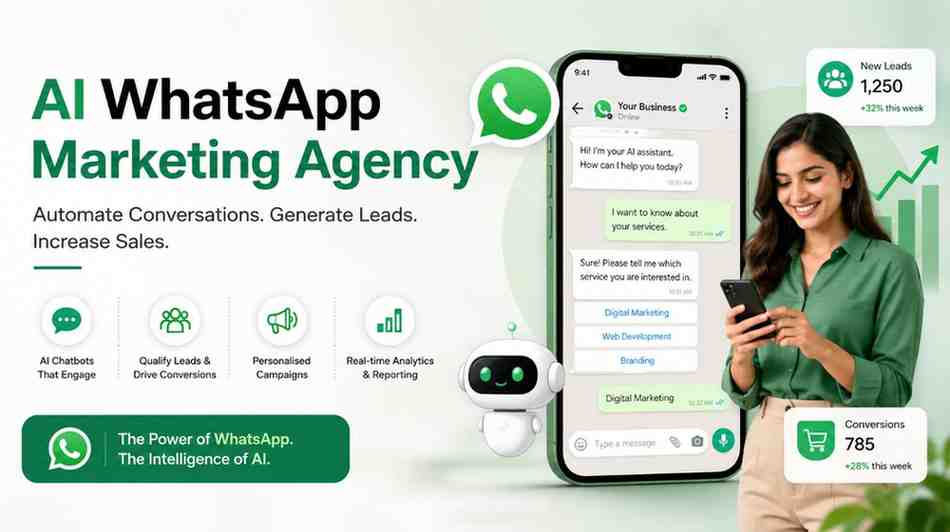
An AI WhatsApp marketing agency helps businesses use WhatsApp as more than a place to send promotional messages. The real work is around conversations, lead handling, customer questions, follow ups, segmentation and timely communication. For many Indian businesses, this matters because customers are already comfortable asking questions, sharing product requirements and even making purchase decisions through WhatsApp.
A typical setup may connect WhatsApp with AI chatbots, CRM systems, lead forms, ecommerce platforms and marketing automation tools. When someone sends a message, the system can understand what the person is asking, respond with relevant information and collect basic details before the sales team gets involved.
That does not mean every conversation should be handed over to AI.
A good AI WhatsApp marketing agency knows where automation makes sense and where a human should take over. A customer asking about product availability can often receive an automated answer. A customer negotiating a large B2B order probably should not be left talking to a bot for twenty minutes.
This distinction is important.
I have seen businesses make the mistake of automating almost everything simply because the technology allows it. The result is usually a WhatsApp account that responds quickly but does not actually help customers. People get repeated messages, irrelevant product suggestions and awkward replies that clearly sound machine generated. It creates more frustration than convenience.
The better approach is to build conversation paths around actual customer behaviour.
For example, a real estate company may receive a WhatsApp enquiry asking about a 2 BHK apartment. AI can respond with available configurations, approximate pricing, location details and a few qualifying questions. It can then pass the interested lead to a sales executive.
A healthcare business may use WhatsApp differently. Someone could ask about appointment availability, consultation timings or required documents. The system can handle straightforward queries and send the conversation to staff when the question becomes sensitive or needs professional judgement.
An AI WhatsApp marketing agency therefore works somewhere between marketing, customer communication and sales automation. The WhatsApp messages are only one part of it.
The less visible part is often more important.
Someone has to decide what happens when a person replies to an advertisement. Someone has to define how leads are classified. Someone has to decide when a reminder should be sent and when it should stop. Someone has to make sure customer information is stored correctly and that a sales executive can see what happened before taking over.
That is where the difference between ordinary WhatsApp marketing and a properly planned AI WhatsApp marketing agency setup becomes noticeable.
For StratMarketer, the focus should not simply be on sending more WhatsApp messages. The focus is on making each conversation useful enough to move the customer towards the next sensible action.
2. Why Businesses Are Moving From Basic WhatsApp Marketing to AI Powered Conversations
Traditional WhatsApp marketing usually follows a fairly simple pattern. A business collects customer numbers, prepares a message and sends an offer, announcement or reminder.
It can work.
But the limitations become obvious once the customer base grows.
Suppose a coaching institute has 5,000 leads. Some are looking for weekend classes. Some are interested in online courses. Some have already attended a counselling session. Others enquired six months ago and never responded.
Sending the same message to all of them is easy. It is also unlikely to produce the best response.
An AI WhatsApp marketing agency can help create different conversation journeys based on what the customer has done previously. Someone who asked about fees can receive fee related information. Someone who downloaded a course brochure can receive a follow up. Someone who stopped replying after asking for a demo may receive a different message after an appropriate gap.
The communication becomes less like a broadcast and more like a conversation.
This is one reason AI is becoming useful in WhatsApp marketing.
Another reason is speed. Customers do not always enquire during office hours. An online shopper may ask a question at 10:45 at night. A business may not have a person available to reply immediately.
AI can handle the first interaction.
It can answer common questions, collect the enquiry details and keep the conversation moving until a person is required. For businesses receiving a large number of repetitive queries, this can remove a considerable amount of manual work.
But I would be careful with the word automation.
Automation itself is not the achievement. A badly automated process can create a bigger problem than a manual one.
I have personally seen situations where businesses had automated follow ups running without proper stopping conditions. A customer had already purchased, yet the promotional messages continued. Another person had clearly said they were not interested, but the system sent another offer later.
That is the sort of thing that makes people mute or block business accounts.
AI powered conversations work better when the system understands context. It should know what the customer asked, what information was already provided and what stage the person appears to be at.
There is also a growing expectation for personalisation. Customers do not necessarily want a beautifully designed marketing message. They want a useful answer.
If someone asks, “Do you deliver to Jaipur?” the best first response is not a long promotional paragraph about the company’s history. Answer the delivery question.
Then continue the conversation.
This sounds obvious, but many campaigns still get this wrong.
An AI WhatsApp marketing agency can also help businesses handle different languages and communication styles. In India, customers may move between English and Hindi in the same conversation. Regional language requirements can become important for local businesses as well.
The technology is getting better at handling these conversations, but businesses still need to test responses carefully. I would not assume that an AI system understands every local phrase perfectly just because it can process multiple languages.
There are situations where a simple human response is still better.
That is not a failure of AI. It is simply good communication.
3. How AI WhatsApp Marketing Agency Services Help Capture and Qualify Leads
Lead generation is where an AI WhatsApp marketing agency can become particularly useful for businesses that receive a high volume of enquiries.
Getting a message on WhatsApp is not the same as getting a qualified lead.
Someone may type “price?” and disappear. Another person may ask ten detailed questions and be ready to purchase. A third person may be collecting information for a future decision. Treating all three people in exactly the same way wastes the opportunity.
AI can help make sense of these different conversations.
Consider a solar company receiving enquiries through Meta Ads. A potential customer may start with a simple WhatsApp message such as, “Need solar for home.”
Instead of immediately passing that lead to a salesperson, an AI WhatsApp marketing agency can create a short qualification conversation.
The system could ask the approximate electricity bill, location, property type and whether the customer owns the property. It could then identify whether the enquiry appears relevant and send the collected information to the sales team.
The salesperson now has something useful to work with.
They are not starting from zero with a message saying only “Customer interested in solar.”
This becomes even more valuable when advertising generates hundreds of enquiries.
AI can help separate different types of leads based on the information provided during the conversation. A high intent enquiry can be prioritised for faster human follow up. A person who is only researching can enter a different nurturing sequence.
The exact qualification questions depend on the industry.
For an education business, the system may ask about the course, preferred learning format and admission timeline.
For a real estate company, it may ask about property type, budget, location preference and buying timeline.
For a B2B manufacturer, the conversation might focus on product requirements, expected quantity, application and delivery location.
For an ecommerce brand, qualification may be much simpler because product selection and purchase behaviour can often be handled directly within the customer journey.
This is where an AI WhatsApp marketing agency should avoid creating long interrogation style chat flows.
Nobody wants to answer fifteen questions before getting a basic product price.
I prefer shorter qualification journeys. Ask what is genuinely needed, provide something useful and then decide whether another question is necessary.
There is also a practical advantage for sales teams. Once WhatsApp conversations are connected with a CRM, the business can maintain a clearer record of enquiries. Sales staff can see where the lead came from, what the customer asked and what information has already been collected.
That reduces one of the most common problems in lead generation.
Repeated questions.
A customer tells one person their budget. Then another sales executive asks the same thing. Later someone calls and asks again which product they were interested in. From the customer’s side, it feels disorganised.
An AI WhatsApp marketing agency can help reduce this by keeping conversation information available to the relevant team.
Still, AI qualification should not be treated as a perfect scoring machine.
A lead that looks weak on paper may turn into a good customer. A lead that gives all the right answers may never buy. Human judgement still matters, especially in high value sales.
I might be wrong here, but I think businesses sometimes expect AI to predict buying intent more accurately than it realistically can. It can identify useful signals. It can organise conversations. It can save sales teams time. But it cannot know a customer’s final decision with certainty.
That distinction matters when building the system.
The best use of an AI WhatsApp marketing agency is not replacing every salesperson with automation. It is removing repetitive work so that salespeople can spend more time on conversations where their judgement actually matters.
And sometimes the most valuable result is not a sale at all. It is knowing why a lead did not move forward, what question kept coming up, or where customers were getting confused before they reached the buying stage. That information can quietly change the way a business markets and sells its products.
4. Using AI Chatbots on WhatsApp Without Making Customer Conversations Feel Robotic
The biggest concern with WhatsApp automation is not really the technology. It is the feeling of talking to a machine.
People notice it quickly.
A chatbot asks a question that was already answered. It gives three paragraphs when the customer asked one simple thing. Or worse, the customer says “I want to speak to someone” and the bot responds with another menu.
That is where businesses lose patience.
An AI WhatsApp marketing agency should design the chatbot around how people actually communicate on WhatsApp. People rarely write perfect sentences. They use short phrases, spelling mistakes, Hindi words mixed with English, voice messages and sometimes just send a product screenshot with no explanation.
A useful AI system needs to handle this reasonably well.
Suppose someone messages a furniture business saying, “bhai sofa ka price?”
A robotic response could immediately send a long catalogue and five buttons.
A better conversation might simply ask which sofa they are looking at, share the relevant price range and then ask whether they want delivery information.
Small difference. Big impact.
I strongly prefer short chatbot responses for the first few exchanges. The customer should feel that the business is available, not that they have entered an IVR system disguised as WhatsApp.
There should also be a clear point where AI steps aside.
If a customer has a complaint about a damaged product, a payment issue or a complicated service problem, pushing them through another automated sequence can make the situation worse. The system should recognise these situations and transfer the conversation to a person.
This is especially important for Indian businesses where customers often want to speak directly with someone once money or service quality becomes a concern.
AI can handle the routine work. It should not become a wall between the customer and the company.
Another useful approach is giving the AI proper business knowledge instead of letting it respond from a generic script. Product information, service details, pricing rules, delivery areas, working hours and common questions should be properly mapped.
Even then, testing is necessary.
A chatbot that works perfectly when the team tests it internally can behave differently when 500 real customers start asking questions in different ways. Somebody will type something unexpected. Somebody always does.
5. Personalised WhatsApp Marketing for Different Customer Segments and Buying Stages
One WhatsApp message rarely works equally well for everyone.
A person who has just discovered a business should not receive the same communication as someone who requested a quotation yesterday. Similarly, an existing customer should not constantly receive messages written as if they have never heard of the company.
This is where personalisation becomes useful.
An AI WhatsApp marketing agency can divide customers based on behaviour, interests, previous enquiries, purchases and where they are in the buying process.
For example, an online supplement brand might have several different groups. One customer may have purchased protein powder recently. Another may have looked at protein products but never purchased. Someone else may have bought the same product three months ago and could be approaching the usual reorder period.
The communication should be different.
The first customer may need usage information. The second may need help choosing the right product. The third might appreciate a reorder reminder.
The same principle applies to service businesses.
A coaching institute can separate new enquiries from students who attended counselling. A real estate company can distinguish between people searching for investment property and families looking for a home. A B2B company can separate distributors, retailers and direct buyers.
Personalisation does not always mean using the customer’s name.
That is a common misunderstanding.
Real personalisation is about relevance.
If a customer previously asked about a particular service, the next message should reflect that interest rather than randomly promoting something else. If someone has already purchased, the business should communicate like it knows that purchase happened.
Timing also matters.
A customer who has just asked for a quotation may need a follow up after some time. Sending the same reminder within an hour can feel desperate. Waiting too long can mean the customer has already moved to another supplier.
AI can help businesses manage these different journeys without requiring someone to manually remember every conversation.
But there is a limit.
Too much personalisation can feel uncomfortable. If a customer receives a message that reveals an excessive amount of behavioural information, they may wonder how closely they are being tracked.
I have some concern about this area. Businesses sometimes get excited about how much customer data they can use and forget to ask whether they should use all of it.
Useful relevance is enough.
A WhatsApp campaign does not need to prove that the business knows everything about the customer.
6. How AI WhatsApp Marketing Agencies Automate Follow Ups, Reminders and Customer Support
Follow up is one of those jobs that looks simple until a business starts doing it at scale.
A salesperson can remember five pending enquiries. Maybe ten. After that, things start slipping.
A customer asks for a quotation on Monday. The salesperson plans to call on Tuesday. Tuesday gets busy. Wednesday comes. Then the customer has already spoken to another company.
An AI WhatsApp marketing agency can automate parts of this process.
For example, once a quotation is shared, the system can schedule a follow up after a suitable period. If the customer responds, the conversation can continue. If there is no response, another message can be sent later, depending on the business rules.
The important part is knowing when to stop.
Three useful follow ups can become irritating if they continue for two weeks without any change in the customer’s response.
I have seen this happen with promotional campaigns, and honestly, it looks careless. The customer has already ignored two messages, yet another automated reminder arrives as if nobody is paying attention.
Good automation should have exit conditions.
A customer who purchases should leave the sales follow up sequence. Someone who says they are not interested should not continue receiving the same sales pitch. Someone who asks for human assistance should be transferred appropriately.
Customer support can also benefit from AI.
Common questions about delivery, order status, appointment timings, return policies, service availability and documentation can often be answered automatically. This can reduce the number of repetitive conversations handled manually by support staff.
There is another benefit that is less obvious.
A business can make its support availability more consistent.
Instead of customers waiting until the next morning for a basic answer, they can receive immediate assistance for routine questions. That does not replace the support team. It gives them fewer repetitive conversations to deal with.
Still, businesses need to be careful with automated answers around refunds, disputes, payments and sensitive customer situations.
These areas need clear rules.
The AI should know what it can confirm and what requires a human decision. If it is uncertain, it should not invent an answer just to keep the conversation moving.
That one rule can prevent a lot of trouble.
7. Connecting WhatsApp Marketing With CRM, Sales, Ecommerce and Other Business Systems
WhatsApp becomes much more useful when it does not operate as an isolated channel.
Imagine a customer sends a WhatsApp enquiry, but the sales team has no idea where the customer came from. The conversation remains inside WhatsApp. Later, someone updates a spreadsheet manually. Then another person enters the same details into the CRM.
It is messy.
An AI WhatsApp marketing agency can connect WhatsApp communication with the systems already used by the business.
A lead generated from a website form can enter the CRM and trigger a WhatsApp conversation. A lead coming from an advertisement can be recorded with campaign information. A customer who purchases through an ecommerce store can be moved into a post purchase communication journey.
The point is not to connect everything simply because integration is possible.
The connection should solve a real business problem.
For a real estate company, WhatsApp can work alongside the CRM so sales executives can see previous enquiries and follow up status.
For ecommerce, the system can connect customer information with order details so the customer does not have to repeatedly explain which order they are asking about.
For B2B businesses, WhatsApp conversations can be connected with lead records, quotation stages and sales ownership.
This can also help management understand what is happening with enquiries.
If 1,000 WhatsApp leads enter the business but only 30 become customers, the problem may not be WhatsApp itself. Perhaps the leads are poorly qualified. Perhaps sales teams are responding too late. Maybe pricing is the issue.
Without connected systems, it is harder to see this clearly.
There is also a practical issue with data quality.
If customer details are being copied manually from WhatsApp into a CRM, errors will happen. Phone numbers get entered incorrectly. Names are misspelled. Lead sources disappear. Notes are forgotten.
Automation can reduce some of that repetition.
But integrations need proper testing before they are put into daily use. A small mapping error can send the wrong information into hundreds of customer records.
I would rather see a business start with two useful integrations and get them right than connect seven systems that nobody fully understands.
8. Measuring Leads, Conversations, Conversions and Revenue From WhatsApp Campaigns
A WhatsApp campaign should not be judged only by how many messages were sent.
That number can look impressive while telling the business almost nothing.
An AI WhatsApp marketing agency should help businesses look at what happened after the message.
How many people responded?
How many conversations became genuine enquiries?
How many leads were qualified?
How many reached the sales team?
How many eventually purchased?
And most importantly, what revenue came from the activity?
These numbers give a much clearer picture.
Suppose a campaign reaches 20,000 customers and produces 3,000 replies. At first glance, that sounds successful. But if most replies are people asking to stop receiving messages, the campaign has a very different meaning.
Another campaign may reach only 5,000 people and produce 400 serious enquiries with 80 purchases.
The second campaign could be far more valuable.
Businesses should also look at response time. A lead that receives a useful response in two minutes may behave differently from one that waits six hours.
This becomes particularly important for high intent enquiries.
For example, someone searching for a wedding venue may be contacting five venues on the same evening. Someone looking for an industrial machine may be comparing suppliers over several weeks. The right measurement window is not the same for both.
Conversion tracking should therefore reflect the actual sales cycle.
For ecommerce, the path may be relatively short. For B2B, real estate, education or consulting, the first WhatsApp conversation may be only the beginning.
Revenue attribution can become complicated too.
A customer might see a Facebook advertisement, visit the website, return through Google and finally message the company on WhatsApp. Which channel gets credit?
There is no perfect answer in every situation.
I might be wrong here, but businesses can spend too much time trying to assign every rupee of revenue to one channel when the buying journey is clearly mixed. It is often more useful to understand the role WhatsApp played in moving the customer forward.
That can include assisted conversions, repeat purchases, faster sales response and reduced support workload.
Cost should also be considered.
If AI automation reduces repetitive support work while maintaining customer satisfaction, that has a financial value even if it does not appear as a direct sale.
The same applies to sales teams. If automation allows five sales executives to spend more time on qualified enquiries instead of answering routine questions, the business may see an improvement in sales productivity.
This is where reporting needs some common sense.
Not every useful WhatsApp interaction ends with a purchase immediately. Sometimes the customer simply gets the answer they needed and comes back two weeks later.
That conversation still mattered.
And then there are the campaigns that look good in a report but make customers quietly irritated. Those are the ones worth discussing internally, even if the dashboard says everything is fine.
9. How StratMarketer Approaches AI WhatsApp Marketing for Different Business Goals
There is no single WhatsApp strategy that works for every business. This sounds obvious, but it is one of the first things that gets forgotten when businesses start looking at AI WhatsApp marketing agency services.
A local education company and a large ecommerce brand may both use WhatsApp, but their customer journeys are completely different.
For one business, the main goal may be generating qualified enquiries. For another, it may be recovering abandoned purchases. A B2B manufacturer may care more about enquiry qualification and sales follow up, while a clinic may need appointment communication and basic customer support.
StratMarketer’s approach to AI WhatsApp marketing should begin with that difference.
The first question should not be, “Which chatbot should we use?”
It should be, “What is currently going wrong in the customer journey?”
If leads are coming in but salespeople are responding late, automation may need to focus on immediate responses and lead qualification. If the problem is that old leads are being forgotten, follow up automation may be more useful.
For an ecommerce business, the requirement can be quite different. A customer might browse a product, ask a question on WhatsApp and then leave without purchasing. The system can support that journey with relevant product information, reminders and post purchase communication.
But there is a line.
I do not think every customer interaction needs to be automated. Some businesses would actually be better served by a simple WhatsApp setup with a good human response process rather than an elaborate AI system that nobody manages properly.
StratMarketer can approach AI WhatsApp marketing agency services by looking at the full journey from the first enquiry to the eventual action.
That can include website enquiries, social media leads, paid advertising, WhatsApp conversations, CRM records, sales follow ups and customer retention.
For a real estate company, the system might capture the customer’s location preference, property type, budget and buying timeline before passing the lead to a sales executive. For an education business, it might collect the course of interest, preferred mode of learning and admission timeline.
For a service company, the conversation could be much shorter.
This is where industry context matters.
A customer looking for a ₹50,000 service may need a detailed discussion. Someone asking for the price of a ₹999 product may simply need a quick answer and a purchase link. Treating both conversations the same does not make much sense.
StratMarketer can also use AI to identify patterns in customer conversations.
If customers repeatedly ask the same question before buying, perhaps the website is not explaining that information clearly. If people frequently ask about delivery after clicking an advertisement, that information may need to appear earlier in the buying journey.
WhatsApp can therefore become a source of customer insight, not just a messaging channel.
I also prefer keeping the human handover simple. When a customer needs a person, the transition should not feel like starting again from the beginning. The salesperson should have access to the previous conversation and whatever information the customer has already provided.
That small detail can make a big difference.
The same principle applies to follow ups. A customer who has already purchased should not continue receiving messages designed for new leads. Someone who has clearly declined an offer should not be pushed through the same sequence repeatedly.
AI WhatsApp marketing agency services work best when the automation has boundaries.
There should be rules for what the AI can answer, what it should not answer, when it should ask for more information and when it should hand the conversation to a person.
And yes, there will be mistakes during the first few weeks.
Someone will ask something nobody expected. A product detail will change. A sales executive will point out that a qualification question is useless. A customer will phrase something in a way the system does not understand.
That is normal.
The system should be reviewed from actual conversations rather than only from internal testing.
For StratMarketer, the practical value of an AI WhatsApp marketing agency approach is not about making WhatsApp look sophisticated. It is about making customer communication easier to manage while keeping the conversation useful and human.
That distinction matters more than the technology itself.
10. Frequently Asked Questions About Hiring an AI WhatsApp Marketing Agency
What does an AI WhatsApp marketing agency do?
An AI WhatsApp marketing agency helps businesses use WhatsApp for automated conversations, lead generation, qualification, follow ups, customer support and personalised communication. Depending on the business, the system can also connect WhatsApp with CRM, ecommerce and sales tools.
Is an AI WhatsApp marketing agency useful for small businesses?
It can be, but not always.
If a small business receives only a few enquiries each day, a complicated AI system may be unnecessary. If the business receives many repetitive questions or loses leads because nobody follows up consistently, automation can make more sense.
The size of the business is not the only factor. Message volume and customer journey matter more.
Can AI WhatsApp marketing replace salespeople?
No, and I would be cautious about any agency promising that.
AI can answer routine questions, collect information, qualify leads and handle some follow ups. But high value sales often require negotiation, trust and judgement. A human salesperson still has an important role.
Can customers speak to a human whenever necessary?
Yes. A properly designed AI WhatsApp marketing system should have clear human handover points.
For example, if a customer has a complaint, asks for a special quotation or needs a decision that falls outside the chatbot’s rules, the conversation can be transferred to a team member.
Can WhatsApp AI handle Indian languages?
AI systems can support multilingual conversations, including common combinations of English and Indian languages. However, businesses should test the actual language patterns used by their customers.
Hindi mixed with English is very different from formal Hindi. Local expressions can also vary.
So I would not simply assume that multilingual support means perfect communication.
Can an AI WhatsApp marketing agency generate leads from advertisements?
Yes. WhatsApp can be connected with advertising campaigns so that people can start a conversation directly after responding to an advertisement.
The AI can then ask qualifying questions, provide initial information and pass suitable leads to the sales team.
The quality of the advertisement still matters, though. AI cannot fix a poor offer or irrelevant audience targeting.
Can WhatsApp automation send follow up messages automatically?
Yes, follow ups can be automated based on events, customer responses and defined time intervals.
For example, a business can send a follow up after a quotation is shared or remind a customer about an appointment.
The important part is controlling the frequency and stopping the sequence when the customer’s situation changes.
How does an AI WhatsApp marketing agency measure campaign performance?
Performance can be measured through several signals, including enquiries, response rates, qualified leads, sales handovers, appointments, purchases, conversion rates and revenue.
For some businesses, support workload and response time are also useful measures.
Looking only at the number of messages sent is not enough.
Can AI WhatsApp marketing connect with a CRM?
Yes, depending on the CRM and the available integration options.
Customer information, lead status, conversation details and follow up activity can be connected so sales teams have a clearer view of each enquiry.
This can also reduce manual data entry.
Is WhatsApp AI suitable for ecommerce businesses?
Yes. Ecommerce brands can use WhatsApp for product enquiries, order communication, abandoned purchase follow ups, customer support, product recommendations and repeat purchase communication.
The exact setup depends on the product category and buying cycle.
How much does an AI WhatsApp marketing agency charge?
There is no single standard price.
The cost depends on the number of conversations, automation requirements, integrations, chatbot complexity, campaign management and support requirements. A basic setup and a large CRM connected system are very different projects.
It is better to ask for a clear scope of work rather than comparing agencies only by monthly price.
What should I ask before hiring an AI WhatsApp marketing agency?
Ask how they handle human handover, customer data, campaign segmentation, follow ups, CRM integration, reporting and chatbot training.
Also ask what happens when the AI does not know the answer.
That last question is surprisingly important.
A system that admits uncertainty and passes the customer to a person is usually safer than one that tries to answer everything.
How long does it take to set up AI WhatsApp marketing?
Simple setups can be implemented relatively quickly. More complex systems involving CRM integration, multiple customer journeys, ecommerce data and detailed automation require more planning and testing.
The timeline should be based on the actual workflow, not just the chatbot itself.
Is AI WhatsApp marketing useful for B2B companies?
Yes, particularly when businesses receive repeated enquiries for products, quotations, catalogues, availability or technical information.
AI can handle the first layer of communication and collect useful information before a sales representative gets involved.
For complex technical questions, human involvement should remain part of the process.
Why should a business work with an AI WhatsApp marketing agency instead of setting up a chatbot itself?
A business can certainly handle simple automation internally.
The reason to work with an AI WhatsApp marketing agency is usually the broader work around strategy, conversation design, lead qualification, integrations, segmentation, reporting and ongoing optimisation.
The technology is only one part of the job.
The real test is what happens when an actual customer sends a message that was never included in the original script. That is where the quality of the setup becomes visible.
And sometimes that is where the uncomfortable lessons begin.