


What Is an AI SEO Agency and Why Businesses Are Looking at It Differently
An AI SEO agency is not simply a conventional SEO company that has added a few AI tools to its workflow. The difference is usually much deeper. AI can influence how keywords are researched, how search intent is interpreted, how content gaps are found, how technical issues are prioritised and even how changes in search behaviour are monitored.
For an Indian business owner, this distinction matters because search has become less predictable than it used to be. A website could once target a keyword, publish several articles around it, build backlinks and wait for rankings. That approach can still work in certain situations, but it is rarely enough on its own now.
Search engines understand context better. Users ask longer and more specific questions. AI generated answers are appearing alongside traditional search results. Local businesses are competing not only for blue links but also for maps, answer boxes, featured results and conversational searches.
This is where an AI SEO agency can bring a different way of working.
At StratMarketer, the focus is not simply on putting more keywords into a page. The bigger question is what someone actually wants when they search, what information they expect to find and why one result deserves to appear ahead of another.
Take a simple example. Suppose a solar company in India wants enquiries for rooftop solar installations. Ranking for “solar panels” may look attractive, but that search is broad. The person could be looking for prices, installation information, government schemes, product specifications or even a definition.
A more commercially useful search could be “rooftop solar installation cost in India” or a city specific search related to installation services.
The SEO work becomes much more practical when this difference is understood.
An AI SEO agency can process large amounts of search data quickly, identify patterns between related queries and help SEO teams understand which topics deserve attention first. But the technology does not replace judgement. In fact, I would be cautious about any agency that presents AI as a substitute for SEO experience.
AI can identify a pattern. It cannot always tell you whether that pattern makes sense for a particular Indian market.
That part still needs human thinking.
There is another reason businesses are looking at AI SEO agencies differently. Content production has become much easier. Anyone can generate thousands of words in a short time. That has created a strange problem. There is now more content available, but a lot of it says almost the same thing.
A manufacturing company, for instance, may have ten competitors publishing articles about the same product. If every article starts with the same definition, follows the same generic explanation and ends with the same sales pitch, simply producing another article will not solve the problem.
An AI SEO agency has to use AI for research and analysis while keeping the actual content grounded in business knowledge, customer questions and industry experience.
That balance is important.
How an AI SEO Agency Changes the Way Search Strategy Is Planned
Traditional SEO planning often begins with a keyword list. Someone collects hundreds or thousands of phrases, assigns them to pages and starts creating content.
An AI SEO agency can approach the same task from a wider angle.
Instead of asking only, “Which keywords have search volume?”, the team can examine relationships between keywords, questions, entities, competitors, content formats and user intent.
This matters because search volume alone can be misleading.
A keyword with 20,000 monthly searches may generate fewer useful enquiries than a keyword with 300 searches if the smaller keyword comes from someone who is ready to buy.
I have seen businesses spend months chasing broad terms because they looked impressive in an SEO report. Meanwhile, the pages that could have generated enquiries were sitting on page three or had never been created.
AI assisted analysis can help reduce that kind of waste.
Search strategy can be divided around several practical questions. What does the user want? What stage of the buying journey are they in? What type of page should answer the query? What competitors already dominate the search results? What information is missing from those pages? Which existing pages on the website can be improved rather than replaced?
This creates a more connected SEO strategy.
For example, a company selling industrial machinery may have product pages, technical specifications, application pages, service pages and educational articles. Instead of treating every page separately, an AI SEO agency can analyse how these pages relate to one another.
A product page might target a commercial search. An article could answer a technical question. Another page could compare two machine types. Internal links can then connect these pages in a way that makes sense for users.
The strategy becomes less about publishing endlessly and more about building a useful search ecosystem around the business.
This is also where competitor analysis has changed.
AI tools can examine competitor pages at scale, identify common topics, compare content structures and find areas where competing websites appear to have stronger coverage. But I would not blindly copy those patterns.
That is one area where businesses sometimes get carried away.
If five competitors have written about a topic, copying the same five angles will not necessarily make your sixth article better. It may just create another similar page.
The better question is what the competitors have missed.
An Indian healthcare business, for example, may find that competitors explain a service but do not answer practical questions about documents, timelines, costs, eligibility or the process involved. Those missing details can become valuable content opportunities because they reflect actual customer concerns.
An AI SEO agency can help find those gaps faster. The final decision still needs context.
And this strategy is not fixed forever. Search behaviour changes, competitors publish new pages and businesses themselves change their products or markets. A keyword plan created once and left untouched for twelve months can become surprisingly outdated.
SEO Services You Can Expect from an AI SEO Agency
The services offered by an AI SEO agency can vary, but the stronger ones usually combine conventional SEO with AI assisted research and analysis.
Technical SEO remains important. So do content, internal linking, keyword research and authority building.
AI does not remove those fundamentals.
It can, however, make parts of the process faster and more detailed.
A typical AI SEO engagement may include technical website audits, keyword research, search intent analysis, content gap research, competitor analysis, content planning, on page optimisation, internal linking, schema analysis, local SEO, Google Business Profile support, conversion focused content and ongoing performance monitoring.
For larger websites, automated analysis can be particularly useful.
Imagine an ecommerce website with several thousand product pages. Manually checking every page for missing metadata, duplicate titles, thin content, indexing problems or internal linking gaps would take a considerable amount of time.
AI assisted tools can identify patterns across the site and bring the most obvious problems to the SEO team’s attention.
But there is a catch.
An automated audit can tell you that something is wrong. It does not always tell you whether fixing it should be the highest priority.
That decision depends on the business.
A minor metadata issue on a page receiving almost no traffic may matter less than a conversion problem on a page that already receives thousands of visitors every month.
This is why StratMarketer’s role should not be viewed simply as tool operation. The useful part of an AI SEO agency is connecting technical findings with commercial priorities.
Content SEO is another major area.
AI can help with topic discovery, search intent classification, content briefs, competitor analysis and content quality checks. But the actual article needs to sound like it belongs to the business.
If a company manufactures pharmaceutical machinery, generic AI generated explanations will not demonstrate much expertise. Technical terminology, manufacturing constraints, buyer concerns and practical experience need to appear naturally.
The same applies to local SEO.
For an Indian business serving a specific city or region, an AI SEO agency can analyse local search patterns, service related queries, competitor listings and location specific content opportunities.
But creating twenty city pages that only replace the city name is not a sensible local SEO strategy.
Users notice that sort of thing.
Google can also recognise weak location pages through broader quality signals.
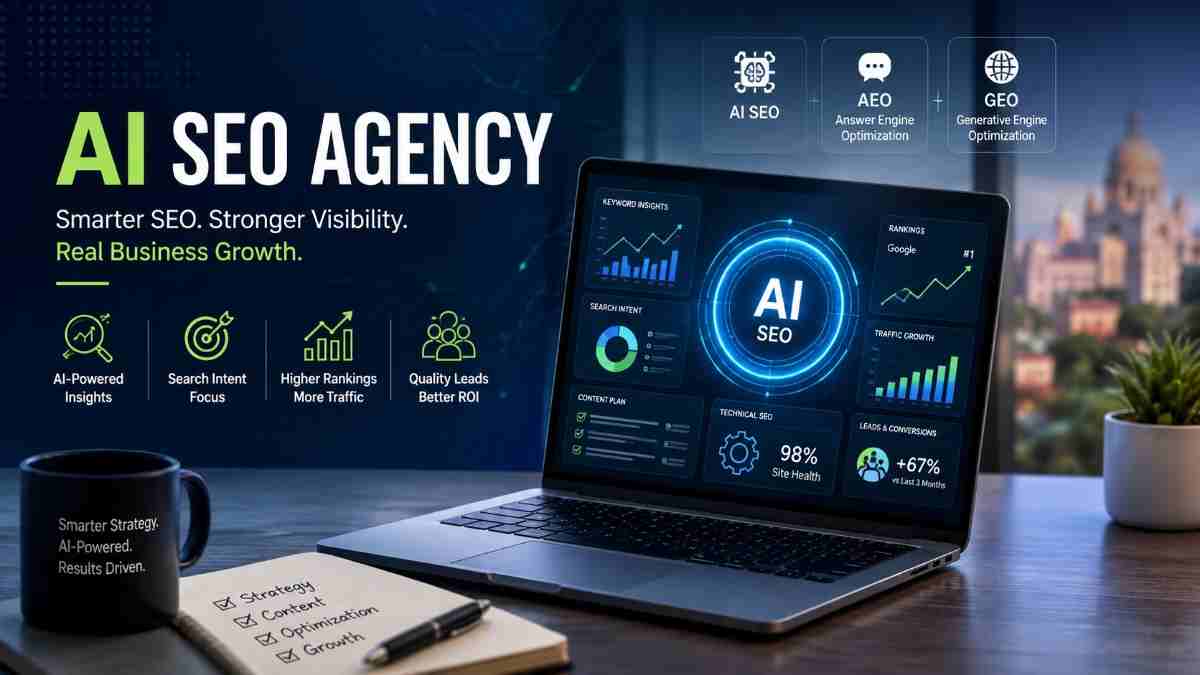
SEO also increasingly overlaps with AEO, GEO and SXO. Businesses are trying to make their information useful for traditional search, direct answers and AI assisted discovery. That does not mean every page needs to be rewritten around artificial intelligence terminology.
Sometimes the best SEO work is still simple.
A clear service page. A fast website. Accurate information. Useful FAQs. Strong internal links. Good evidence of expertise.
That sounds less exciting than an AI dashboard, but it is often what actually matters.
AI Powered Keyword Research, Search Intent and Content Planning
Keyword research used to revolve heavily around finding phrases with search volume and reasonable competition.
Those metrics still have a place.
They just should not be the entire decision.
An AI SEO agency can analyse thousands of related searches and group them according to meaning. This can help identify the different ways people describe the same problem.
Consider someone searching for project finance.
They might search for “project finance companies in India”, “project financing for manufacturing”, “how to get project finance”, “project finance consultant”, “project finance eligibility” or “project finance requirements for banks”.
These are related, but the intent behind them is not identical.
One person may be researching the concept. Another may be comparing service providers. Someone else may already have a project and be looking for funding assistance.
A good SEO strategy should recognise those differences.
AI makes this kind of clustering much quicker. Instead of looking at keywords individually, an SEO team can examine groups of related searches and decide whether they belong on one page or need separate content.
That second decision is important.
Not every keyword deserves its own article.
Creating separate pages for extremely similar phrases can produce a website full of thin or repetitive content. I would rather see one strong page that properly answers five closely related searches than five weak pages written only to capture slight keyword variations.
This is especially relevant now because search engines are better at understanding language and context.
Content planning also becomes more useful when keyword research is connected to real questions.
Suppose a company sells private label nutraceutical products. Potential customers may search for manufacturing costs, minimum order quantities, formulations, packaging, certifications, product development, testing, export requirements and private label options.
Those searches can form a content cluster around the actual commercial process.
One article might explain how private label nutraceutical manufacturing works. Another could discuss MOQ considerations. A service page could explain the company’s manufacturing capabilities. A product page could focus on a specific supplement category.
The pages then have different jobs.
AI can help map these relationships, but the business still needs to verify the information.
This is particularly important in regulated industries. Healthcare, finance and pharmaceuticals cannot rely on automatically generated claims simply because an AI system produced them confidently.
I might be wrong here, but I think this is one of the areas where many businesses underestimate human review. AI can make research faster, but it can also make an incorrect statement sound very convincing.
That is dangerous.
Content planning should therefore include expert review wherever the subject requires it.
There is also a growing shift towards question based search. Users increasingly type conversational queries rather than short keywords, particularly when using voice assistants and AI search interfaces.
For an SEO team, that means understanding the question behind the keyword.
Someone searching “best accounting software for small business” is different from someone asking “how do I calculate GST on this invoice?”
The first may need comparisons. The second needs a direct explanation.
The page format should reflect that.
Content briefs should therefore consider the likely answer format, supporting questions, entities, examples, internal links, evidence and conversion path.
And not every article needs to be 2,000 words.
This is something I strongly disagree with when I see SEO agencies selling fixed word counts as a ranking strategy. A simple question may need 500 useful words. A complex technical topic may need 2,500. Length should follow the subject, not the invoice.
How AI SEO Agencies Handle Technical SEO and Website Performance
Technical SEO is where AI assisted SEO can become genuinely useful, particularly for websites with large numbers of pages.
A technical SEO audit can examine crawlability, indexing, duplicate pages, canonical tags, redirects, broken links, structured data, metadata, internal links, page templates and other technical signals.
AI can help identify patterns that are difficult to spot manually.
For example, imagine an ecommerce website where hundreds of product URLs are generating near duplicate pages because of filters and sorting parameters. An automated system can detect the repeated patterns quickly.
The SEO team can then investigate whether those URLs should be indexed, canonicalised or blocked from crawling.
The same principle applies to internal linking.
A website may have hundreds of articles but only a small number of internal links pointing towards important commercial pages. AI based analysis can help identify orphan pages, weakly connected pages and opportunities to connect relevant content.
Website performance is another part of the conversation.
Core Web Vitals, mobile usability and page speed remain important because users do not enjoy waiting for a slow website. A technically perfect SEO strategy is of little comfort if a visitor opens a service page and waits several seconds for the main content to load.
Still, technical SEO should be handled with some judgement.
Not every warning from an SEO tool needs immediate action.
I have seen businesses spend money fixing low priority technical warnings while their most important service pages had poor content and weak conversion paths. That is the wrong order of work.
AI can help prioritise issues by analysing scale, page importance, traffic patterns and potential impact. It can also help SEO teams monitor recurring problems after website updates.
For example, a website redesign can unintentionally remove metadata, change URL structures or break internal links. Automated monitoring can catch some of these changes sooner than a manual review.
Structured data is another area where technical SEO and search visibility overlap. Depending on the page type, relevant schema can help search engines understand products, organisations, articles, FAQs and other content.
But schema should not be treated as a shortcut to rankings.
It describes information. It does not magically make poor information valuable.
The same applies to AI generated technical recommendations. They should be reviewed before implementation, particularly when changes involve robots.txt, canonicalisation, redirects or large scale indexing decisions.
One wrong technical change can affect thousands of URLs.
That is where experience still matters more than speed. A tool can point at the problem. Someone has to decide what happens next.
And sometimes the correct decision is to leave a warning alone for the moment and fix something else first. That part rarely appears in a neat SEO report, but it is often what separates useful SEO work from endless technical housekeeping.
AI SEO, AEO, GEO and the Changing Search Landscape in India
Search in India is no longer limited to typing a few words into Google and choosing one of the first ten blue links. People now ask complete questions, compare answers across platforms, use voice search, check local listings and increasingly interact with AI generated search experiences.
This has created some confusion for business owners.
They hear terms such as AI SEO, AEO and GEO and sometimes assume that these are completely separate replacements for SEO. They are not. There is considerable overlap between them, although each one focuses on a slightly different part of how information is found and presented.
AI SEO generally refers to using artificial intelligence within SEO research, analysis, content planning, technical work and monitoring.
AEO, or Answer Engine Optimisation, is more concerned with making information suitable for direct answers. GEO, or Generative Engine Optimisation, focuses more on how a business and its information may be understood and referenced within generative search experiences.
The names matter less than the underlying change.
Search engines are becoming better at understanding questions and relationships between information.
For an Indian business, this can have practical consequences. Someone looking for a chartered accountant in Delhi may not simply search for “CA in Delhi”. They might ask which CA handles startup taxation, compare firms, ask about GST filing or look for reviews before making a decision.
Likewise, someone searching for a hospital, manufacturing company, financial consultant or digital marketing agency may expect useful answers before contacting a business.
That means a website needs to contain information that is clear, accurate and easy to understand.
An AI SEO agency can help businesses identify these questions and build content around them. But I would not advise creating pages merely because an AI system has identified a question.
The question needs to make business sense.
There is also a growing importance of entities and brand context. Search systems need to understand what a company actually does, which services it provides, where it operates and how its different pages relate to one another.
A company with a strong service page, detailed supporting content, consistent business information and genuine references across the web gives search systems more context to work with.
This is particularly useful for Indian businesses serving specific cities.
A manufacturing company in Pune, a financial consultancy in Mumbai and a healthcare provider in Bengaluru may all have different search behaviour even when their basic SEO requirements look similar.
Local intent matters.
So does language. English remains highly important in Indian search, but businesses also encounter Hindi and regional language searches depending on their audience. AI based language analysis can help identify variations that conventional keyword research may miss.
Still, there is a limit.
AI cannot decide exactly how an Indian customer thinks about a service in every situation. Sometimes the best insight comes from speaking to sales teams and asking what customers repeatedly misunderstand.
That information is not always sitting inside a keyword tool.
Common Mistakes Businesses Make When Choosing an AI SEO Agency
The first mistake is choosing an agency because it promises quick rankings using AI.
AI does not remove the time required to build a website’s authority, fix technical problems, create useful content and earn trust.
If an agency says its AI system can guarantee first position rankings, I would be concerned.
Search results change. Competitors change. Algorithms change. No serious SEO professional can control all of that.
The second mistake is assuming that more content means better SEO.
It does not.
A business might publish 100 AI generated articles and still struggle to rank because those articles have no real depth, repeat the same ideas and do not answer the questions customers actually have.
I have seen websites where five articles essentially said the same thing using different headings. The business owner thought the website was becoming stronger because the blog count had increased. It was actually becoming harder to manage.
More pages are not automatically more useful pages.
Another common mistake is asking only about backlinks.
Backlinks still matter in SEO, but an AI SEO agency should be able to explain the wider picture. Technical SEO, content quality, internal linking, search intent, brand signals, local SEO and conversion paths all have a role.
A monthly report showing hundreds of backlinks can look impressive while telling you very little about whether the website is generating better business.
The same problem appears with keyword rankings.
Rankings are useful, but they are not the final business objective.
A page moving from position 45 to position 12 is meaningful progress. But if the keyword has little commercial relevance, the business may not see any improvement in enquiries.
Another warning sign is excessive automation.
AI can help create drafts, analyse data and identify patterns. That does not mean the entire SEO process should be automated.
I would be particularly careful with agencies that publish technical or regulated content without proper human review.
A factual mistake on a finance, healthcare or pharmaceutical page can damage credibility quickly.
There is also the question of transparency.
A business should know what the agency is doing with its website. If the explanation is simply “our AI system handles everything”, that is not really an explanation.
Ask what is being changed.
Ask why it is being changed.
Ask how success will be measured.
And ask what happens when something goes wrong.
A good agency should be comfortable answering these questions.
How StratMarketer Approaches AI SEO for Indian Businesses
StratMarketer approaches AI SEO as a combination of technology, SEO experience and business understanding rather than as an automated content factory.
The starting point should be the business itself.
What does the company sell? Who buys it? Which locations matter? What questions do sales teams hear every week? Which services bring the highest value enquiries? Which pages already perform well?
These questions sound basic, but they often reveal more than a giant keyword spreadsheet.
After that, the website can be examined from technical and content perspectives.
An AI assisted audit can help identify indexing problems, content gaps, duplicate information, weak internal linking and other patterns across the site. Those findings can then be reviewed manually and prioritised.
Keyword research follows a similar approach.
Instead of chasing every available search phrase, StratMarketer can group related queries around search intent and business relevance. Some keywords may deserve a service page. Others may belong in educational content. Some may not deserve a separate page at all.
This keeps the website from becoming unnecessarily fragmented.
Content is another important part of the approach.
AI can help research topics and identify questions, but the content should still reflect the actual business. If a company has ten years of experience dealing with a particular customer problem, that experience should appear in the content.
Generic explanations cannot replace that.
For an Indian business, location can also influence the strategy. A company targeting Hyderabad may need a different local search approach from one targeting Jaipur or Kochi. The service, audience, competition and language behaviour can vary considerably.
StratMarketer can also work across related areas such as local SEO, AEO, GEO, content marketing, technical SEO and search experience.
The objective is not to create separate strategies that operate independently.
A useful service page should support relevant informational content. That content should link back to appropriate commercial pages. Local signals should remain consistent. Technical improvements should make the site easier to crawl and use.
This is where AI can save considerable time.
It can process large datasets faster than a person can manually review them. The human SEO team can then spend more time deciding what those findings actually mean.
I might be wrong here, because every business behaves differently, but I have generally found that the most useful SEO strategies are not the ones with the most complicated dashboards. They are the ones where someone can explain why a particular page is being changed and what the business expects to happen afterwards.
That is a much healthier way to work.
How to Measure the Performance of an AI SEO Agency
The first thing to measure is not simply how many keywords have reached page one.
Look at the wider picture.
Organic traffic is useful because it shows whether more people are finding the website through search. But traffic quality matters too. A rise in visitors is not necessarily positive if those visitors have no connection with the business.
Track organic enquiries, calls, form submissions, product enquiries and other meaningful actions where possible.
For ecommerce businesses, this may include transactions and revenue from organic search. For a B2B company, it could be qualified enquiries rather than raw lead numbers.
Keyword visibility is still worth monitoring.
Look at priority commercial keywords, important informational topics and local search terms. Pay attention to movement over time rather than getting excited about one week’s ranking.
Search Console data can also reveal useful patterns. Impressions, clicks, click through rates and queries can show where the website is gaining attention and where pages are appearing but not attracting enough clicks.
A page receiving many impressions but few clicks may need a better title or description. Or perhaps the search intent is not being matched properly.
That is where interpretation matters.
Technical performance should also be tracked. Indexing issues, crawl errors, Core Web Vitals, broken links and other technical problems should not be ignored simply because traffic is increasing.
For content, look beyond publishing volume.
Measure which pages gain organic traffic, which pages attract links or mentions, which articles assist conversions and which content receives impressions without meaningful engagement.
This can lead to some uncomfortable decisions.
An article may have taken hours to create and still be useless. Another short page may quietly generate enquiries every month.
Keep the useful one.
A good AI SEO agency should be able to connect SEO metrics with commercial outcomes. If the monthly report is filled with impressions, keyword counts and technical scores but never discusses enquiries, sales opportunities or business priorities, something is missing.
There is also a time factor.
SEO rarely behaves like paid advertising where you spend money today and can see the traffic immediately. Technical improvements may show effects relatively quickly, while content and authority building can take considerably longer.
That does not mean waiting forever.
If nothing meaningful changes after a reasonable period, the strategy needs to be questioned.
Why are pages not gaining visibility? Is the content too generic? Is the competition stronger than expected? Are we targeting the wrong searches? Is the website technically restricting growth? Are the pages getting traffic but failing to convert?
SEO needs this kind of questioning.
Frequently Asked Questions About AI SEO Agencies
What does an AI SEO agency actually do?
An AI SEO agency uses artificial intelligence to support SEO research, analysis, content planning, technical audits, competitor research and performance monitoring. The better agencies combine these tools with human SEO judgement rather than relying entirely on automation.
Is an AI SEO agency better than a traditional SEO agency?
Not automatically.
The quality of the people, strategy and execution still matters more than the label. A traditional agency with strong SEO experience can outperform an agency using sophisticated AI tools without understanding the business.
Can AI SEO guarantee first page rankings?
No credible agency should guarantee a specific Google ranking.
SEO depends on many factors outside an agency’s direct control, including competition, search behaviour, website quality and changes in search systems.
Does AI generated content rank on Google?
AI generated content can appear in search results, but using AI does not automatically make content good or bad. What matters is whether the content is useful, accurate, original enough to deserve attention and appropriate for the search intent.
How long does AI SEO take to show results?
There is no fixed timeline. Technical improvements may produce changes relatively quickly, while content development and authority building can take months.
The starting condition of the website matters a lot.
Can AI SEO help local businesses in India?
Yes. It can support local keyword research, competitor analysis, content planning and local search optimisation. But local SEO also depends heavily on accurate business information, genuine reviews, relevant local relevance and a useful website.
Is AEO replacing SEO?
No.
AEO is better understood as an extension of the broader search optimisation process. Businesses still need strong technical foundations, useful content and clear information.
Should every business hire an AI SEO agency?
Not necessarily.
A business with a very small website and limited search potential may only need focused SEO work rather than a large ongoing programme. The requirement should come from the business problem, not from the popularity of AI.
What should I ask an AI SEO agency before hiring it?
Ask how it will understand your business, how it selects keywords, how content is reviewed, what technical changes it expects to make, how it handles AI generated content and which business metrics it will report.
Also ask what it will not do.
That last question can tell you quite a lot.
Can StratMarketer handle AI SEO along with other digital marketing services?
Yes. StratMarketer can approach SEO alongside related areas such as content marketing, local SEO, AEO, GEO, search experience and other digital marketing requirements where they make sense for the business.
The important thing is not using AI everywhere simply because it is available. Sometimes a straightforward SEO fix is enough. Sometimes the website needs deeper work. Sometimes the real issue is the offer itself, which SEO cannot quietly repair.
And that is probably the part businesses should discuss before they sign any AI SEO contract.